Rice farmers and climate change: a vulnerability study and adaptation strategy in Deli Serdang Regency
DOI:
https://doi.org/10.33474/jase.v7i1.25096Keywords:
Livelihood Sustainability, Adaptive Capacity, Rice Farmers, SEM-PLS, Climate ChangeAbstract
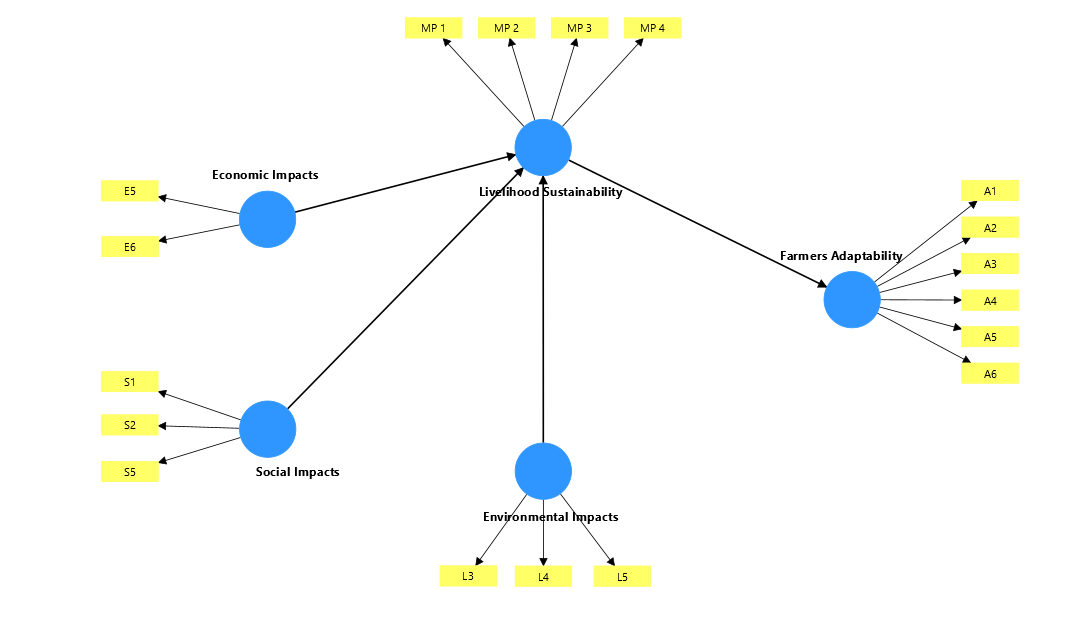
Rice is a strategic commodity for national food security; however, its production is increasingly threatened by climate change, including shifting rainfall patterns, rising temperatures, and more frequent extreme weather events that create yield uncertainty and reduce farmer welfare. This study aims to analyze the influence of economic, social, and environmental factors on livelihood sustainability and the adaptive capacity of rice farmers in Deli Serdang Regency. The main contribution of this research lies in explicitly modeling livelihood sustainability as a mediating variable linking climate change impacts to farmers’ adaptive capacity within an integrated SEM-PLS framework. Unlike previous studies that mainly focus on direct effects, this study examines both direct and indirect relationships, providing a clearer understanding of how environmental pressures translate into adaptive outcomes at the household level. A quantitative approach was employed using data from 95 rice-farming households. The SEM-PLS results indicate that environmental factors significantly affect livelihood sustainability and adaptive capacity. Livelihood sustainability also significantly enhances adaptive capacity, confirming its role as a key mediating variable. In contrast, economic and social factors do not show significant effects. The model demonstrates moderate explanatory power (R² = 0.389). These findings highlight that adaptation is not solely a direct response to environmental stressors but is strongly mediated by livelihood sustainability, emphasizing the importance of strengthening livelihoods as a central strategy in climate change adaptation policies.
References
Amandaria, R., Darma, R., Zain, M. M., Fudjaja, L., Wahda, M. A., Kamarulzaman, N. H., Bakheet Ali, H., & Akzar, R. (2025). Sustainable resilience in flood-prone rice farming: Adaptive strategies and risk-sharing around Tempe Lake, Indonesia. Sustainability, 17(6), 2456. https://doi.org/10.3390/su17062456
Ansari, A., Pranesti, A., Telaumbanua, M., Alam, T., Wulandari, R. A., & Nugroho, B. D. A. (2023). Evaluating the effect of climate change on rice production in Indonesia using a multimodelling approach. Heliyon, 9(9), e19639. https://doi.org/10.1016/j.heliyon.2023.e19639
Arifah, S. D., Yassi, A., & Demmallino, E. B. (2022). Livelihood vulnerability of smallholder farmers to climate change: A comparative analysis based on irrigation access in South Sulawesi, Indonesia. Regional Sustainability, 3(3), 244–253. https://doi.org/10.1016/j.regsus.2022.10.002
Asfaw, S., McCarthy, N., Lipper, L., & Arslan, A. (2016). What determines farmers’ adaptive capacity? Empirical evidence from Malawi. Food Security, 8, 643–664. https://doi.org/10.1007/s12571-016-0571-0
Azis, Y., Shafriani, K. A., & Hartoni, H. (2024). Efisiensi teknis padi sawah varietas lokal Siam Mayang pada lahan rawa pasang surut di Kabupaten Barito Kuala dengan pendekatan Data Envelopment Analysis (DEA) [Technical efficiency of local Siam Mayang paddy rice on tidal swamp land in Barito Kuala Regency using the Data Envelopment Analysis approach]. Journal of Agricultural Socio-Economics (JASE), 5(1), 45–53. https://doi.org/10.33474/jase.v5i1.22000
Chaniago, N. (2023). The effect of rainfall on rice production and productivity in Percut Sei Tuan District, Deli Serdang Regency, North Sumatra. AGRILAND: Jurnal Ilmu Pertanian, 11(3), 130–136. https://jurnal.uisu.ac.id/index.php/agriland/article/view/8756
Chetri, P., Sharma, U., & Ilavarasan, P. V. (2024). Weather information, farm-level climate adaptation, and farmers’ adaptive capacity: Examining the role of information and communication technologies. Environmental Science & Policy, 151, 103630. https://doi.org/10.1016/j.envsci.2023.103630
Chowdhury, K. J., Ali, M. R., Chowdhury, M. A., & Islam, S. L. U. (2024). Climate change induced risks assessment of a coastal area: A socioeconomic and livelihood vulnerability index-based study in coastal Bangladesh. Natural Hazards Research, 5(1), 75–87. https://doi.org/10.1016/j.nhres.2024.06.005
Estiningtyas, W., Surmaini, E., Susanti, E., Mulyani, A., Kartiwa, B., Apriyana, Y., & Alifia, A. D. (2024). Analysing food farming vulnerability in Kalimantan, Indonesia: Determinant factors and adaptation measures. PLOS ONE, 19(1), e0296262. https://doi.org/10.1371/journal.pone.0296262
Haldar, N., & Pearlin, A. R. (2023). Sustainable and climate-smart agriculture for food security: A review. Journal of Experimental Agriculture International, 45(11), 229–239. https://doi.org/10.9734/jeai/2023/v45i112253
Haque, A. T. M. S., Kumar, L., & Bhullar, N. (2023). Gendered perceptions of climate change and agricultural adaptation practices: A systematic review. Climate and Development, 15(10), 885–902. https://doi.org/10.1080/17565529.2023.2176185
Kujur, A. N., Barla, S., & Upasani, R. R. (2026). Climate-smart agriculture: A pathway to food security and climate resilience—A review. Agricultural Reviews, 47(3), 1–5. https://doi.org/10.18805/ag.R-2777
Kurniawan, R. E., & Arisurya, R. E. (2021). Kerentanan dan adaptasi rumah tangga petani terhadap perubahan iklim di Kabupaten Gunungkidul [Vulnerability and adaptation of farming households to climate change in Gunungkidul Regency]. Jurnal Agro Ekonomi, 38(2), 127–141. https://doi.org/10.21082/jae.v38n2.2020.127-141
Mehraj, J., Ahmed, L., Qayoom, K., Rasool, F., Bhat, R. A., & Fayaz, U. (2024). Climate-smart agriculture: A roadmap to sustainable food security. International Journal of Environment and Climate Change, 14(7), 234–253. https://doi.org/10.9734/ijecc/2024/v14i74266
Prayitno, G., Fikriyah, Nugraha, A. T., Siankwilimba, E., Wicaksono, A. D., Dinanti, D., Subagiyo, A., Hoque, M. E., & Hiddlestone-Mumford, J. (2025). The role of social and human capital on climate change adaptation in agricultural activities in Indonesia. Environmental Challenges, 21, 101353. https://doi.org/10.1016/j.envc.2025.101353
Purwanti, T. S., Syafrial, S., Huang, W. C., & Saeri, M. (2022). What drives climate change adaptation practices in smallholder farmers? Evidence from potato farmers in Indonesia. Atmosphere, 13(1), 113. https://doi.org/10.3390/atmos13010113
Rahayu, L., Putri, S. E., Rozaki, Z., & Triyono, T. (2024). Climate change adaptation in red rice farming of Segreng and Inpari 24 varieties in Gunungkidul District, Yogyakarta, Indonesia. BIO Web of Conferences, 119, 05005. https://doi.org/10.1051/bioconf/202411905005
Rozci, F. (2024). Dampak perubahan iklim terhadap sektor pertanian padi [The impact of climate change on the rice farming sector]. Jurnal Ilmiah Sosio Agribis, 23(2), 108–118. https://doi.org/10.30742/jisa23220233476
Sanogo, K., Touré, I., Arinloye, D. D. A. A., Dossou-Yovo, E. R., & Bayala, J. (2023). Factors affecting the adoption of climate-smart agriculture technologies in rice farming systems in Mali, West Africa. Smart Agricultural Technology, 5, 100283. https://doi.org/10.1016/j.atech.2023.100283
Siagian, D. R., Shrestha, R. P., Marpaung, I., Napitupulu, D., Haloho, L., Simatupang, S., Ramija, K. E. L., & Girsang, S. S. (2022). Assessing rice production sustainability under future land use and population in Deli Serdang Regency, Indonesia. Landscape Online, 110, 1103. https://doi.org/10.3097/LO.2022.1103
Singh, A. M. (2021). Vulnerability assessment of local population: A case study from Loktak Lakeshore Villages, Manipur. Applied Ecology and Environmental Sciences, 9(11), 964–975. https://doi.org/10.12691/aees-9-11-8
Statistics Indonesia. (2024). Luas panen dan produksi padi di Indonesia 2024 [Harvested area and rice production in Indonesia 2024]. https://www.bps.go.id/pressrelease/2024/10/16/2037
Tran, P. T., Vu, B. T., Ngo, S. T., Tran, V. D., & Ho, T. D. (2022). Climate change and livelihood vulnerability of rice farmers in the North Central Region of Vietnam: A case study in Nghe An Province, Vietnam. Environmental Challenges, 7, 100460. https://doi.org/10.1016/j.envc.2022.100460
Wassmann, R., Villanueva, J., Khounthavong, M., Okumu, B., Vo, T., & Sander, B. (2019). Adaptation, mitigation and food security: A multi-criteria ranking system for climate-smart agriculture technologies illustrated for rainfed rice in Laos. Global Food Security, 23, 33–40. https://doi.org/10.1016/j.gfs.2019.02.003
Downloads
Published
How to Cite
Issue
Section
License
Copyright (c) 2026 Herlyna Novasari Siahaan, Mia Wananda Varwasih , Hendris Syah Putra, M. Fariz Afif Hasibuan

This work is licensed under a Creative Commons Attribution-ShareAlike 4.0 International License.