Social sustainability of smallholder coffee partnerships and SDG linkages in North Sumatra Province
DOI:
https://doi.org/10.33474/jase.v7i1.25103Keywords:
Social Sustainability, Partnership, Smallholder Coffee, SDGs/TPB, SLCAAbstract
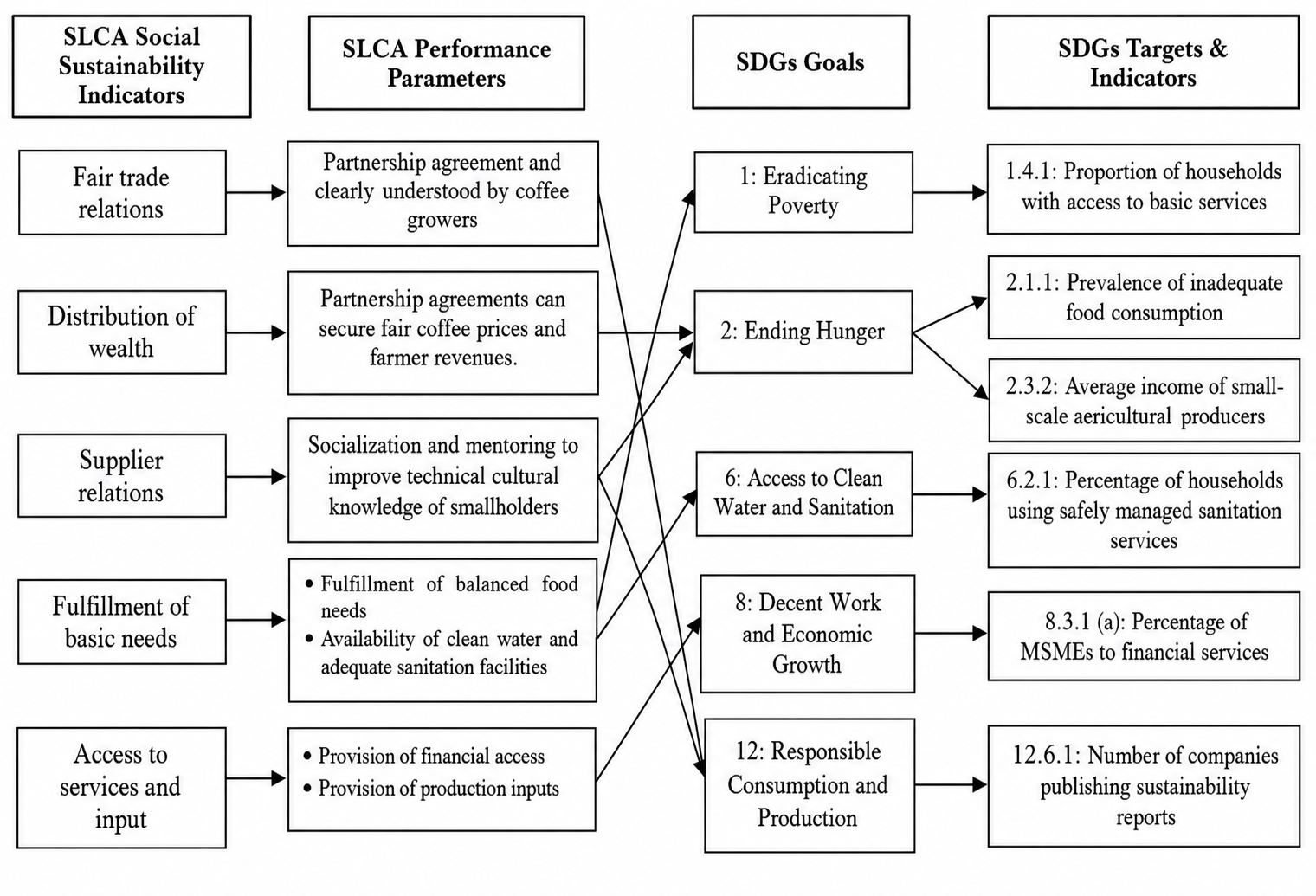
This study evaluates the social sustainability of a smallholder coffee partnership in Gung Pinto Village, where farmers still face production and quality constraints, limited market information, and price fluctuations. While previous research predominantly focuses on the economic outcomes of coffee supply chains, the social life cycle impact of informal smallholder partnerships remains under-investigated. The novelty of this study lies in its application of SLCIA Type I to evaluate localized social sustainability and its precise integration with regional SDG indicators in North Sumatra. The case study was conducted in November 2025; the location was selected purposively, and 30 farmer households were selected using simple random sampling. The assessment applied the UNEP-SETAC Social Life Cycle Assessment (SLCA) framework and Social Life Cycle Impact Assessment (SLCIA) type I with performance reference points on five indicators: fair trade relations, wealth distribution, supplier relations, fulfillment of basic needs, and access to services and inputs. The results indicate that the social performance of the partnership is generally positive with an average score of 3.5, indicating compliance and, in some aspects, performance exceeding minimum standards. Access to services and inputs performed best (score 5), followed by wealth distribution (4.1), supplier relationships (3.7), and basic needs fulfillment (3.7), reflecting input and service support, increased income, improved access to basic services, and strengthened technical capacity through extension activities. Conversely, fair trade relationships scored low (1.0) due to the lack of written contracts, which can weaken the clarity of long-term rights and obligations. Overall, the partnership advances SDGs 1, 2, 6, 8, and 12 through improved income, access to basic services, and more sustainable production, while adaptive written agreements are needed to strengthen fairness and social resilience.
References
Anh, N. H., Bokelmann, W., Thuan, N. T., & Nga, D. T. (2019). Smallholders' preferences for different contract farming models: Empirical evidence from sustainable certified coffee production in Vietnam. Sustainability, 11(14), 9–13. https://doi.org/10.3390/su11143799
Asfaw, T. B., & Negeri, P. G. (2025). Impact of voluntary sustainability standards on decent rural employment: Evidence from smallholder coffee farms and cooperatives. Journal of Agriculture and Food Research, 24, 102352. https://doi.org/10.1016/j.jafr.2025.102352
Cahyanto, G. D., Wibowo, A., & Permatasari, P. (2021). Kemitraan antara petani kopi dan perusahaan: Studi kasus Kintamani [Partnership between coffee farmers and companies: Kintamani case study]. SALAM: Jurnal Sosial dan Budaya Syar-i, 8(1), 173–190. https://doi.org/10.15408/sjsbs.v8i1.19426
Chiputwa, B., Spielman, D. J., & Qaim, M. (2015). Food standards, certification, and poverty among coffee farmers in Uganda. World Development, 66, 400–412. https://doi.org/10.1016/j.worlddev.2014.09.006
Dreyer, L. C., Hauschild, M. Z., & Schierbeck, J. (2006). A framework for social life cycle impact assessment. International Journal of Life Cycle Assessment, 11(2), 88–97. https://doi.org/10.1065/lca2005.08.223
Fariz, M., Hasibuan, A., & Putra, H. S. (2023). Analisis persaingan ekspor biji kopi di pasar internasional [Analysis of coffee bean export competition in the international market]. Agriprimatech, 7(1), 25–33. https://doi.org/10.34012/agriprimatech.v7i1.4160
Faul, F., Erdfelder, E., Lang, A.-G., & Buchner, A. (2007). G*Power 3: A flexible statistical power analysis program for the social, behavioral, and biomedical sciences. Behavior Research Methods, 39(2), 175–191. https://doi.org/10.3758/BF03193146
Felix, M. (2024). Potensi implementasi fair trade dan studi kasus di Indonesia [Potential for fair trade implementation and case studies in Indonesia]. Perspektif, 13(3), 793–810. https://doi.org/10.31289/perspektif.v13i3.11744
Haloho, R. D., Amruddin, U. D. R., Boekoesoe, Y., Tapi, T., Harli, N. H., M. F. A., S., M., & Karim, A. R. (2024). Manajemen agribisnis [Agribusiness management]. Yayasan Kita Menulis. https://kitamenulis.id/2024/01/22/manajemen-agribisnis-3/
Hasibuan, M. F. A., Putra, H. S., Siadari, U., & Uli, V. (2025). Sustainability analysis of Arabica coffee plantation agribusiness in North Sumatra Province. Journal of Sustainability Science and Management, 20(8), 1616–1629. https://doi.org/10.46754/jssm.2025.08.005
Machieu, S. R., Amruddin, A., Z., Hasibuan, M. F. A., Arianti, D., Elza, N. I., Rahmah, K., Mastuti, R., Lestari, S. U., & Hidayati, R. (2025). Agribisnis kreatif: Pilar agripreneurship masa depan [Creative agribusiness: Pillars of future agripreneurship]. Yayasan Kita Menulis. https://kitamenulis.id/2025/01/01/agribisnis-kreatif-pilar-agripreneurship-masa-depan/
Mulyani, S. I., Karsidi, R., Kartono, D. T., & Anantanyu, S. (2024). Sustainable partnership between farmers and companies in the PT Sido Muncul Tbk Spice Village Program. In Proceedings of the International Conference on Multidisciplinary Studies (ICoMSi, 2023): Advances in Social Science, Education and Humanities Research (Vol. 829, pp. 565–575). https://doi.org/10.2991/978-2-38476-228-6_47
Nasution, Z. P. S., Mulatsih, S., & Rahma, H. (2023). Penilaian keberlanjutan sosial kemitraan usaha perkebunan kelapa sawit rakyat dan kaitannya terhadap pencapaian tujuan pembangunan berkelanjutan: Studi kasus di Provinsi Sumatera Utara [Assessment of the social sustainability of smallholder oil palm plantation business partnerships and their linkage to the achievement of sustainable development goals: A case study in North Sumatra Province]. Jurnal Penelitian Kelapa Sawit, 31(1), 55–72. https://www.academia.edu/download/103630826/144.pdf
Novita, E., Suryaningrat, I. B., Andriyani, I., & Widyotomo, S. (2012). Analisis keberlanjutan kawasan usaha perkebunan kopi (KUPK) rakyat di Desa Sidomulyo Kabupaten Jember [Sustainability analysis of the smallholder coffee plantation business area (KUPK) in Sidomulyo Village, Jember Regency]. Journal Agritech, 32(2), 183–191. https://doi.org/10.22146/agritech.9621
Pangestuty, F. W., & Dessatria, A. N. U. (2013). Patterns and trust formed on the partnership contract between the sugar factory and the cane farmers. Proceedings Book of ICEFMO 2013: Malaysia Handbook on the Economic, Finance and Management Outlooks.
Pratama, Y. Y., Ismono, R. H., & Prasmatiwi, F. E. (2015). Manfaat ekonomi dan risiko tunda jual kopi di Desa Tanjung Rejo Kecamatan Pulau Panggung Kabupaten Tanggamus [Economic benefits and risks of delaying coffee sales in Tanjung Rejo Village, Pulau Panggung District, Tanggamus Regency]. Jurnal Ilmu Ilmu Agribisnis: Journal of Agribusiness Science, 3(3), 221–228. https://doi.org/10.23960/jiia.v3i3.1051
Priska, P. R., & Noor, T. I. (2024). Analisis kemitraan dan pendapatan usahatani mitra dan nonmitra CV Bumi Agro Technology di Desa Sarimukti, Kecamatan Pasirwangi, Kabupaten Garut [Analysis of partnership and farming income of partners and non-partners of CV Bumi Agro Technology in Sarimukti Village, Pasirwangi District, Garut Regency]. Jurnal Ilmiah Mahasiswa Agroinfo Galuh, 11(3), 1596–1607. http://dx.doi.org/10.25157/jimag.v11i3.14528
Product Social Impact Assessment. (2020). Handbook for product social impact assessment. https://www.scribd.com/document/811180989/Handbook-for-Product-Social-Impact-Assessment-2020
Purwanti, R. E., Lasinta, M., & Jayadisastra, Y. (2024). Komunikasi pembangunan pertanian [Agricultural development communication]. Eureka Media Aksara. https://repository.penerbiteureka.com/media/publications/585408-komunikasi-pembangunan-pertanian-180dcf47.pdf
Putra, H. S., Octoyuda, E., & Hasibuan, M. F. A. (2024). Decoding Arabica coffee purchase intention: Exploring the role of product origin through fuzzy-set qualitative comparative analysis. In 2024, the 12th International Conference on Cyber and IT Service Management (CITSM) (pp. 1–6). https://doi.org/10.1109/CITSM64103.2024.10775358
Putra, H. S., & Siahaan, H. N. (2024). Commodity regional analysis and the role of smallholder Arabica coffee plantations in the regional development of North Sumatra Province. Jurnal Ilmiah Membangun Desa dan Pertanian, 9(3), 212–221. https://doi.org/10.37149/jimdp.v9i3.1139
Radiah, R. (2021). Analisis faktor-faktor yang mempengaruhi permintaan komoditi kopi di Provinsi Sumatera Utara [Analysis of factors influencing demand for coffee commodities in North Sumatra Province]. Wahana Inovasi: Jurnal Penelitian dan Pengabdian Masyarakat UISU, 10(2), 338–353.
Raynolds, L. T., Murray, D. L., & Wilkinson, J. (Eds.). (2007). Fair trade: The challenges of transforming globalization. Routledge. https://books.google.co.id/books?id=0gQymQ7nbTIC
Sahat, S. F., Nuryartono, N., & Hutagaol, M. P. (2016). Analisis pengembangan ekspor kopi di Indonesia [Analysis of coffee export development in Indonesia]. Jurnal Ekonomi dan Kebijakan Pembangunan, 5(1), 63–89. https://doi.org/10.29244/jekp.5.1.2016.63-89
Syakir, M., & Surmaini, E. (2017). Perubahan iklim dalam konteks sistem produksi dan pengembangan kopi di Indonesia [Climate change in the context of coffee production and development systems in Indonesia]. Jurnal Penelitian dan Pengembangan Pertanian, 36(2), 77–90. https://doi.org/10.21082/jp3.v36n2.2017.p77-90
United Nations Environment Programme. (2020). Guidelines for social life cycle assessment of products and organizations 2020. https://www.lifecycleinitiative.org/wp-content/uploads/2021/01/Guidelines-for-Social-Life-Cycle-Assessment-of-Products-and-Organizations-2020-22.1.21sml.pdf
United Nations Environment Programme. (2021). Methodological sheets for subcategories in social life cycle assessment (S-LCA) 2021. https://www.lifecycleinitiative.org/library/methodological-sheets-for-subcategories-in-social-life-cycle-assessment-s-lca-2021/
Vicol, M., Neilson, J., Faila, D., Hartatri, S., & Cooper, P. (2018). Upgrading for whom? Relationship coffee, value chain interventions and rural development in Indonesia. World Development, 110, 26–37. https://doi.org/10.1016/j.worlddev.2018.05.020
Watemin, & Lestari, E. (2025). Partnership pattern between Robusta coffee farmers and Mukidi Coffee Home Industry in Gandurejo Village, Temanggung, Central Java. New Countryside, 4(1), 70–78. https://doi.org/10.55121/nc.v4i1.429
Widaningsih, R. (2022). Outlook komoditas perkebunan kopi [Outlook for coffee plantation commodities]. Pusat Data dan Sistem Informasi Pertanian, Sekretariat Jenderal Kementerian Pertanian.
Wright, J., & Aklimawati, L. (2018). Geographical indications and value capture in the Indonesia coffee sector. Journal of Rural Studies, 59, 35–48. https://doi.org/10.1016/j.jrurstud.2018.01.003
Zakaria, A. P., Aditiawati, A., & Rosmiati, M. (2017). Strategi pengembangan usahatani kopi arabika: Kasus pada petani kopi di Desa Suntenjaya, Kecamatan Lembang, Kabupaten Bandung Barat, Provinsi Jawa Barat [Arabica coffee farming development strategy: Case study of coffee farmers in Suntenjaya Village, Lembang District, West Bandung Regency, West Java Province]. Jurnal Sosioteknologi, 16(3), 325–339. https://doi.org/10.5614/sostek.itbj.2017.16.3.7
Zikra, A., Dhardiri, H., & Yulianti, S. (2022). Analisis potensi komoditas kopi kabupaten/kota di Indonesia tahun 2015: Metode fuzzy C-medoid clustering [Analysis of coffee commodity potential in regencies/cities in Indonesia in 2015: Fuzzy C-medoid clustering method]. Journal of Agricultural Socio-Economics (JASE), 3(1), 1–7. https://doi.org/10.33474/jase.v3i1
Downloads
Published
How to Cite
Issue
Section
License
Copyright (c) 2026 Indah Kartika Sandra Indah, Hendris Syah Putra, M. Fariz Afif Hasibuan

This work is licensed under a Creative Commons Attribution-ShareAlike 4.0 International License.