Spatial heterogeneity and determinants of agricultural GRDP in East Java, Indonesia: a geographically weighted regression approach
DOI:
https://doi.org/10.33474/jase.v7i1.25132Keywords:
Agricultural GRDP, Spatial, Haterogeneity, GWR, DeterminantsAbstract
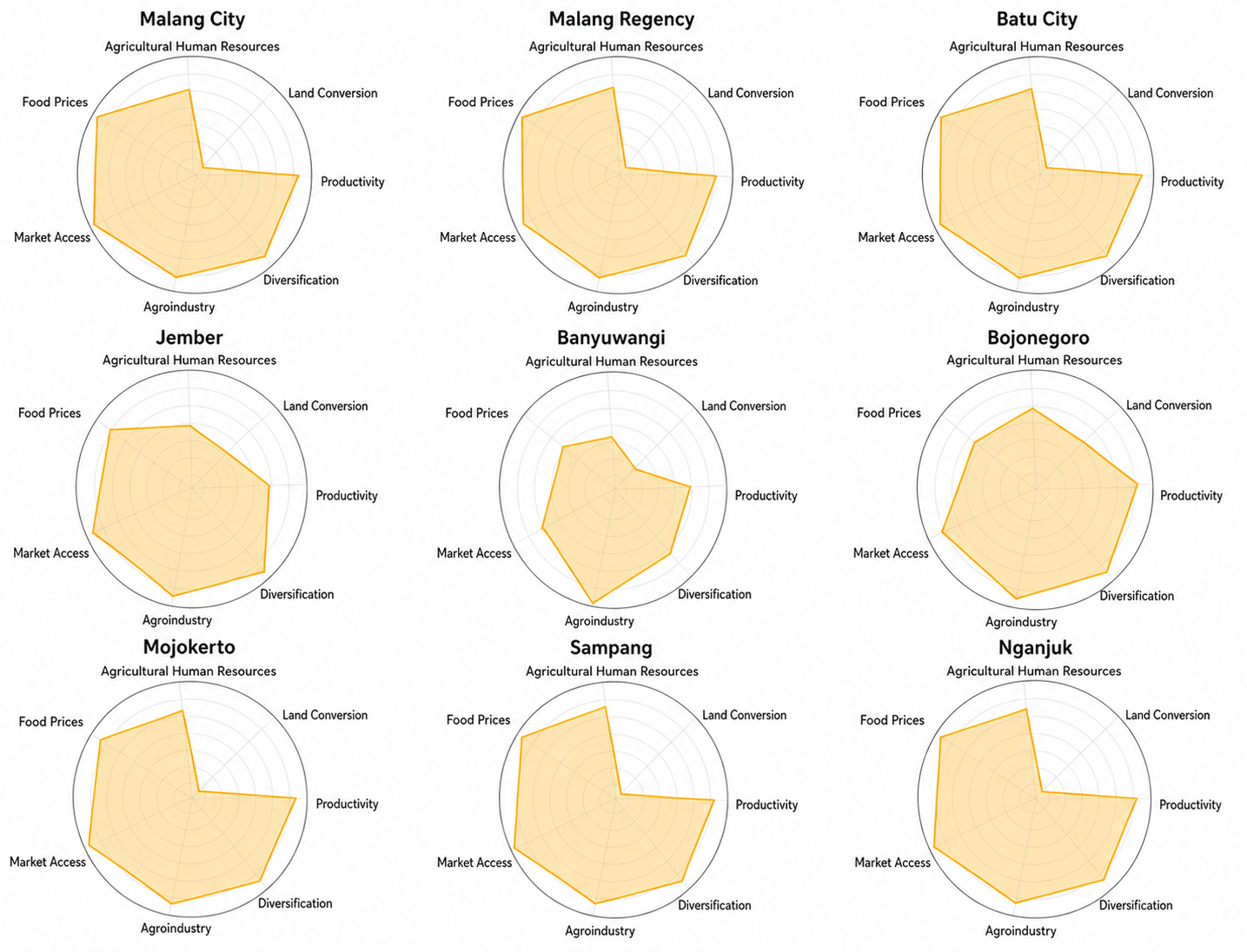
Agriculture plays a strategic role in supporting regional economic growth, employment, and food security in East Java, Indonesia. However, its contribution to Agricultural Gross Regional Domestic Product (GRDP) differs markedly across districts and cities, indicating spatial and structural disparities. These variations suggest that agricultural performance is shaped by localized biophysical and socio-economic factors that global regression models often fail to capture. Previous studies have largely relied on single-commodity analyses or global approaches that assume spatial homogeneity, thereby overlooking spatial non-stationarity in the determinants of agribusiness. This study aims to analyze the spatial heterogeneity of agricultural GRDP determinants and evaluate how localized factors, including productivity, land conversion, labor, food prices, market access, agroindustry value added, and food diversification, differentially impact nine districts and cities in East Java. The novelty lies in integrating multidimensional upstream-to-downstream agribusiness variables within a Geographically Weighted Regression (GWR) framework, moving beyond traditional production-centric models to identify specific regional drivers. Using 2023 secondary data from nine districts/cities, the study employs Ordinary Least Squares (OLS) as a benchmark, followed by GWR with a Gaussian kernel and cross-validation bandwidth. The GWR model outperforms OLS, increasing R² from 0.75 to 0.89 and reducing AICc from 134.2 to 112.5, while residual Moran’s I declines from 0.32 to –0.05. Agro-industry value added shows the strongest positive effect (0.38 in Banyuwangi), whereas land conversion negatively affects urban areas (–0.41 in Malang City). These findings confirm spatial non-stationarity and support place-based agricultural policy design.
References
Abusiri, M., Santosa, B., & Setiaji, J. (2024). Analysis of horticulture farmers' credit provision in Kemungsarilor Village, Panti District, Jember Regency. Journal of Agricultural Socio-Economics, 5(2), 85–95. https://doi.org/10.33474/jase.v5i2.22540
Adhiarsya Perdana, Sukanta, & R. A. M. (2021). Analisis Business Model Canvas dan kelayakan keuangan di UMKM Tim’s Kuliner [Analysis of the Business Model Canvas and financial feasibility of Tim’s Kuliner MSME]. Jurnal Ilmiah Wahana Pendidikan, 7(1), 391–402. https://doi.org/10.5281/zenodo.6301707
Allard, D. (2025). Growth of spatial statistics for agriculture and environment: The example of BioSP at INRAE. Spatial Statistics, 70, 100938. https://doi.org/10.1016/j.spasta.2025.100938
Anselin, L. (1995). Local indicators of spatial association—LISA. Geographical Analysis, 27(2), 93–115. https://doi.org/10.1111/j.1538-4632.1995.tb00338.x
Bray, B., & A. S. (2021). Food security and nutrition: Building a global narrative towards 2030. FAO. https://openknowledge.fao.org/server/api/core/bitstreams/8357b6eb-8010-4254-814a-1493faaf4a93/content
Brunsdon, C., Fotheringham, A. S., & Charlton, M. E. (1996). Geographically weighted regression: A method for exploring spatial nonstationarity. Geographical Analysis, 28(4), 281–298. https://doi.org/10.1111/1467-9884.00145
Carlucci, F., Corcione, C., Mazzocchi, P., & Trincone, B. (2021). The role of logistics in promoting Italian agribusiness: The Belt and Road Initiative case study. Land Use Policy, 108, 105560. https://doi.org/10.1016/j.landusepol.2021.105560
Fanzo, J., & Miachon, L. (2023). Harnessing the connectivity of climate change, food systems and diets: Taking action to improve human and planetary health. Anthropocene, 42, 100381. https://doi.org/10.1016/j.ancene.2023.100381
Feng, J., Liu, Y., & Liu, Y. (2020). Spatiotemporal analysis of rural economic development using GWR. Sustainability, 12(3), 945. https://doi.org/10.3390/su12030945
Fotheringham, A. S., Brunsdon, C., & Charlton, M. (2002). Geographically weighted regression: The analysis of spatially varying relationships. John Wiley & Sons. https://books.google.co.id/books/about/Geographically_Weighted_Regression.html?hl=id&id=9DZgV1vXOuMC&redir_esc=y
Gujarati, D. N., & Porter, D. C. (2009). Basic econometrics (5th ed.). McGraw-Hill. https://ucanapplym.s3.ap-south-1.amazonaws.com/RGU/notifications/E_learning/0nline_study/Basic-Econometrics-5th-Ed-Gujarati-and-P.pdf
Hadianto, A., Harianto, H., Sinaga, B. M., & Sartono, B. (2022). The spatial effect of agricultural sector growth in West Java: A spatial approach to panel data. Jurnal Ilmu Pertanian Indonesia, 27(3), 332–340. https://doi.org/10.18343/jipi.27.3.332
Li, W., Zhou, Y., & Zhang, X. (2023). Spatial heterogeneity analysis of agricultural productivity using GWR in China. Land, 12(2), 378. https://doi.org/10.3390/land12020378
Mesang, M., Arvianti, E. Y., & Santoso, B. (2025). Assessing the impact of climate change on the productivity, income, and yield of chili and shallot farming in East Java, Indonesia. Journal of Agricultural Socio-Economics, 6(2), 49–59. https://doi.org/10.33474/jase.v6i2.23933
Murakami, D., Lu, B., Harris, P., Brunsdon, C., Charlton, M., Nakaya, T., & Griffith, D. A. (2019). The importance of scale in spatially varying coefficient modeling. Annals of the American Association of Geographers, 109(1), 50–70. https://doi.org/10.1080/24694452.2018.1462691
Nashrudien, A. A., & Pramono, R. W. D. (2024). Perbandingan teknik pembobotan dalam downscaling PDRB menggunakan metode Geographically Weighted Regression (GWR) [Comparison of weighting techniques in GRDP downscaling using the Geographically Weighted Regression method]. Plano Madani, 13, 356–367. http://journal.uin-alauddin.ac.id/index.php/planomadani
Noerul Hanin, Meilandra, I., Debataraja, N. N., & Pertiwi, R. (2024). Application of Geographically Weighted Regression for modeling the poverty cases in Kalimantan, Indonesia. Jurnal Statistika dan Aplikasinya, 8(1), 1–16. https://doi.org/10.21009/jsa.08101
Parlato, M. C. M., Valenti, F., Guerrini, L., Perbellini, A., & Pezzuolo, A. (2025). From agricultural by-products to building materials: A spatial modelling approach to foster green construction sector. Cleaner Environmental Systems, 18, 100307. https://doi.org/10.1016/j.cesys.2025.100307
Pumhirunroj, B., Littidej, P., & Boonmars, T. (2026). Spatial prediction of the probability of liver fluke infection using a geographic weighted regression (GWR) model in waterways connecting the Mekong River, Sakon Nakhon of Thailand. One Health, 22, 101320. https://doi.org/10.1016/j.onehlt.2026.101320
Purwaningsih, S., & Suseno, D. A. (2023). Analysis of spatial autocorrelation and causality GRDP and income inequality in Java. Efficient: Indonesian Journal of Development Economics, 6(1), 73–83. https://doi.org/10.15294/efficient.v6i1.57599
Seto, K. C., Güneralp, B., & Hutyra, L. R. (2012). Global forecasts of urban expansion to 2030 and direct impacts on biodiversity and carbon pools. Proceedings of the National Academy of Sciences of the United States of America, 109(40), 16083–16088. https://doi.org/10.1073/pnas.1211658109
Shi, X., Han, W., & Wang, Y. (2025). Spatial heterogeneity of agricultural drought drivers in irrigation district: A causal inference framework bridging covariation and structural equation modeling. Agricultural Water Management, 322, 109978. https://doi.org/10.1016/j.agwat.2025.109978
Sinaga, J. P., Hendriadi, A., Firdaus, M., Fauzi, A., & Arsanti, I. W. (2021). Analysis of Geographically Weighted Regression (GWR) on retail prices of medium rice and red chili in Java. Jurnal Manajemen dan Agribisnis, 18(2), 144–155. https://doi.org/10.17358/jma.18.2.144
Sinha, S., & Swain, M. (2022). Response and resilience of agricultural value chain to COVID-19 pandemic in India and Thailand. In R. Shaw & I. Pal (Eds.), Pandemic risk, response, and resilience (pp. 363–381). Elsevier. https://doi.org/10.1016/B978-0-323-99277-0.00002-4
Sobari, M., & Jaya, I. G. N. M. (2023). Modeling rice production in West Java by means Geographically Weighted Regression. Jurnal Ekonomi dan Statistik Indonesia, 2(3), 316–326. https://doi.org/10.11594/jesi.02.03.08
Somantri, L. (2022). Pemetaan mobilitas penduduk di kawasan pinggiran Kota Bandung [Mapping population mobility in the peri-urban areas of Bandung City]. Majalah Geografi Indonesia, 36(2), 95. https://doi.org/10.22146/mgi.70636
Statistics Indonesia. (2023). Produk domestik regional bruto Provinsi Jawa Timur menurut lapangan usaha 2017–2021 [Gross regional domestic product of East Java Province by industry 2017–2021]. https://jatim.bps.go.id/id/publication/2022/04/05/534135b1ca5f824ae64559b6/produk-domestik-regional-bruto-provinsi-jawa-timur-menurut-lapangan-usaha-2017-2021-.html
Tangka, E., Hatidja, D., & Weku, W. C. D. (2024). Geographically Weighted Regression modeling with adaptive Gaussian kernel weighting on GRDP in Indonesia. Jurnal Ilmiah Sains, 24(1), 1–14. https://doi.org/10.35799/jis.v24i2.50366
Wicaksono, D., Kusumasari, P., Fajar, H., Fajritia, R., Puspita Anggraini, I. G., & Budiasih, B. (2023). Geographically Weighted Regression (GWR)’s implementation on factor determination of rice production in Indonesia 2021. Seminar Nasional Official Statistics, 2023(1), 537–546. https://doi.org/10.34123/semnasoffstat.v2023i1.1714
Wicaksono, D. S., Kusumasari, P. A., Fajar, H. M., Fajritia, R., Puspita Anggraini, I. G. A., & Budiasih, B. (2023). Implementasi Geographically Weighted Regression (GWR) pada determinasi faktor produksi beras di Indonesia tahun 2021 [Geographically Weighted Regression (GWR) analysis of rice production determinants in Indonesia in 2021]. Seminar Nasional Official Statistics, 2023(1), 537–546. https://doi.org/10.34123/semnasoffstat.v2023i1.1714
Widodo, I. D., Qurtubi, Q., Kusrini, E., Firdaus, F., & Yanti, R. (2025). Adopting global circular food supply chain practices: Drivers, barriers, and strategies for food industry in Indonesia. International Journal of Industrial Engineering and Production Research, 36(1), 57–86. https://doi.org/10.22068/ijiepr.36.1.2186
Zhao, W., Zhong, J., & Lv, J. (2024). Influencing factors and spatial differentiation of rental housing in a smart city: A GWR model analysis. Measurement: Sensors, 33, 101126. https://doi.org/10.1016/j.measen.2024.101126
Downloads
Published
How to Cite
Issue
Section
License
Copyright (c) 2026 Bambang Siswadi, Dina Kartika Sari

This work is licensed under a Creative Commons Attribution-ShareAlike 4.0 International License.