The impact of human and spatial crowding on customer loyalty in Indonesia's trending sustainable restaurants: The mediating role of perceived value and brand management
DOI:
https://doi.org/10.33474/jase.v7i1.25208Keywords:
crowding, brand management strategies, sustainable food, customer loyaltyAbstract
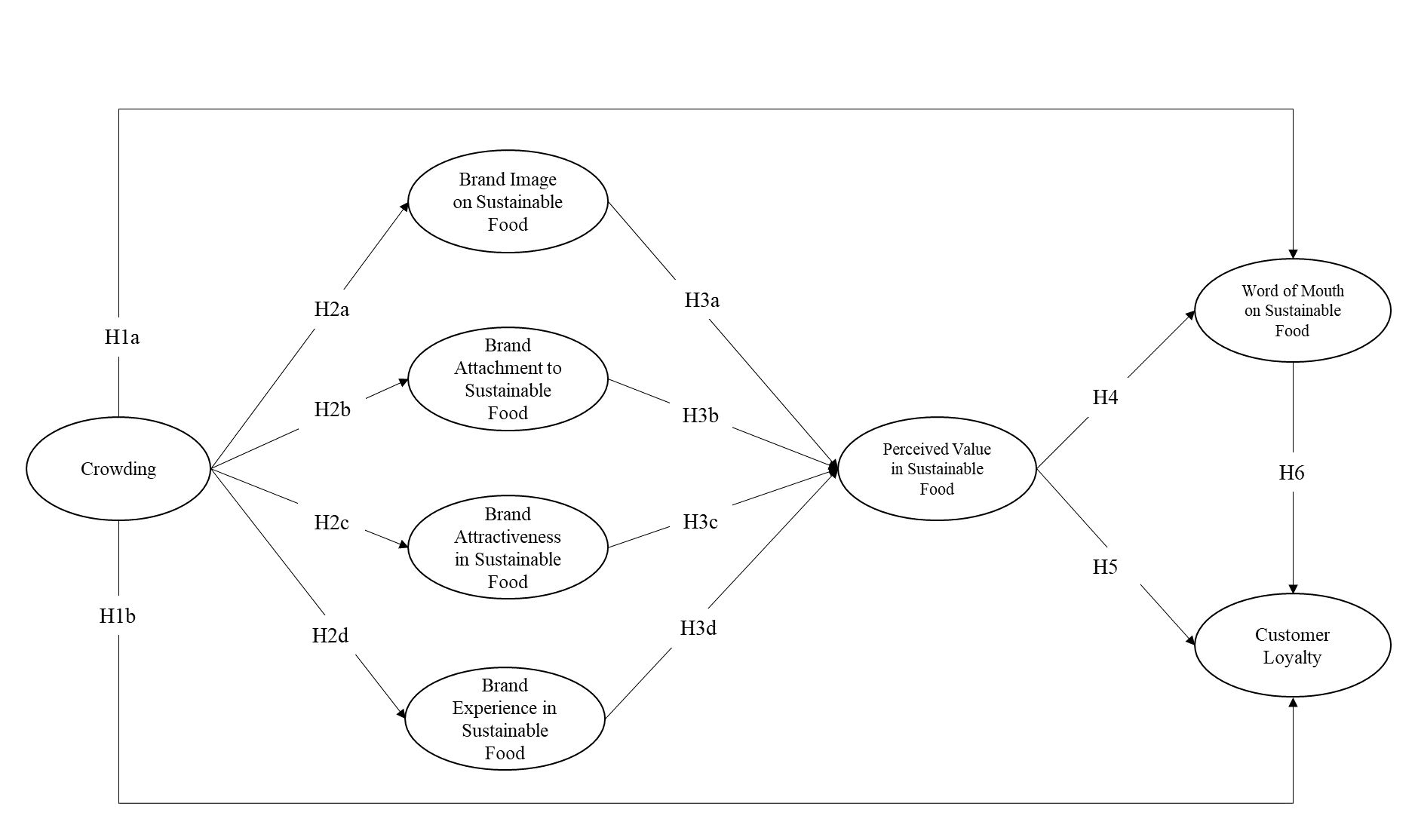
One of the main external environmental factors influencing consumer behavior in the trending food sector is crowding, both human and spatial, where crowding can have both positive and negative effects on consumer repurchase intentions. To explore whether crowding conditions should be managed or left to unfold naturally, this study will compare the direct effect of crowding on customer loyalty and its effect through three main mediators of consumer perception. This study uses a questionnaire instrument with 36 indicators across eight variables, collected through interviews with 500 respondents aged at least 15 years who have visited trending restaurants in Indonesia during 2022-2024, using a 5-point Likert scale, and analyzed using SEM-PLS with WarpPLS 8.0 software. Brand management strategies in the food industry need to be carefully formulated to address crowding, especially in light of sustainability issues that consumers are increasingly aware of. Research shows that the effect of crowding on customer loyalty is stronger when mediated by the restaurant's sustainability perception, consumer perceived value, and word-of-mouth communication, compared to its direct effect. In crowding conditions, restaurant managers need to implement effective crowd management, increase perceived value, and strengthen sustainable brand management elements.
References
Agu, E. E., Iyelolu, T. V., & Idemudia, C. (2024). Exploring the relationship between sustainable business practices and increased brand loyalty. International Journal of Multidisciplinary Engineering Research, 6(8), 2463–2475. https://doi.org/10.51594/ijmer.v6i8.1365
Ahmed, S., Al Asheq, A., Ahmed, E., Chowdhury, U. Y., Sufi, T., & Mostofa, M. G. (2023). The intricate relationships of consumers’ loyalty and their perceptions of service quality, price and satisfaction in restaurant service. The TQM Journal, 35(2), 519–539. https://doi.org/10.1108/TQM-06-2021-0158
Ahmed, U., & Hashim, S. (2022). Sustainable brand management: The role of internal brand management and intrinsic motivation in building employee’s brand relationship quality towards organization’s brand. Sustainability, 14(24), 16660. https://doi.org/10.3390/su142416660
Ali, M. A., Ting, D. H., Ahmad-ur-Rahman, M., Ali, S., Shear, F., & Mazhar, M. (2021). Effect of online reviews and crowd cues on restaurant choice of customer: Moderating role of gender and perceived crowding. Frontiers in Psychology, 12, 780863. https://doi.org/10.3389/fpsyg.2021.780863
Argo, J. J., Dahl, D. W., & Manchanda, R. V. (2005). The influence of a mere social presence in a retail context. Journal of Consumer Research, 32(2), 207–212. https://doi.org/10.1086/432230
Arisandi, E. (2022). Analysis of brand loyalty through brand image as an intervening variable. Journal of International Conference Proceedings, 5(5), 1999. https://doi.org/10.32535/jicp.v5i5.1999
Azhari, N. F. B., Senathirajah, A. R. B. S., & Haque, R. (2023). The role of customer satisfaction, trust, word of mouth, and service quality in enhancing customers’ loyalty toward e-commerce. Transnational Marketing Journal, 11(1), 31–43. https://doi.org/10.58262/tmj.v11i1.1003
Barraza, J. A., Hu, X., Terris, E. T., Wang, C., & Zak, P. J. (2021). Oxytocin increases perceived competence and social-emotional engagement with brands. PLOS ONE, 16(11), e0260589. https://doi.org/10.1371/journal.pone.0260589
Bauerné Gáthy, A., Kovácsné Soltész, A., & Szűcs, I. (2022). Sustainable consumption: Examining the environmental and health awareness of students at the University of Debrecen. Cogent Business & Management, 9(1), 2105572. https://doi.org/10.1080/23311975.2022.2105572
Blut, M., & Iyer, G. R. (2020). Consequences of perceived crowding: A meta-analytical perspective. Journal of Retailing, 96(3), 362–382. https://doi.org/10.1016/j.jretai.2019.11.007
Brakus, J. J., Schmitt, B. H., Zarantonello, L., & Simon, W. E. (2009). Brand experience: What is it? How is it measured? Does it affect loyalty? Journal of Marketing, 73(3), 52–68. https://doi.org/10.1509/jmkg.73.3.052
Bushara, M. A., Abdou, A. H., Hassan, T. H., Sobaih, A. E. E., Albohnayh, A. S. M., Alshammari, W. G., Aldoreeb, M., Elsaed, A. A., & Elsaied, M. A. (2023). Power of social media marketing: How perceived value mediates the impact on restaurant followers’ purchase intention, willingness to pay a premium price, and e-WOM? Sustainability, 15(6), 5331. https://doi.org/10.3390/su15065331
Castro-González, S., Bande, B., & Fernández-Ferrín, P. (2021). Influence of companies’ credibility and trust in corporate social responsibility aspects of consumer food products: The moderating intervention of consumer integrity. Sustainable Production and Consumption, 28, 129–141. https://doi.org/10.1016/j.spc.2021.03.032
Chen, Y. S., & Chang, C. H. (2013). Greenwash and green trust: The mediation effects of green consumer confusion and green perceived risk. Journal of Business Ethics, 114(3), 489–500. https://doi.org/10.1007/s10551-012-1360-0
Dangaiso, P. (2024). Leveraging green brand equity for organic food brands: The multifaceted role of green satisfaction. Cogent Business & Management, 11(1), 2321791. https://doi.org/10.1080/23311975.2024.2321791
Day, G. S., & Montgomery, D. B. (1999). Fundamental issues and directions for marketing. American Marketing Association, 1–28.
Dwivedi, A., Johnson, L. W., Wilkie, D. C., & De Araujo-Gil, L. (2019). Consumer emotional brand attachment with social media brands and social media brand equity. European Journal of Marketing, 53(6), 1176–1204. https://doi.org/10.1108/EJM-09-2016-0511
Emamisaleh, K., & Rahmani, K. (2017). Sustainable supply chain in food industries: Drivers and strategic sustainability orientation. Cogent Business & Management, 4(1), 1345296. https://doi.org/10.1080/23311975.2017.1345296
Eroglu, S. A., Machleit, K., & Barr, T. F. (2005). Perceived retail crowding and shopping satisfaction: The role of shopping values. Journal of Business Research, 58(8), 1146–1153. https://doi.org/10.1016/j.jbusres.2004.01.005
Esch, F. R., Langner, T. L., Schmitt, B. H., & Geus, P. (2006). Are brands forever? How brand knowledge and relationships affect current and future purchases. Journal of Product & Brand Management, 15(2), 98–105. https://doi.org/10.1108/10610420610658938
Espinosa, J. A., Ortinau, D. J., Krey, N., & Monahan, L. (2018). I’ll have the usual: How restaurant brand image, loyalty, and satisfaction keep customers coming back. Journal of Product & Brand Management, 27(6), 599–614. https://doi.org/10.1108/JPBM-10-2017-1610
FAO. (2020). Enabling sustainable food systems. Food and Agriculture Organization of the United Nations and National Research Institute for Agriculture, Food and Environment. https://doi.org/10.4060/ca9917en
Flores, J., & Vasquez-Parraga, A. Z. (2015). The impact of choice on co-produced customer value creation and satisfaction. Journal of Consumer Marketing, 32(1), 15–25. https://doi.org/10.1108/JCM-04-2014-0931
Fonny, A., & Tandijaya, T. N. (2022). Pengaruh brand attachment terhadap repurchase intention dengan brand commitment sebagai variabel intervening pada customer Crunchaus Salads [The effect of brand attachment on repurchase intention with brand commitment as an intervening variable in Crunchaus Salads customers]. Jurnal Manajemen Pemasaran, 16(1), 37–47. https://doi.org/10.9744/pemasaran.16.1.37-47
Foroudi, P., Palazzo, M., & Sultana, A. (2021). Linking brand attitude to word-of-mouth and revisit intentions in the restaurant sector. British Food Journal, 123(13), 221–240. https://doi.org/10.1108/BFJ-11-2020-1008
Gharib, R. K., Philpott, E., & Duan, Y. (2017). Factors affecting active participation in B2B online communities: An empirical investigation. Information & Management, 54(4), 516–530. https://doi.org/10.1016/j.im.2016.11.004
Gómez-Suárez, M., & Veloso, M. (2020). Brand experience and brand attachment as drivers of WOM in hospitality. Spanish Journal of Marketing - ESIC, 24(2), 231–246. https://doi.org/10.1108/SJME-12-2019-0106
Gong, X., Chen, J., Wu, P., & Jiang, Y. (2025). The shape of freshness: The effect of a circular logo on consumers’ perceived food freshness. Food Quality and Preference, 123, 105346. https://doi.org/10.1016/j.foodqual.2024.105346
Grubor, A., & Milovanov, O. (2017). Brand strategies in the era of sustainability. Interdisciplinary Description of Complex Systems, 15(1), 78–88. https://doi.org/10.7906/indecs.15.1.6
Ha, M. T. (2021). Optimizing green brand equity: The integrated branding and behavioral perspectives. SAGE Open, 11(3). https://doi.org/10.1177/21582440211036087
Hair, J. F., Howard, M. C., & Nitzl, C. (2020). Assessing measurement model quality in PLS-SEM using confirmatory composite analysis. Journal of Business Research, 109, 101–110. https://doi.org/10.1016/j.jbusres.2019.11.069
Holbrook, M. B. (1999). Consumer value: A framework for analysis and research. Routledge.
Hsu, C. L. (2023). Enhancing brand love, customer engagement, brand experience, and repurchase intention: Focusing on the role of gamification in mobile apps. Decision Support Systems, 174, 114020. https://doi.org/10.1016/j.dss.2023.114020
Huang, X., Huang, Z., & Wyer, R. S. (2018). The influence of social crowding on brand attachment. Journal of Consumer Research, 44(5), 1068–1084. https://doi.org/10.1093/jcr/ucx087
Hwang, J., & Lee, J. H. (2019). Relationships among senior tourists’ perceptions of tour guides’ professional competencies, rapport, satisfaction with the guide service, tour satisfaction, and word of mouth. Journal of Travel Research, 58(8), 1331–1346. https://doi.org/10.1177/0047287518803199
Hwang, Y. H., Su, N., & Mattila, A. (2020). The interplay between social crowding and power on solo diners’ attitudes toward menus with popularity and scarcity cues. International Journal of Contemporary Hospitality Management, 32(3), 1227–1246. https://doi.org/10.1108/IJCHM-05-2019-0422
Jin, Q., Hu, H., & Kavan, P. (2016). Factors influencing perceived crowding of tourists and sustainable tourism destination management. Sustainability, 8(10), 976. https://doi.org/10.3390/su8100976
Kang, J., Manthiou, A., Sumarjan, N., & Tang, L. (2017). An investigation of brand experience on brand attachment, knowledge, and trust in the lodging industry. Journal of Hospitality Marketing & Management, 26(1), 1–22. https://doi.org/10.1080/19368623.2016.1172534
Kaur, H., Choudhary, S., Manoj, A., & Tyagi, T. (2024). Creating a sustainable future: Insights into brand marketing in the luxury fashion industry. Cogent Business & Management, 11(1), 2328391. https://doi.org/10.1080/23311975.2024.2328391
Khan, K. I., Mahmood, S., & Muzammil, I. (2021). Effect of store environment, perceived crowdedness, and perceived noisiness on consumer buying behavior through brand attachment. NUML International Journal of Business & Management, 16, 37–69.
Khan, K., Iqbal, S., Riaz, K., & Hameed, I. (2022). Organic food adoption motivations for sustainable consumption: Moderating role of knowledge and perceived price. Cogent Business & Management, 9(1), 2143015. https://doi.org/10.1080/23311975.2022.2143015
Kim, D. Y., & Park, S. (2008). Customers’ responses to crowded restaurant environments: Cross-cultural differences between American and Chinese. Journal of Hospitality and Leisure Marketing, 16(1–2), 137–157. https://doi.org/10.1080/10507050802097024
Li, B. (2018). The influence of brand experience on people’s revisit and purchase intention in the context of China’s museum. American Journal of Industrial and Business Management, 8(3), 563–578. https://doi.org/10.4236/ajibm.2018.83037
Liu, A., & Ma, E. (2019). Travel during holidays in China: Crowding’s impacts on tourists’ positive and negative affect and satisfactions. Journal of Hospitality and Tourism Management, 41, 60–68. https://doi.org/10.1016/j.jhtm.2019.09.008
Lusch, R. F., Vargo, S. L., & O’Brien, M. (2007). Competing through service: Insights from service-dominant logic. Journal of Retailing, 83(1), 5–18. https://doi.org/10.1016/j.jretai.2006.10.002
Macready, A. L., Hieke, S., Klimczuk-Kochańska, M., Szumiał, S., Wachter, K., Arnoult, M. H., Vranken, L., & Grunert, K. G. (2025). Why trust is crucial: The moderating role of trust in the relationship between motivation and intention to buy healthy, sustainable and novel foods. Food Quality and Preference, 126, 105386. https://doi.org/10.1016/j.foodqual.2024.105386
Maeng, A., Tanner, R. J., & Soman, D. (2013). Conservative when crowded: Social crowding and consumer choice. Journal of Marketing Research, 50(6), 739–752. https://doi.org/10.1509/jmr.12.0118
Maghembe, M., & Magasi, C. (2024). The role of customer perceived value, brand trust and service personalization in shaping customer loyalty. International Journal of Management, Accounting and Economics, 11(9). https://doi.org/10.5281/zenodo.13761101
Mayr, T., & Zins, A. H. (2012). Extensions on the conceptualization of customer perceived value: Insights from the airline industry. International Journal of Culture, Tourism, and Hospitality Research, 6(4), 356–376. https://doi.org/10.1108/17506181211265086
Mehta, T. C., & Shah, B. (2023). The impact of perceived crowding on consumer’s behavioural intentions: A pilot study. Boletín de Literatura Oral, 10.
Molinillo, S., Ekinci, Y., & Japutra, A. (2019). A consumer-based brand performance model for assessing brand success. International Journal of Market Research, 61(1), 93–110. https://doi.org/10.1177/1470785318762990
Nguyen, P. L., Phan, D. Q., & Nguyen, T. U. (2024). The perceived value of customers: Antecedents and its effect on word-of-mouth. Global Business and Finance Review, 29(1), 101–114. https://doi.org/10.17549/gbfr.2024.29.1.101
Ningrum, P. F. W., Wahyuningtyas, A. S. H., & Andriani, D. R. (2024). The impacts of crowding restaurant image and consumer satisfaction on the intention to revisit. SOCA: Jurnal Sosial Ekonomi Pertanian, 18(2), 145–164. https://doi.org/10.24843/SOCA.2024.v18.i02.p04
Noone, B. M., & Mattila, A. S. (2009). Restaurant crowding and perceptions of service quality: The role of consumption goals and attributions. Journal of Foodservice Business Research, 12(4), 331–343. https://doi.org/10.1080/15378020903344281
O’Guinn, T. C., Tanner, R. J., & Maeng, A. (2015). Turning to space: Social density, social class, and the value of things in stores. Journal of Consumer Research, 42(2), 196–213. https://doi.org/10.1093/jcr/ucv010
Öksuz, M., Bulut, Ç., Candemir, A., & Bozkurt, İ. (2025). Digital or physical satisfaction? The effects of consumers’ digital intentions and physical experiences on revisiting the restaurants. International Journal of Hospitality Management, 125, 104011. https://doi.org/10.1016/j.ijhm.2024.104011
Østergaard, P., Hermansen, J., & Fitchett, J. (2015). Structures of brand and anti-brand meaning: A semiotic square analysis of reflexive consumption. Journal of Brand Management, 22(1), 60–77. https://doi.org/10.1057/bm.2015.4
Pomering, A. (2017). Marketing for sustainability: Extending the conceptualisation of the marketing mix to drive value for individuals and society at large. Australasian Marketing Journal, 25(2), 157–165. https://doi.org/10.1016/j.ausmj.2017.04.011
Putri, D. A. D., Shinta, A., & Andriani, D. R. (2023). Psikologi lingkungan konsumen ditinjau dari kesesakan manusia dan spasial pada rumah makan pedas di Kota Malang [Consumer environmental psychology reviewed from the perspective of human and spatial crowding in spicy restaurants in Malang City]. Jurnal Ekonomi Pertanian dan Agribisnis (JEPA), 7(1), 15–26. https://doi.org/10.21776/ub.jepa.2023.007.01.2
Qiu, N., Li, H., Pan, C., Wu, J., & Guo, J. (2024). The study on the relationship between perceived value, satisfaction, and tourist loyalty at industrial heritage sites. Heliyon, 10(17), e37184. https://doi.org/10.1016/j.heliyon.2024.e37184
Quan, W., Al-Ansi, A., & Han, H. (2021). Spatial and human crowdedness, time pressure, and Chinese traveler word-of-mouth behaviors for Korean restaurants. International Journal of Hospitality Management, 94, 102851. https://doi.org/10.1016/j.ijhm.2020.102851
Rahma, T. H. P., Setiawan, B., Isaskar, R., & Wahyuningtyas, A. S. H. (2024). The influence of crowdedness and brand experience to increase the customer loyalty in a spicy noodle restaurant. Jurnal Social Economic of Agriculture, 13(1), 11–23. https://doi.org/10.26418/jsea.v13i1.75400
Renaldi, A., Hati, S. R. H., Ghazali, E., Sumarwan, U., & Ramayah, T. (2024). The determinants of customer loyalty in the sharing economy: A study of the largest local food delivery apps in Indonesia. Cogent Business & Management, 11(1), 2364055. https://doi.org/10.1080/23311975.2024.2364055
Robson, S. K. A., Kimes, S. E., Becker, F., & Evans, G. W. (2011). Consumers’ responses to table spacing in restaurants. Cornell Hospitality Quarterly, 52(3), 253–264. https://doi.org/10.1177/1938965511410310
Sanz-Blas, S., Buzova, D., & Garrigos-Simon, F. J. (2024). Understanding crowding perceptions and their impact on place experience: Insights from a mixed-methods study. Psychology & Marketing, 41(5), 1022–1035. https://doi.org/10.1002/mar.21964
Saraniemi, S., & Ahonen, M. (2008). Destination branding from corporate branding perspective. Proceedings of the Conference on Corporate Communication 2008, Wroxton England.
Shakir, C. A. B., Mushtaq, N., Saeed, A., & Sarwar, G. (2021). Impact of green advertisement, green brand awareness, green brand image on green satisfaction with mediating role of green buying behavior. International Journal of Management, 12(1), 1757–1779. https://doi.org/10.34218/IJM.12.1.2021.154
Shandy, V. M., Mulyana, A., & Harsanto, B. (2023). Social media richness, brand equity, and business performance: An empirical analysis of food and beverage SMEs. Cogent Business & Management, 10(2), 2244411. https://doi.org/10.1080/23311975.2023.2244211
Siddique, N., Hamid, K., Sajid, M., Ali, A., & Akash, R. S. I. (2022). Investigating the impact of perceived crowding and various determinants on customers satisfaction: Insights from family restaurants. Middle East Journal of Management, 9(1), 23–41. https://doi.org/10.1504/mejm.2022.119359
Siegrist, M., & Hartmann, C. (2020). Consumer acceptance of novel food technologies. Nature Food, 1(6), 343–350. https://doi.org/10.1038/s43016-020-0094-x
Solimun, Fernandes, A. A. R., & Nurjannah. (2017). Metode statistika multivariat: Pemodelan persamaan struktural (SEM) pendekatan WarpPLS. UB Press.
Song, M., & Noone, B. M. (2017). The moderating effect of perceived spatial crowding on the relationship between perceived service encounter pace and customer satisfaction. International Journal of Hospitality Management, 65, 37–46. https://doi.org/10.1016/j.ijhm.2017.06.005
Soon, J. M., Vanany, I., Abdul Wahab, I. R., Hamdan, R. H., & Jamaludin, M. H. (2021). Food safety and evaluation of intention to practice safe eating out measures during COVID-19: Cross sectional study in Indonesia and Malaysia. Food Control, 125, 107920. https://doi.org/10.1016/j.foodcont.2021.107920
Sungnoi, P., & Soonthonsmai, V. (2024). Investigating the brand equity strategy of halal food in a promising emerging Islamic market in a non-Muslim country. Cogent Business & Management, 11(1), 2327140. https://doi.org/10.1080/23311975.2024.2327140
Tartaglione, A. M., Cavacece, Y., Russo, G., & Granata, G. (2019). A systematic mapping study on customer loyalty and brand management. Administrative Sciences, 9(1), 8. https://doi.org/10.3390/admsci9010008
Tjahjaningsih, E., Ningsih, D. H. U., & Utomo, A. P. (2020). The effect of service quality and product diversity on customer loyalty: The role of customer satisfaction and word of mouth. Journal of Asian Finance, Economics and Business, 7(12), 481–490. https://doi.org/10.13106/JAFEB.2020.VOL7.NO12.481
Tse, A. C. B., Sin, L., & Yim, F. H. K. (2002). How a crowded restaurant affects consumers’ attribution behavior. International Journal of Hospitality Management, 21(4), 449–454. https://doi.org/10.1016/S0278-4319(02)00035-X
Utami, D. D., Dhewanto, W., & Lestari, Y. D. (2023). Rural tourism entrepreneurship success factors for sustainable tourism village: Evidence from Indonesia. Cogent Business & Management, 10(1), 2180845. https://doi.org/10.1080/23311975.2023.2180845
Wahyuningtyas, A. S. H., Abidin, Z., Putri, W. D. R., Maligan, J. M., Berlian, G. O., & Ningrum, P. F. W. (2024). Consumer’s willingness to try new microalgae-based food in Indonesia. Journal of Agriculture and Food Research, 18, 101367. https://doi.org/10.1016/j.jafr.2024.101367
Wang, D., Yao, J., & Martin, B. A. S. (2021). The effects of crowdedness and safety measures on restaurant patronage choices and perceptions in the COVID-19 pandemic. International Journal of Hospitality Management, 95, 102910. https://doi.org/10.1016/j.ijhm.2021.102910
Wang, M., Gong, S., Liang, L., Bai, L., Weng, Z., & Tang, J. (2023). Norms triumph over self-interest! The role of perceived values and different norms on sustainable agricultural practices. Land Use Policy, 129, 106619. https://doi.org/10.1016/j.landusepol.2023.106619
Wei, Y. P., & Huang, S. H. (2017). Food traceability system as elevating good corporate social responsibility for fast-food restaurants. Cogent Business & Management, 4(1), 1290891. https://doi.org/10.1080/23311975.2017.1290891
Wiedmann, K. P., Hennigs, N., & Siebels, A. (2009). Value-based segmentation of luxury consumption behavior. Psychology & Marketing, 26(7), 625–651. https://doi.org/10.1002/mar.20292
Zehrer, A., & Raich, F. (2016). The impact of perceived crowding on customer satisfaction. Journal of Hospitality and Tourism Management, 29, 88–98. https://doi.org/10.1016/j.jhtm.2016.06.007
Zeithaml, V. A. (1988). Consumer perceptions of price, quality, and value: A means-end model and synthesis of evidence. Journal of Marketing, 52(3), 2–22. https://doi.org/10.2307/1251446
Zhu, C., Liu, X., Nayga, R. M., & Li, X. (2023). Does crowdedness affect consumers’ food consumption and nutrients intake in restaurant environments? A cross-city analyses from China. International Journal of Hospitality Management, 115, 103598. https://doi.org/10.1016/j.ijhm.2023.103598
Downloads
Published
How to Cite
Issue
Section
License
Copyright (c) 2026 Agustina Shinta Hartati Wahyuningtyas

This work is licensed under a Creative Commons Attribution-ShareAlike 4.0 International License.