Evaluation of agricultural land carrying capacity and projection of agricultural land requirements in Grobogan Regency based on Geographic Information Systems (GIS)
DOI:
https://doi.org/10.33474/jase.v7i1.25214Abstract
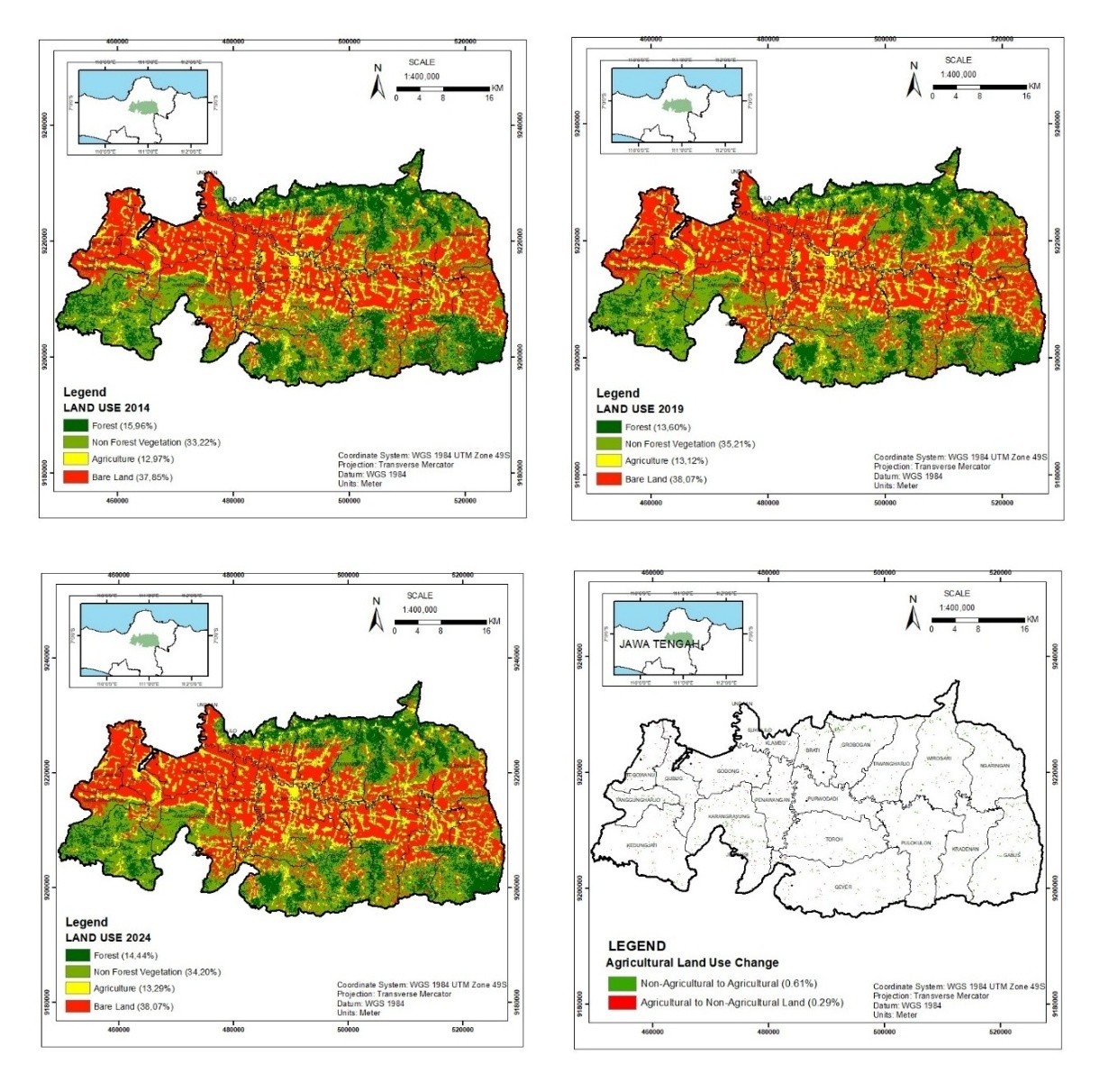
Increasing population growth and agricultural land conversion pose significant challenges to food security, particularly in regions heavily dependent on agriculture. Grobogan Regency, a major rice-producing area in Central Java, has experienced a decline in harvested area alongside rising population pressure, indicating potential risks to long-term agricultural sustainability. Unlike previous studies that examine land carrying capacity, land requirements, or land use change separately, this study integrates these aspects within a Geographic Information System (GIS)-based spatial framework. The novelty of this study lies in integrating agricultural land carrying capacity, land-use requirement projections, and GIS-based land-use analysis within a multi-temporal, spatially explicit framework at the sub-district level to provide a more comprehensive understanding of agricultural sustainability and land-based food supply planning under population pressure. This study employed a quantitative, descriptive approach, combined with GIS-based spatial analysis, using secondary data on population, harvested area, rice production, and land use for 2014, 2019, and 2024. Agricultural land carrying capacity was calculated using the Suhardjo–Tukiran method, while land requirements were projected using a geometric population growth model. The results show that carrying capacity remained positive, with σ values of 3.45 in 2014, 4.62 in 2019, and 3.94 in 2024, although the number of Class I sub-districts declined from 18 in 2019 to 16 in 2024, indicating increasing localized land pressure and spatial disparities in agricultural resources. Projected land requirements increased from 46,699.19 ha in 2029 to 49,297.08 ha in 2034, while land-use analysis indicates ongoing changes in agricultural and non-agricultural land allocation. These findings highlight the importance of GIS-based spatial planning and land-use control to support sustainable agricultural development and long-term food security.
References
Afni, N. (2016). Daya dukung lingkungan Kecamatan Pattalassang Kabupaten Takalar [Environmental carrying capacity of Pattalassang District, Takalar Regency]. Plano Madani, 5(1), 74–85. https://doi.org/10.24252/jpm.v5i1.984
Akmal, F. A., & Mohammadi, Y. (2025). The nexus of agricultural land use change and food security: A comprehensive systematic review. Land Use Policy, 158, 107717. https://doi.org/10.1016/j.landusepol.2025.107717
Bachtiar, B. A., Haq, F. S., Janah, M., Amalia, N. R., Novaldi, J., & Budiasih, B. (2023). Penyerapan tenaga kerja sektor pertanian tanaman pangan pada Generasi Z [Labor absorption in the food crop agricultural sector among Generation Z]. Seminar Nasional Official Statistics, 2023(1), 491–502. https://doi.org/10.34123/semnasoffstat.v2023i1.1706
Bununu, Y., Bello, A., & Ahmed, A. (2023). Land cover, land use, climate change and food security. Sustainable Earth Reviews, 6. https://doi.org/10.1186/s42055-023-00065-4
Cahyanto, A. (2021). Analisis daya dukung lahan dan proyeksi kebutuhan lahan pertanian di Kabupaten Klaten [Analysis of land carrying capacity and projection of agricultural land requirements in Klaten Regency]. Jurnal Samudra Geografi, 4(1), 16–29. https://doi.org/10.33059/jsg.v4i1.2505
Das, S., & Mondal, P. (2021). Socio-economic factors affecting agricultural production and income in Bangladesh. Journal of Agricultural Socio-Economics (JASE), 2(2), 56–63. https://doi.org/10.33474/jase.v2i2.10856
Faoziyah, U., Rosyaridho, M. F., & Panggabean, R. (2024). Unearthing agricultural land use dynamics in Indonesia: Between food security and policy interventions. Land, 13(12), 2030. https://doi.org/10.3390/land13122030
Gamaputra, Y., & Nuswantara, B. (2023). Analisis komoditas unggulan pertanian tanaman pangan berdasarkan nilai produksi di Kabupaten Grobogan [Analysis of leading food crop agricultural commodities based on production value in Grobogan Regency]. Jurnal Agrotech, 13(2), 144–149. https://doi.org/10.31970/agrotech.v13i2.133
Harini, R., Ariani, R. D., Kuncoro, A. B., Buana, A. S., & Puspitaningrum, I. N. (2025a). Impact of land conversion on agricultural carrying capacity and sustainable food agricultural land in Sleman Regency. Jurnal Geografi, 17(1), 15–31. https://doi.org/10.24114/jg.v17i1.57795
Harini, R., Rijanta, R., Pangaribowo, E. H., Putri, R. F., & Sukri, I. (2025b). Modeling the effects of land use change on agricultural carrying capacity and food security. Global Journal of Environmental Science and Management, 11(2), 533–554. https://doi.org/10.22034/gjesm.2025.02.10
Hidayat, I., Efani, A., & K, M. P. (2025). From land capability to food security: Mapping agricultural spatial directives in West Nusa Tenggara using GIS-based analysis. Journal of Agri-Sociopreneur and Rural Development, 36(December), 246–263. https://doi.org/10.21776/ub.habitat.2025.036.3.20
Ibrahim, J. T., Amir, N. O., & Suprapti, P. S. D. (2023). Minat anak petani terhadap pekerjaan di sektor pertanian [Farmers’ children’s interest in working in the agricultural sector]. Paradigma Agribisnis, 6(1), 10–19. https://doi.org/10.33603/jpa.v6i1.8762
Ikhwanto, A. (2019). Alih fungsi lahan pertanian menjadi lahan non-pertanian [Conversion of agricultural land into non-agricultural land]. Jurnal Hukum dan Kenotariatan, 3(1), 60–73. https://doi.org/10.33474/hukeno.v3i1.1919
Jakapratama, I. D., Arrasyid, R., Zidan, M., Alfiah, N. S., & Alifia Rahma, S. D. (2021). Analisis daya dukung dan kebutuhan lahan pertanian di Kabupaten Purwakarta tahun 2028 [Analysis of carrying capacity and agricultural land requirements in Purwakarta Regency in 2028]. Jurnal Kajian Ilmu dan Pendidikan Geografi, 4(1), 16–29. https://doi.org/10.33059/jsg.v4i1.2505
Jayadi, I. M. Y., Christiawan, P. I., & Sarmita, I. M. (2017). Dampak pertumbuhan penduduk terhadap daya dukung lahan pertanian di Desa Sambangan [The impact of population growth on agricultural land carrying capacity in Sambangan Village]. Jurnal Pendidikan Geografi Undiksha, 5(2). https://doi.org/10.23887/jjpg.v5i2.20658
Kementerian Pertanian Republik Indonesia. (2015). Peraturan Menteri Pertanian Republik Indonesia Nomor 16/Permentan/HK.140/4/2015 tentang Pedoman Penguatan Lembaga Distribusi Pangan Masyarakat Tahun 2015 [Regulation of the Minister of Agriculture of the Republic of Indonesia Number 16/Permentan/HK.140/4/2015 concerning guidelines for strengthening community food distribution institutions in 2015]. https://disperta.pesisirselatankab.go.id/transparasi/file/Permentan_No_Tahun_2015_Ttg_Pedoman_Penguatan_Lembaga_Distribusi_Pangan_Masyarakat.Pdf
Martanto, R., Ngabekti, S., Juhadi, Hamid, N., Mahat, H., Natsir, N., & Aroyandini, E. N. (2023). Determination of sustainable food land directions in Bantul Regency, Indonesia based on food security level and land use conversion. International Journal of Sustainable Development and Planning, 18(1), 161–169. https://doi.org/10.18280/ijsdp.180117
Moniaga, V. R. B. (2011). Analisis daya dukung lahan pertanian [Analysis of agricultural land carrying capacity]. AGRI-SOSIOEKONOMI, 7(2), 61–68. https://doi.org/10.35791/agrsosek.7.2.2011.92
Mubarokah, N., Rachman, L. M., & Tarigan, S. D. (2020). Analysis of carrying capacity of crop agricultural land in Cibaliung Watershed, Banten Province. Jurnal Ilmu Pertanian Indonesia, 25(1), 73–80. https://doi.org/10.18343/jipi.25.1.73
Mulya, S. P., Hudalah, D., Prilandita, N., & Sakti, A. D. (2024). Spatio-temporal changes in agricultural land and rural–urban transitions in Greater Jakarta, Indonesia. Regional Environmental Change, 24, 145. https://doi.org/10.1007/s10113-024-02306-4
Nugroho, F., & Afandi, A. (2024). Analisis faktor-faktor yang mempengaruhi indeks harga pangan di Indonesia tahun 2000–2023 [Analysis of factors affecting the food price index in Indonesia, 2000–2023]. Jurnal Kebijakan Ekonomi dan Keuangan, 3(1), 1–9. https://doi.org/10.20885/jkek.vol3.iss1.art1
Peltonen-Sainio, P., Jauhiainen, L., Laurila, H., Sorvali, J., Honkavaara, E., Wittke, S., Karjalainen, M., & Puttonen, E. (2019). Land use optimization tool for sustainable intensification of high-latitude agricultural systems. Land Use Policy, 88, 104104. https://doi.org/10.1016/j.landusepol.2019.104104
Rochaida, E. (2016). Dampak pertumbuhan penduduk terhadap pertumbuhan ekonomi dan keluarga sejahtera di Provinsi Kalimantan Timur [The impact of population growth on economic growth and prosperous families in East Kalimantan Province]. Forum Ekonomi: Jurnal Ekonomi, Manajemen dan Akuntansi, 18(1), 14–24. https://doi.org/10.29264/jfor.v18i1.42
Ruwanto, S., & Banowati, E. (2021). Analisis perubahan penggunaan lahan sawah menjadi lahan terbangun di Kecamatan Gubug Kabupaten Grobogan tahun 2000–2018 [Analysis of paddy-field land-use conversion into built-up land in Gubug District, Grobogan Regency, 2000–2018]. Geo Image, 10(1), 60–67. https://journal.unnes.ac.id/sju/geoimage/article/view/47324/19133
Sarastika, T., & Anggrasari, H. (2024). Analisis daya dukung lahan pertanian sebagai upaya mendukung ketersediaan pangan di Kawasan Sleman Tengah [Analysis of agricultural land carrying capacity as an effort to support food availability in Central Sleman Area]. Jurnal Tanah dan Sumberdaya Lahan, 11(2), 413–421. https://doi.org/10.21776/ub.jtsl.2024.011.2.12
Setyowati, D. L., & Hardati, P. (2025). Community-based springs management of the Sukolilo Karst landscape area to fulfill clean water needs. Geografi, 13(2), 33–61. https://doi.org/10.37134/geografi.vol13.2.2.2025
Statistics Indonesia of Grobogan Regency. (2015). Grobogan Regency in figures 2015. Statistics Indonesia of Grobogan Regency. https://grobogankab.bps.go.id/id/publication/2015/10/30/f16dde2a035f6bb577b060bf/statistik-daerah-kabupaten-grobogan-2015.html
Statistics Indonesia of Grobogan Regency. (2020). Grobogan Regency in figures 2020: Data provision for development planning. Statistics Indonesia of Grobogan Regency. https://grobogankab.bps.go.id/id/publication/2020/04/27/e44d829b03d429bd01828642/kabupaten-grobogan-dalam-angka-2020.html
Statistics Indonesia of Grobogan Regency. (2025). Grobogan Regency in figures 2025. Statistics Indonesia of Grobogan Regency. https://grobogankab.bps.go.id/publication/2025/02/28/8c2e6a8a777dff15f92e26e9/kabupaten-grobogan-dalam-angka-2025.html
Sudrajat, J., Suyatno, A., & Oktoriana, S. (2021). Land-use changes and food insecurity around oil palm plantations: Evidence at the village level. Forest and Society, 5(2), 352–364. https://doi.org/10.24259/fs.v5i2.11376
Suhardjo, D., & Tukiran. (1990). Studi literatur konsep yang sudah ada mengenai daya tampung wilayah [Literature study of existing concepts on regional carrying capacity]. Kantor Menteri Negara Kependudukan dan Lingkungan Hidup.
Wang, J. (2025). The impact of urban expansion on food production: A bibliometric study of development, hotspots, and future prospects. Frontiers in Sustainable Food Systems, 10, 1550373. https://doi.org/10.3389/fsufs.2025.1550373
Wang, X. (2022). Managing land carrying capacity: Key to achieving sustainable production systems for food security. Land, 11(4), 484. https://doi.org/10.3390/land11040484
Downloads
Published
How to Cite
Issue
Section
License
Copyright (c) 2026 Muhammad Fauzan, Mochammad Arief Budihardjo, Budi Prasetyo Samadikun

This work is licensed under a Creative Commons Attribution-ShareAlike 4.0 International License.