Applying the stimulus–organism–response model to social media-driven organic vegetable consumption among housewives in Malang City
DOI:
https://doi.org/10.33474/jase.v7i1.25270Keywords:
Green Consumption, Organic Food, SOR Model, Sustainable Agribusiness, PLS-SEMAbstract
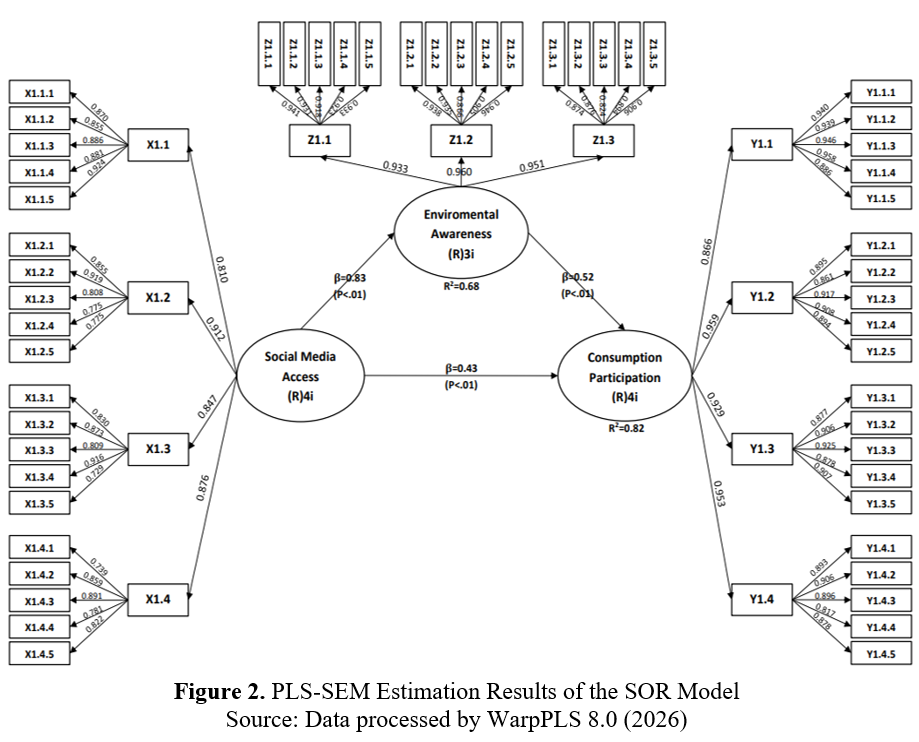
Sustainable food consumption has become increasingly important in promoting environmentally responsible household food choices, including organic vegetable consumption. Although social media is widely used to disseminate health and environmental information, few studies have examined how access to social media stimulates organic vegetable consumption by fostering environmental awareness among housewives in a local agribusiness context. This study fills this gap by applying the Stimulus–Organism–Response (SOR) model to explain participation in organic vegetable consumption among housewives in Malang City. A quantitative survey was conducted with 65 housewives who had purchased and consumed organic vegetables and actively used social media. Data were analyzed using Partial Least Squares–Structural Equation Modeling (PLS-SEM). The results show that social media access had a positive and significant effect on environmental awareness (β = 0.826; p < 0.001), environmental awareness significantly influenced organic vegetable consumption participation (β = 0.520; p < 0.001), and social media access directly affected consumption participation (β = 0.430; p < 0.001). Environmental awareness also mediated the relationship between social media access and participation in organic vegetable consumption. However, 60% of respondents purchased organic vegetables less than five times per month, indicating an awareness–behavior gap. These findings strengthen the SOR model in explaining sustainable consumption behavior and highlight the strategic role of digital communication in organic vegetable market development. The study suggests that organic farmers, retailers, and digital marketers should integrate consumer education, transparency in certification, and targeted social media campaigns to strengthen household participation in sustainable agribusiness.
References
Agrawal, M., Kalia, P., Nema, P., Zia, A., Kaur, K., & John, H. B. (2023). Evaluating the influence of government initiatives and social platforms on green practices of Gen Z: The mediating role of environmental awareness and consciousness. Cleaner and Responsible Consumption, 8, 100109. https://doi.org/10.1016/j.clrc.2023.100109
Alfiansyah, H., Ardikoesoema, N., & Samuel, J. (2023). Potensi degradasi lingkungan dampak eksistensi karbofuran di Indonesia [Potential environmental degradation due to the existence of carbofuran in Indonesia]. Jurnal Bisnis Kehutanan dan Lingkungan, 1(1), 66–87. https://doi.org/10.61511/jbkl.v1i1.2023.258
Alkhawaldeh, K., Suwan, R., & Qadri, M. (2025). The influence of customer value on sustainable green purchasing decision: The mediating role of customer attitudes and behavior. OPSEARCH, 62(2), 643–660. https://doi.org/10.1007/s12597-024-00822-9
Apolinaris, F., Sa’diyah, A. A., Wulandari, A., Suliana, G., & Lakmali, A. W. S. (2024). Technical efficiency of organic caisim farming using Data Envelopment Analysis (DEA). Journal of Agricultural Socio-Economics (JASE), 5(2), 66–75. https://doi.org/10.33474/jase.v5i2.21660
Bakti, I. (2024). Peran media sosial dalam meningkatkan kepedulian terhadap isu lingkungan [The role of social media in increasing concern for environmental issues]. Indonesian Research Journal on Education, 4(4), 3198–3205. https://doi.org/10.31004/irje.v4i4.1561
Borah, P. S., Dogbe, C. S. K., & Marwa, N. (2024). Generation Z’s green purchase behavior: Do green consumer knowledge, consumer social responsibility, green advertising, and green consumer trust matter for sustainable development? Business Strategy and the Environment, 33(5), 4530–4546. https://doi.org/10.1002/bse.3714
BPS-Statistics Malang Municipality. (2026). Malang Municipality in figures 2026. https://malangkota.bps.go.id/en/publication/2026/02/27/ee38eae8c3d260cd84bbbc22/kota-malang-dalam-angka-2026.html
Cohen, J. (1988). Statistical power analysis for the behavioral sciences (2nd ed.). Lawrence Erlbaum Associates. https://doi.org/10.4324/9780203771587
Cohen, J. (1992). A power primer. Psychological Bulletin, 112(1), 155–159. https://doi.org/10.1037/0033-2909.112.1.155
David, W., & Alkausar, S. (2023). Statistik pertanian organik Indonesia [Statistics of organic agriculture in Indonesia] (Vol. 1, No. 1). Universitas Bakrie Press. https://repository.bakrie.ac.id/8918/1/Draft%20Buku%20SOI-Update%2014-1-2024.pdf
Dlamini, S., & Mahowa, V. (2024). Investigating factors that influence the purchase behavior of green cosmetic products. Cleaner and Responsible Consumption, 13, 100190. https://doi.org/10.1016/j.clrc.2024.100190
Eyinade, G. A., Mushunje, A., & Yusuf, S. F. G. (2021). The willingness to consume organic food: A review. Food and Agricultural Immunology, 32(1), 78–104. https://doi.org/10.1080/09540105.2021.1874885
Gasper, D., Shah, A., & Tankha, S. (2019). The framing of sustainable consumption and production in SDG 12. Global Policy, 10(S1), 83–95. https://doi.org/10.1111/1758-5899.12592
Gundala, R. R., & Singh, A. (2021). What motivates consumers to buy organic foods? Results of an empirical study in the United States. PLOS ONE, 16(9), e0257288. https://doi.org/10.1371/journal.pone.0257288
Hair, J. F., Hult, G. T. M., Ringle, C. M., & Sarstedt, M. (2017). A primer on partial least squares structural equation modeling (PLS-SEM) (2nd ed.). SAGE Publications.
Hair, J. F., Risher, J. J., Sarstedt, M., & Ringle, C. M. (2019). When to use and how to report the results of PLS-SEM. European Business Review, 31(1), 2–24. https://doi.org/10.1108/EBR-11-2018-0203
Hair, J., & Alamer, A. (2022). Partial least squares structural equation modeling (PLS-SEM) in second language and education research: Guidelines using an applied example. Research Methods in Applied Linguistics, 1(3), 100027. https://doi.org/10.1016/j.rmal.2022.100027
Isanani, F. A. N., Thohiriyah, N., Putri, A. A., Winri, R. M., Zordi, D. A., & Purwanto, H. E. (2025). Peran media sosial sebagai pranata sosial dalam pembentukan kesadaran lingkungan masyarakat: Kajian sosiologi komunikasi [The role of social media as a social institution in shaping public environmental awareness: A sociology of communication study]. Jurnal Bincang Komunikasi, 3(1), 32–38.
Jiang, B., Pang, J., Li, J., Mi, L., Ru, D., Feng, J., Li, X., Zhao, A., & Cai, L. (2024). The effects of organic food on human health: A systematic review and meta-analysis of population-based studies. Nutrition Reviews, 82(9), 1151–1175. https://doi.org/10.1093/nutrit/nuad124
Kock, N. (2024). WarpPLS user manual: Version 8.0. ScriptWarp Systems. https://scriptwarp.com/warppls/UserManual_v_8_0.pdf
Li, Y., & Shan, B. (2025). Exploring the role of health consciousness and environmental awareness in purchase intentions for green-packaged organic foods: An extended TPB model. Frontiers in Nutrition, 12, 1528016. https://doi.org/10.3389/fnut.2025.1528016
Liu, Y., Cai, L., Ma, F., & Wang, X. (2023). Revenge buying after the lockdown: Based on the SOR framework and TPB model. Journal of Retailing and Consumer Services, 72, 103263. https://doi.org/10.1016/j.jretconser.2023.103263
Liu, Y., Wang, P., Zhang, M., Chen, X., Li, K., & Qu, J. (2024). Bridging the intention–behavior gap in organic food consumption: Empirical evidence from China. Foods, 13(14), 2239. https://doi.org/10.3390/foods13142239
Mehrabian, A., & Russell, J. A. (1974). An approach to environmental psychology. MIT Press.
Pezzullo, P. C., & Cox, J. R. (2018). Environmental communication and the public sphere (5th ed.). SAGE Publications. https://studentebookhub.com/wp-content/uploads/2024/preview/9781544387031.pdf
Salim, B. A., Mutia, A., & Prasaja, A. S. (2023). Pengaruh supporting environmental protection dan green identification product terhadap keputusan pembelian green product pada mahasiswa [The effect of supporting environmental protection and green identification product on students’ green product purchasing decisions]. Dinamika: Jurnal Manajemen Sosial Ekonomi, 3(2), 29–43. https://doi.org/10.51903/dinamika.v3i2.378
Sarstedt, M., Hair, J. F., Pick, M., Liengaard, B. D., Radomir, L., & Ringle, C. M. (2022). Progress in partial least squares structural equation modeling use in marketing research in the last decade. Psychology & Marketing, 39(5), 1035–1064. https://doi.org/10.1002/mar.21640
Shihab, M. S., Ikhsan, R. B., & Fakhrorazi, A. (2025). The power of social media: Exploring online member groups and psychological factors to support responsible consumption. Digital Business, 5(1), 100101. https://doi.org/10.1016/j.digbus.2024.100101
Shimul, A. S., Cheah, I., & Khan, B. B. (2022). Investigating female shoppers’ attitude and purchase intention toward green cosmetics in South Africa. Journal of Global Marketing, 35(1), 37–56. https://doi.org/10.1080/08911762.2021.1934770
Sholihin, M., & Ratmono, D. (2021). Analisis SEM-PLS dengan WarpPLS 7.0 untuk hubungan nonlinier dalam penelitian sosial dan bisnis [SEM-PLS analysis with WarpPLS 7.0 for nonlinear relationships in social and business research]. Penerbit Andi. https://books.google.co.id/books?id=NbMWEAAAQBAJ&lpg=PR2&hl=id&pg=PA4#v=onepage&q&f=false
Solimun, Fernandes, A. A. R., & Nurjannah. (2017). Metode statistika multivariat: Pemodelan persamaan struktural (SEM) pendekatan WarpPLS [Multivariate statistical methods: Structural equation modeling (SEM) using the WarpPLS approach]. Universitas Brawijaya Press. https://books.google.co.id/books?id=GrRVDwAAQBAJ&lpg=PR4&hl=id&pg=PR4#v=onepage&q&f=false
Sun, Y., & Xing, J. (2022). The impact of social media information sharing on the green purchase intention among Generation Z. Sustainability, 14(11), 6879. https://doi.org/10.3390/su14116879
Syah, M. A., Sari, P. N., & Azizah, B. (2025). Kepedulian dan kesadaran konsumen mengonsumsi produk sayur/buah organik di pasar modern, Surabaya [Consumer concern and awareness in consuming organic vegetable/fruit products in modern markets, Surabaya]. Jurnal Agrosains: Karya Kreatif dan Inovatif, 10(1), 137–155. https://doi.org/10.31102/agrosains.2025.10.1.137-155
Zamrodah, Y., Sativa, R. D. O., & Moeis, E. M. (2023). Strategi pengembangan pemasaran beras organik di Vigur Organik Cemorokandang Malang [Marketing development strategy for organic rice at Vigur Organik Cemorokandang Malang]. VIABEL: Jurnal Ilmiah Ilmu-Ilmu Pertanian, 17(2), 73–80. https://doi.org/10.35457/viabel.v17i2.3343
Downloads
Published
How to Cite
Issue
Section
License
Copyright (c) 2026 Fithana Silma Ridani, Mofit Jamroni, Rizka Amalia

This work is licensed under a Creative Commons Attribution-ShareAlike 4.0 International License.