SWOT-AHP-Based strategies for improving corn productivity and export sustainability in Gorontalo, Indonesia
DOI:
https://doi.org/10.33474/jase.v7i1.25347Keywords:
Analytical Hierarchy Process, Corn, Export, SWOT, SustainabilityAbstract
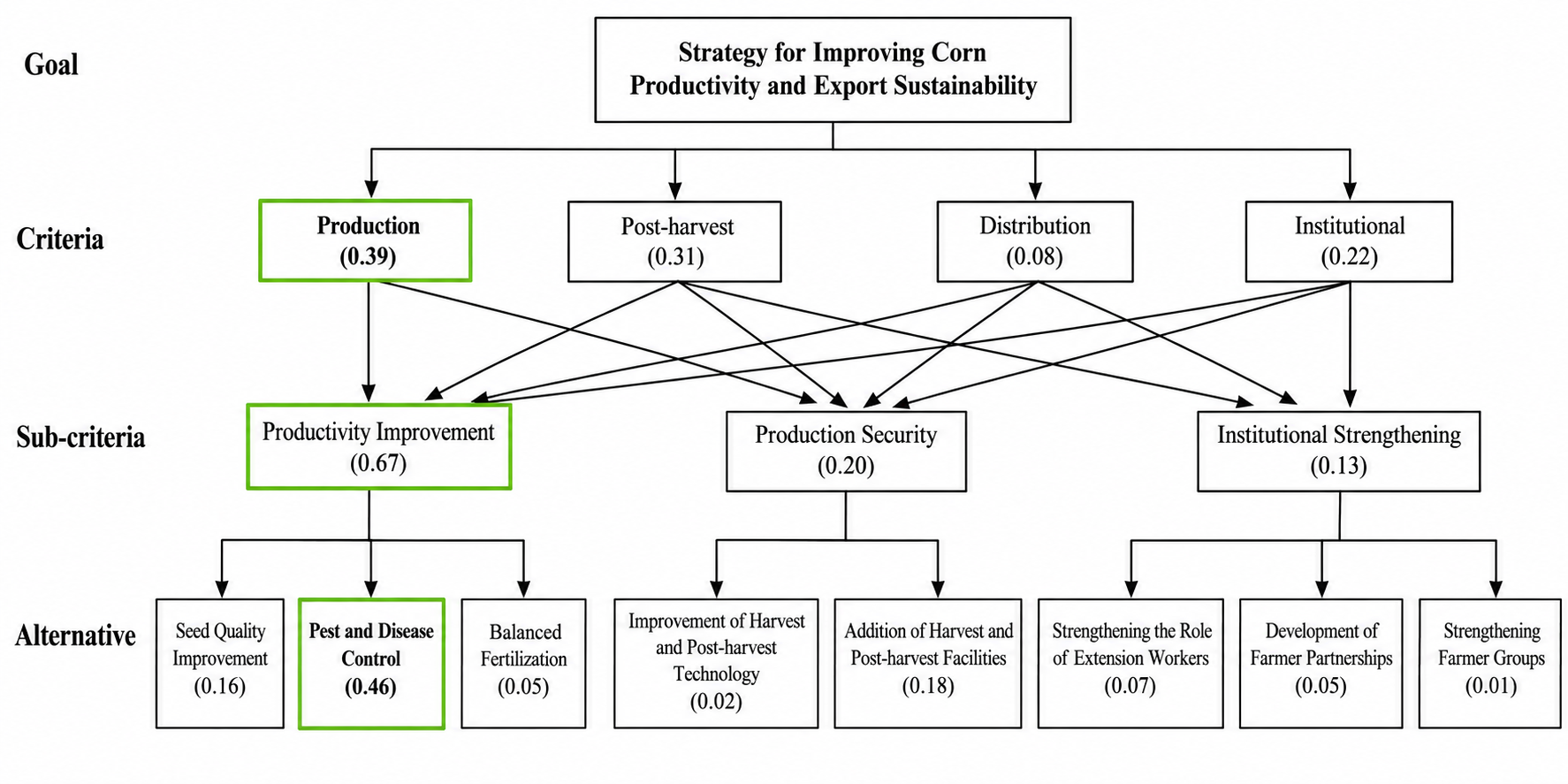
Corn is a strategic commodity for Gorontalo Province because it supports food security, farmer income, regional agribusiness development, and export-oriented agricultural competitiveness. However, corn productivity and export sustainability in the region are still constrained by production risks, limited post-harvest facilities, weak institutional support, and market access challenges. This study aims to formulate and prioritize strategies for improving corn productivity and export sustainability in Gorontalo Province using an integrated SWOT-AHP approach. Data were collected through surveys of 98 corn farmers, stakeholder interviews, field observations, and expert judgment. SWOT analysis was used to identify internal and external strategic factors related to cultivation, post-harvest, distribution, and institutional aspects, while AHP was applied to determine the priority weights of criteria, sub-criteria, and alternative strategies. The SWOT results show that weaknesses were more dominant than strengths, and threats were more dominant than opportunities, placing corn farming in the WT quadrant with coordinates of X = −0.53 and Y = −0.64. This indicates that the appropriate strategic direction is a defensive strategy, emphasizing the minimization of internal weaknesses and the anticipation of external threats. The AHP results show that production was the highest priority criterion (0.39), followed by post-harvest (0.31), institutional aspects (0.22), and distribution (0.08). At the sub-criteria level, productivity improvement obtained the highest priority weight (0.67). The main alternative strategy was pest and disease control (0.46), followed by the addition of harvest and post-harvest facilities (0.18) and seed quality improvement (0.16). These findings indicate that strategies to improve corn productivity and export sustainability in Gorontalo should prioritize risk management in production, post-harvest infrastructure improvements, and support for quality seed. The study provides practical guidance for local government, extension officers, farmer groups, and agribusiness actors in strengthening the competitiveness of Gorontalo corn.
References
Arbulú Ballesteros, M. A., Montes Ninaquispe, J. C., Corrales Otazú, C. D., Apaza Miranda, S. J., León Luyo, S. L., Coronel Estela, C. V., Marquez Yauri, H. Y., Barinotto Roncal, P. I., Sandoval Reyes, C. J., & Palma Vallejo, J. G. (2026). Sustainability through diversification and competitiveness: An analysis of global maize exports. Sustainability, 18(3), 1227. https://doi.org/10.3390/su18031227
Asgar, F., Pudjiastuti, A. Q., & Khoirunnisa, N. (2024). Economic analysis of tempeh industry households in Beji Village, Junrejo Sub-District, Batu City. Journal of Agricultural Socio-Economics (JASE), 5(1), 37–44. https://doi.org/10.33474/jase.v5i1.22020
Asprooth, L., Norton, M., & Galt, R. (2023). Transforming the Corn Belt: A recipe for collaborative, farmer-driven research and diffusion of innovation. Journal of Rural Studies, 103, 103133. https://doi.org/10.1016/j.jrurstud.2023.103133
Barrett, C. B., Reardon, T., Swinnen, J., & Zilberman, D. (2022). Agri-food value chain revolutions in low- and middle-income countries. Journal of Economic Literature, 60(4), 1316–1377. https://doi.org/10.1257/jel.20201539
David, F. R., David, F. R., & David, M. E. (2017). Strategic management: A competitive advantage approach, concepts and cases (16th ed.). Pearson. https://cmls.org.uk/online/wp-content/uploads/2019/07/Strategic-Management-A-Competitive-Advantage-Approach.pdf
Erenstein, O., Chamberlin, J., Sonder, K., Mottaleb, K. A., & Prasanna, B. M. (2022). Global maize production, consumption and trade: Trends and R&D implications. Food Security, 14(5), 1295–1319. https://doi.org/10.1007/s12571-022-01288-7
Hajad, M., Radi, R., & Purwantana, B. (2021). Pengembangan alat tanam jagung tipe tugal dalam untuk lahan kritis [Development of a deep dibble-type corn planter for critical land]. Jurnal Teknik Pertanian Lampung (Journal of Agricultural Engineering), 10(2), 129–138. https://doi.org/10.23960/jtep-l.v10i2.129-138
Karman, J., Subaruto, S., & Hotapia, Y. (2020). The effect of organic fertilizer on corn productivity and income. SOCA: Jurnal Sosial Ekonomi Pertanian, 14(3), 430. https://doi.org/10.24843/SOCA.2020.v14.i03
Kassam, A., Friedrich, T., & Derbech, R. (2019). Global expansion of conservation agriculture. International Journal of Environmental Studies, 76(1), 29–51. https://doi.org/10.1080/00207233.2018.1494927
Kembauw, E., Mahulette, A. S., Wattimena, A. Y., & Senewe, R. E. (2021). Analisis rantai pasok komoditas cengkih hutan di Maluku [Supply chain analysis of forest clove commodities in Maluku]. Journal of Agricultural Socio-Economics (JASE), 2(2), 81–87. https://doi.org/10.33474/jase.v2i2.13083
Klerkx, L., & Begemann, S. (2020). Supporting food systems transformation: The what, why, who, where and how of mission-oriented agricultural innovation systems. Agricultural Systems, 184, 102901. https://doi.org/10.1016/j.agsy.2020.102901
Kurttila, M., Pesonen, M., Kangas, J., & Kajanus, M. (2000). Utilizing the analytic hierarchy process (AHP) in SWOT analysis: A hybrid method and its application to a forest-certification case. Forest Policy and Economics, 1(1), 41–52. https://doi.org/10.1016/S1389-9341(99)00004-0
Maula, L. R., & Susilowati, D. (2024). Household socioeconomic factors affecting family food consumption: A case study of households in Gunung Jati Village, East Java Province, Indonesia. Journal of Agricultural Socio-Economics (JASE), 5(1), 1–7. https://doi.org/10.33474/jase.v5i1.21493
Nendissa, D. R., Budi, M., Hendrik, E., & Kana, Y. R. (2024). Food and non-food expenditure patterns in pre-prosperous and prosperous families-1 in the rural areas of Semiringkai. Journal of Agricultural Socio-Economics (JASE), 4(2). https://doi.org/10.33474/jase.v4i2.21255
Nguyen, H. T., & Canh, T. T. (2022). Integral SWOT-AHP-TOWS model for strategic agricultural development in the context of drought: A case study in Ninh Thuan, Vietnam. International Journal of the Analytic Hierarchy Process, 14(1). https://doi.org/10.13033/ijahp.v14i1.890
Reardon, T., Echeverría, R., Berdegué, J., Minten, B., Liverpool-Tasie, L. S. O., Tschirley, D., & Zilberman, D. (2019). Rapid transformation of food systems in developing regions: Highlighting the role of agricultural research and innovations. Agricultural Systems, 172, 47–59. https://doi.org/10.1016/j.agsy.2018.01.022
Saaty, T. L. (1990). How to make a decision: The analytic hierarchy process. European Journal of Operational Research, 48(1), 9–26. https://doi.org/10.1016/0377-2217(90)90057-I
Salam, M., Rukka, R. M., Samma, M. A.-N. K., Tenriawaru, A. N., Rahmadanih, Muslim, A. I., Ali, H. N. B., & Ridwan, M. (2024). The causal-effect model of input factor allocation on maize production: Using binary logistic regression in search for ways to be more productive. Journal of Agriculture and Food Research, 16, 101094. https://doi.org/10.1016/j.jafr.2024.101094
Susilowati, S. H., Ariningsih, E., Saliem, H. P., Roosganda, E., Adawiyah, C. R., & Muksin. (2021). Opportunities and challenges for increasing corn exports from Gorontalo Province, Indonesia. IOP Conference Series: Earth and Environmental Science, 672(1), 012027. https://doi.org/10.1088/1755-1315/672/1/012027
Waheed, A., Goyal, M., Gupta, D., Khanna, A., Hassanien, A. E., & Pandey, H. M. (2020). An optimized dense convolutional neural network model for disease recognition and classification in corn leaf. Computers and Electronics in Agriculture, 175, 105456. https://doi.org/10.1016/j.compag.2020.105456
Wang, J., & Hu, X. (2021). Research on corn production efficiency and influencing factors of typical farms: Based on data from 12 corn-producing countries from 2012 to 2019. PLOS ONE, 16(7), e0254423. https://doi.org/10.1371/journal.pone.0254423
Downloads
Published
How to Cite
Issue
Section
License
Copyright (c) 2026 Indriana Indriana, Sjahril Botutihe, Jolanda CE Lamaega

This work is licensed under a Creative Commons Attribution-ShareAlike 4.0 International License.