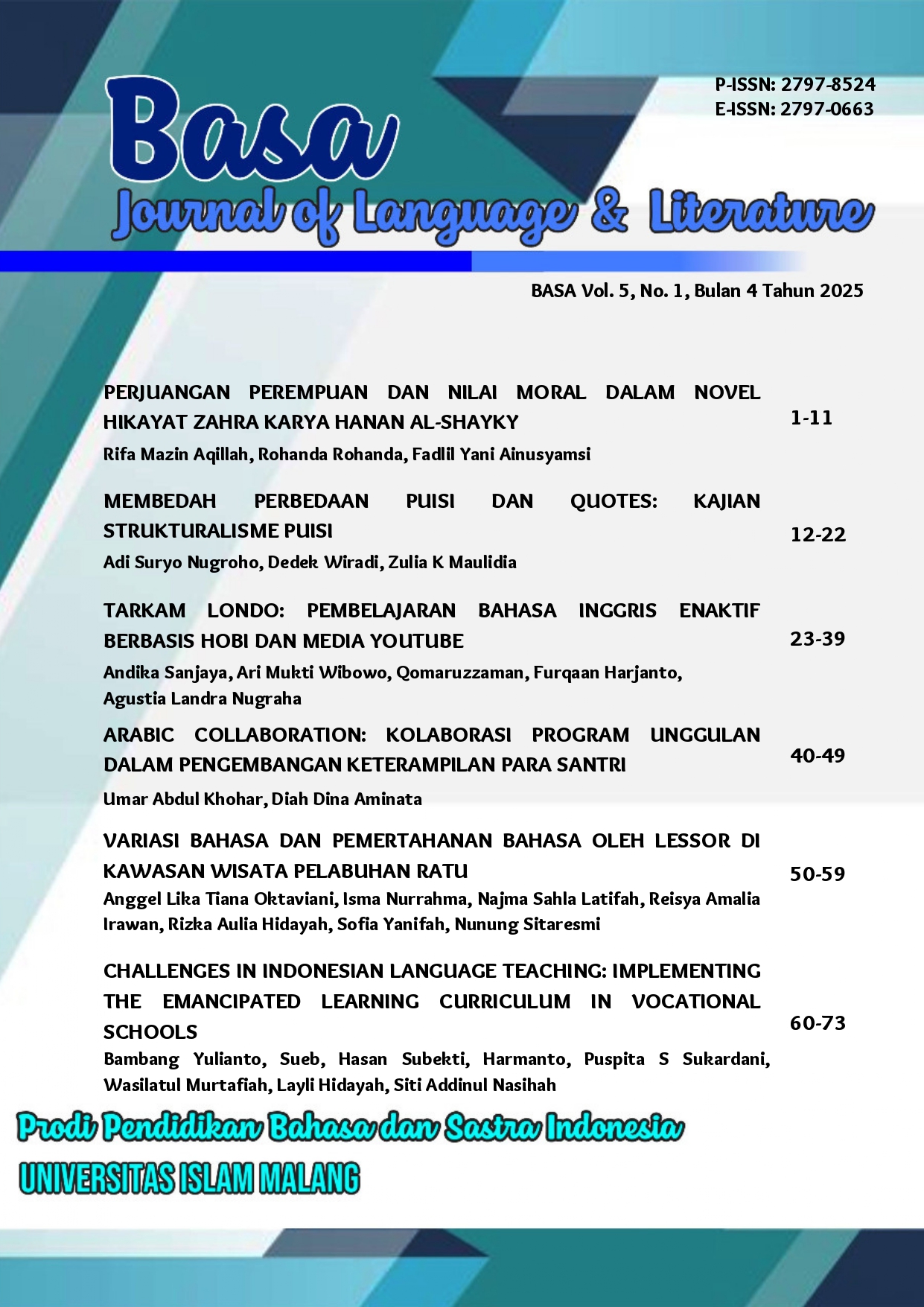
CHALLENGES IN INDONESIAN LANGUAGE TEACHING: IMPLEMENTING THE EMANCIPATED LEARNING CURRICULUM IN VOCATIONAL SCHOOLS
DOI:
https://doi.org/10.33474/basa.v5i1.23160Keywords:
Assessment Practices, Emancipated Learning Curriculum, Indonesian Language, Teacher Challenges, Vocational EducationAbstract
This study explores the challenges faced by Indonesian language teachers in vocational schools (SMK) in implementing the Emancipated Learning Curriculum, focusing on three key areas: curriculum understanding, material management, and assessment practices. The curriculum emphasizes student-centered, contextual learning, yet its implementation presents obstacles for teachers. A mixed-methods approach was employed, involving a survey of 40 teachers from East Java. The findings reveal that more than half of teachers have only a partial understanding of the curriculum, with experienced teachers struggling the most to transition from traditional methods. In material management, 70% of respondents reported inadequate or partially adequate resources, with rural teachers facing severe shortages. Assessment practices were dominated by traditional tests, while project-based and performance-based assessments were rarely used due to lack of training, logistical challenges, and systemic emphasis on standardized evaluations. These challenges highlight the need for targeted interventions, including practical training on curriculum application, development and equitable distribution of curriculum-aligned resources, and supportive policies for flexible assessments. Addressing these issues is critical for achieving the curriculum’s goals of fostering critical thinking, creativity, and contextual learning. Future research should investigate long-term impacts and scalable solutions for effective curriculum implementation in diverse settings.
References
Anistasya, Susanti, R., Safitri, E.R., & Gulo, F. (2024). Studi Analisis Sistem Pendidikan Jenjang Sekolah Pertama di Singapura dan di Indonesia. EduInovasi: Journal of Basic Educational Studies.
Aprilia, E., Afindi, A., & Saputra, H. (2024). Kasus Pendayagunaan Sumber Daya Pendidikan. Jurnal Pendidikan, Bahasa dan Budaya, 3(4), 112-124.
Arsyad Arrafii, M. (2023). Assessment reform in Indonesia: Contextual barriers and opportunities for implementation. Asia Pacific Journal of Education, 43(1), 79-94.
Aryawan, F. N. (2023). Overcoming the Challenges of Vocational Education in Indonesian SMK: Ideas on Curriculum Improvement, Teaching Quality, And English Language Teaching. Journal of Practice Learning and Educational Development, 3(3), 243-252.
Black, P., & Wiliam, D. (1998). Assessment and classroom learning. Assessment in Education: principles, policy & practice, 5(1), 7-74.
Brody, D. L., & Hadar, L. L. (2015). Personal professional trajectories of novice and experienced teacher educators in a professional development community. Teacher development, 19(2), 246-266.
Carrete-Marín, N., Domingo-Peñafiel, L., & Simó-Gil, N. (2024). Teaching materials for rural schools: challenges and practical considerations from an international perspective. International Journal of Educational Research Open, 7, 100365.
Çelik, E., & Gül, İ. (2024). Teachers' Opinions on the Problems Encountered in Internship Practices in Special Education Vocational Schools. Journal of Social Sciences and Education, 7(1), 1-24.
Defianty, M., & Wilson, K. (2024). Beating Barriers to Formative Assessment in a Testing-Oriented Nation. TARBIYA: Journal of Education in Muslim Society, 11(1), 1-12.
Efendi, M. Y., & Hsi, N. L. (2020). The comparison of elementary curriculum education between Indonesia and Singapore. Journal Of Teaching And Learning In Elementary Education, 3(1), 22-36.
Ellen, K. K., & Sudimantara, L. B. (2023). Examining Emancipated Curriculum Development in Middle Schools: A Case Study. PANYONARA: Journal of English Education, 5(2), 165-188.
Febriyatko, A., Rahmawati, C. D., Fatimah, K., & Batalemba, I. (2023). Titik Temu Konsep Pendidikan Ki Hadjar Dewantara Dengan Kurikulum Merdeka Belajar (Studi Komparatif). BASA Journal of Language & Literature, 3(1), 1-10.
Frey, B. B., & Schmitt, V. L. (2010). Teachers’ Classroom Assessment Practices. Middle Grades Research Journal, 5(3).
Gutman, M., & Oplatka, I. (2021). “Maintaining the image of a desired teacher”: major issues of late-career senior teacher educators. Educational Studies, 47(5), 538-553.
Hadiastriani, Y., & Djarot, P. (2024). Bibliometric Insights into Assessment Practices in the Merdeka Curriculum: Identifying Opportunities for New Assessment Development. JSEP (Journal of Science Education and Practice), 8(1), 14-38.
Hanayanti, H., Tahapary, N. L., Basalama, P. N., & Miniaty, Y. (2023). Exploring Challenges in Applying the Merdeka Curriculum at Schools. MATAI: International Journal of Language Education, 4(1), 115-121.
Hunaepi, H., & Suharta, I. (2024). Transforming education in Indonesia: The impact and challenges of the Merdeka belajar curriculum. Path of Science, 10(6), 5026-5039.
Kawuryan, S. P., Sayuti, S. A., & Dwiningrum, S. I. A. (2021). Teachers Quality and Educational Equality Achievements in Indonesia. International Journal of Instruction, 14(2), 811-830.
Lei, M., & Medwell, J. (2022). The changing role of chinese english-as-foreign-language teachers in the context of curriculum reform: Teachers’ understanding of their new role. Frontiers in Psychology, 13, 904071.
May, Y. T., & Ali, U. (2023). Kemampuan Dasar Guru yang Profesional dalam Mengimplementasikan Kurikulum Merdeka Belajar. Daskalos: Penelitian Tindakan Kelas, 1(1), 36-44.
Mustadi, A., Surya, P., & Chen, M. Y. (2021). Pre-service teacher education reform in Indonesia: Traditional and contemporary paradigms. In Educational Innovation in Society 5.0 Era: Challenges and Opportunities (pp. 80-90). Routledge.
Nasution, I. N., & Indrasari, S. Y. (2024). Twenty Years of Change: A Systematic Literature Review of Indonesian Teachers’ Responses to Curriculum Change. Jurnal Kependidikan: Jurnal Hasil Penelitian dan Kajian Kepustakaan di Bidang Pendidikan, Pengajaran dan Pembelajaran, 10(1), 100-112.
Neibling, J. (2014). Teachers' Conceptions Toward Type of Assessment: Grade Level and State Tested Content Area (Doctoral dissertation, University of Kansas).
Nihayah, R. W., Dina, W. F., Wijayanti, D., & Asyah, A. N. (2023). How does granting teacher autonomy influence classroom instruction? Lessons from Indonesia’s curriculum reform implementation. Jurnal Penelitian Kebijakan Pendidikan, 16(1).
Pradana, M. R. A., & Josiah, T. (2024). Application of Technology in Educational Management in Rural Schools. Ensiklopedia: Jurnal Pendidikan dan Inovasi Pembelajaran Saburai, 4(01), 37-43.
Qiftiyah, M., & Hidayati, A. N. (2024). Analisis Implementasi Kurikulum Merdeka di Sekolah Dasar. Al Banin: Jurnal Ilmiah Pendidikan Dasar, 1(2), 134-145.
Ramdhani, N., Ancok, D., Swasono, Y., & Suryanto, P. (2012). Teacher quality improvement program: Empowering teachers to increasing a quality of Indonesian's education. Procedia-Social and Behavioral Sciences, 69, 1836-1841.
Retnawati, H., Hadi, S., & Nugraha, A. C. (2016). Vocational High School Teachers' Difficulties in Implementing the Assessment in Curriculum 2013 in Yogyakarta Province of Indonesia. International journal of instruction, 9(1), 33-48.
Revina, S., Pramana, R. P., Bjork, C., & Suryadarma, D. (2023). Replacing the old with the new: long-term issues of teacher professional development reforms in Indonesia. Asian Education and Development Studies, 12(4/5), 262-274.
Rohmah, Z., Hamamah, H., Junining, E., Ilma, A., & Rochastuti, L. A. (2024). Schools’ support in the implementation of the Emancipated Curriculum in secondary schools in Indonesia. Cogent Education, 11(1), 2300182.
Rusydi, A., Subroto, W. T., & Sakti, N. C. (2023). Influence of Self-Efficacy and Resilience on Subjective Well-Being: A Study of the New Curriculum Implementation in Indonesia. IJORER: International Journal of Recent Educational Research, 4(5), 597-609.
Şahinoğlu, A., & Arslan, A. S. (2023). Examining of Teachers’ Practices Supported by Mentoring Application. Continuing Professional Education: Theory and Practice, 77(4), 66-87.
Saifani, A. S. I., & Adawiyah, R. (2023). The Analysis of the Educational Unit Assessment Strategy on the Independent Learning Curriculum at the Schools. JIIP-Jurnal Ilmiah Ilmu Pendidikan, 6(6), 4275-4287.
Salamah, U., Listiyani, Y., & Mustafiyanti, M. (2024). Analisis Konsep Dan Struktur Kurikulum Merdeka Dan Merdeka Belajar. Khatulistiwa: Jurnal Pendidikan dan Sosial Humaniora, 4(2), 123-129.
Samani, M., Sunwinarti, S., Putra, B. A., Rahmadian, R., & Rohman, J. N. (2019). Learning strategy to develop critical thinking, creativity, and problem-solving skills for vocational school students. Jurnal Pendidikan Teknologi dan Kejuruan, 25(1), 36-42.
Saputra, E. R., Hamied, F. A., & Suherdi, D. (2019, June). A case of authentic assessment in indonesian secondary EFL classroom context: Teachers’ struggle. In Eleventh Conference on Applied Linguistics (CONAPLIN 2018) (pp. 198-201). Atlantis Press.
Saragih, O., & Marpaung, R. (2024). Tantangan dan Peluang: Studi Kasus Penerapan Kurikulum Merdeka di Sekolah Mandiri Berubah Kabupaten Tapanuli Utara. Jurnal Pendidikan Dan Pembelajaran Indonesia (JPPI), 4(3), 888-903.
Sarah, S., Suprihatiningrum, J., Gunawan, Y. I. P., & Salam, F. W. (2024). Construction and validation of a scale to measure Islamic primary school teachers’ readiness in implementing emancipated curriculum referring to the technological pedagogical and content knowledge. Jurnal Kependidikan: Jurnal Hasil Penelitian dan Kajian Kepustakaan di Bidang Pendidikan, Pengajaran dan Pembelajaran, 10(3), 1255-1267.
Setioyuliani, S. E. P., & Andaryani, E. T. (2023). Permasalahan Kurikulum Merdeka dan Dampak Pergantian Kurikulum K13 dan Kurikulum Merdeka. Pedagogika: Jurnal Ilmu-Ilmu Kependidikan, 3(2), 157-162.
Soepriyanti, H., & Waluyo, U. (2019). Barriers to the implementation of the 2013 English curriculum in high schools in Mataram City: mapping teachers’ problems, needs, and supplementary literacy materials for the 2013 English curriculum. In Proceedings of the 65th TEFL in International Conference (65) (Vol. 1, pp. 446-452).
Soleha, Z., & Mujahid, K. (2024). Analisis Hambatan dan Tantangan: Implementasi Kurikulum Merdeka dalam Kehidupan Sehari-hari Guru. TSAQOFAH, 4(1), 563-574.
Suryati, D., Salamah, U., & Mustafiyanti, M. (2023). Efektivitas Penggunaan Kurikulum Merdeka Belajar Sebagai Pengganti Kurikulum 2013 Dalam Dunia Pendidikan. Concept: Journal of Social Humanities and Education, 2(4), 142-152.
Syarochil, A. I., & Abadi, M. (2023). Problematics of The Implementation of The Emancipated Curriculum (IKM) In Indonesian Language of Class X. JP (Jurnal Pendidikan): Teori Dan Praktik, 8(1), 1-8.
Wardana, M. D. K. (2024). Classroom Teachers' Problems and Strategies in Implementing the Merdeka Curriculum. Academia Open, 9(1), 10-21070.
Yoto, Y. (2017). Preparing skilled labor in industry through production-based curriculum approach in vocational high school. In AIP Conference Proceedings (Vol. 1887, No. 1). AIP Publishing.
Downloads
Published
Issue
Section
License
Copyright (c) 2025 Bambang Yulianto, Sueb Sueb, Hasan Subekti, Harmanto Harmanto, Puspita Sukardani, Wasilatul Murtafiah, Layli Hidayah, Siti Addinul Nasihah

This work is licensed under a Creative Commons Attribution-ShareAlike 4.0 International License.