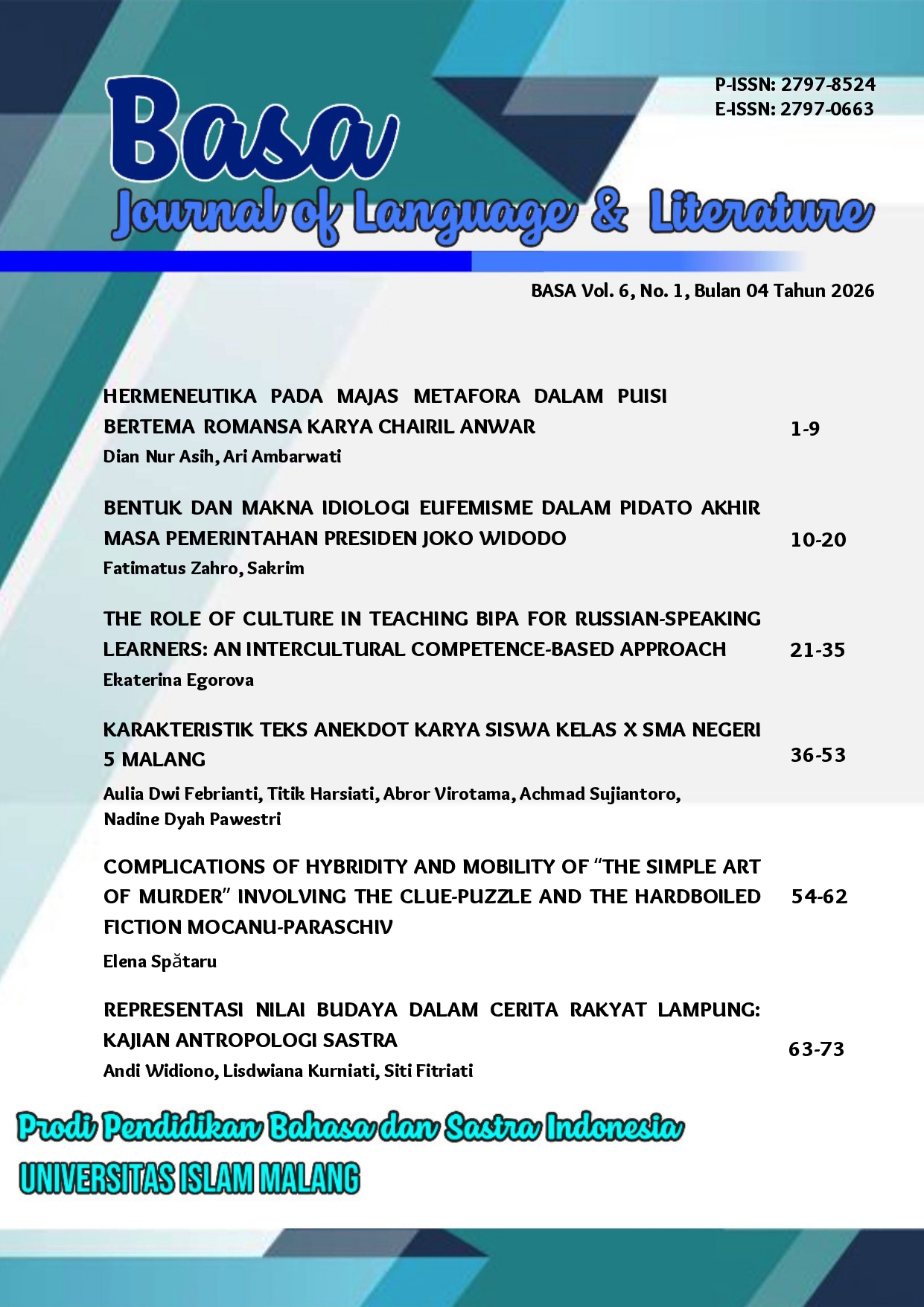
REPRESENTASI NILAI BUDAYA DALAM CERITA RAKYAT LAMPUNG: KAJIAN ANTROPOLOGI SASTRA
DOI:
https://doi.org/10.33474/basa.v6i1.25125Keywords:
Lampung folk tales, cultural values, cultural representation, literary anthropologyAbstract
Folktales, as part of the oral tradition, play an important role in transmitting cultural values within society. In the context of Lampung society, folktales not only serve as entertainment but also as a means of reflecting the outlook on life and the value system adopted by the community. This study aims to examine and describe the representation of cultural values in Lampung folktales using a literary anthropology approach. This study uses a qualitative descriptive method. Data collection was carried out through literature studies and text analysis of several relevant Lampung folktales. The data consisted of quotations containing cultural values, which were then analyzed through the stages of identification, grouping, and interpretation. The results of the study indicate that Lampung folktales contain various cultural values, including religious, moral, social, and customary values that reflect the life of the Lampung people. These values are represented through story elements such as characters, events, conflicts, and cultural symbols. Therefore, Lampung folktales function not only as literary works but also as a medium for preserving and passing on cultural values to future generations. The novelty of this research lies in the analysis of the representation of cultural values associated with narrative structures and local symbols in an integrated manner, as well as the affirmation of the function of folklore as a cultural educational medium that is relevant in the context of modern society.
References
Arifin, M. (2020). Folklor dan Identitas Budaya Lokal. Jurnal Kajian Budaya, 12(2), 89–102.
Balai Bahasa Provinsi Lampung. (2017). Kumpulan Cerita Rakyat Lampung. Bandar Lampung: Kementerian Pendidikan dan Kebudayaan.
Bascom, W. R. (1965). The Forms of Folklore: Prose Narratives. Journal of American Folklore, 78(307), 3–20.
Danandjaja, J. (2007). Folklor Indonesia: Ilmu Gosip, Dongeng, dan Lain-Lain. Jakarta: Pustaka Utama Grafiti.
Dundes, A. (1980). Interpreting Folklore. Bloomington: Indiana University Press.
Durkheim, Émile. (2014). The Division of Labor in Society. New York: Free Press.
Eagleton, T. (2008). Literary Theory: An Introduction. Oxford: Blackwell Publishing.
Endraswara, S. (2013). Metodologi Penelitian Sastra. Yogyakarta: CAPS.
Faruk. (2012). Metode Penelitian Sastra. Yogyakarta: Pustaka Pelajar.
Finnegan, R. (2012). Oral Literature in Africa. Cambridge: Open Book Publishers.
Geertz, C. (2017). The Interpretation of Cultures. New York: Basic Books.
Hadikusuma, Hilman. (2014). Pengantar Ilmu Hukum Adat Indonesia. Bandung: Mandar Maju.
Hall, S. (1997). Representation: Cultural Representations and Signifying Practices. London: Sage Publications.
Herlina, E. (2021). Sastra Lisan dan Identitas Budaya Lokal. Jurnal Bahasa dan Budaya, 13(1), 66–78.
Hidayat, T. (2022). Kearifan Lokal dalam Cerita Rakyat Nusantara. Jurnal Humaniora, 14(2), 98–110.
Kluckhohn, C. (1951). Values and Value Orientations in the Theory of Action. Cambridge: Harvard University Press.
Koentjaraningrat. (2009). Pengantar Ilmu Antropologi. Jakarta: Rineka Cipta.
Lickona, Thomas. (2012). Educating for Character: How Our Schools Can Teach Respect and Responsibility. New York: Bantam Books.
Moleong, L. J. (2017). Metodologi Penelitian Kualitatif. Bandung: Remaja Rosdakarya.
Nugroho, B. (2022). Nilai Moral dalam Sastra Lisan Nusantara. Jurnal Kajian Sastra, 11(2), 101–115.
Nurgiyantoro, B. (2015). Teori Pengkajian Fiksi. Yogyakarta: Gadjah Mada University Press.
Pranoto, D. (2020). Fungsi Folklor dalam Kehidupan Masyarakat. Jurnal Antropologi Indonesia, 41(1), 50–62.
Prasetyo, A. (2021). Representasi Nilai Moral dalam Cerita Rakyat Indonesia. Jurnal Bahasa dan Sastra, 15(1), 45–56.
Putri, R. (2021). Representasi Nilai Sosial dalam Cerita Rakyat Daerah. Jurnal Sastra Nusantara, 10(1), 55–67.
Rahmawati, D. (2019). Cerita Rakyat sebagai Media Pendidikan Karakter. Jurnal Pendidikan Bahasa, 8(1), 65–74.
Ratna, N. K. (2011). Antropologi Sastra: Peranan Unsur-unsur Kebudayaan dalam Proses Kreatif. Yogyakarta: Pustaka Pelajar.
Ratna, N. K. (2019). Teori, Metode, dan Teknik Penelitian Sastra. Yogyakarta: Pustaka Pelajar.
Saputra, H. (2020). Analisis Antropologi Sastra dalam Cerita Rakyat Indonesia. Jurnal Bahasa dan Seni, 48(1), 77–88.
Sari, N. (2020). Nilai Budaya dalam Cerita Rakyat Nusantara: Kajian Antropologi Sastra. Jurnal Pendidikan Bahasa dan Sastra Indonesia, 9(2), 120–130.
Sugiyono. (2019). Metode Penelitian Kualitatif, Kuantitatif, dan R&D. Bandung: Alfabeta.
Sutrisno, A. (2022). Kajian Nilai Budaya dalam Sastra Daerah. Jurnal Ilmu Sastra, 10(1), 73–85.
Utami, L. (2019). Representasi Budaya dalam Cerita Rakyat Daerah. Jurnal Sastra Indonesia, 8(2), 89–97.
Vansina, J. (1985). Oral Tradition as History. Madison: University of Wisconsin Press.
Wibowo, A. (2021). Cerita Rakyat sebagai Media Pelestarian Budaya. Jurnal Pendidikan dan Kebudayaan, 6(2), 140–150.
Yuliana, S. (2019). Tradisi Lisan sebagai Warisan Budaya. Jurnal Ilmu Budaya, 7(1), 33–44.
Downloads
Published
Issue
Section
License
Copyright (c) 2026 Andi Widiono, Lisdwiana Kurniati, Siti Fitriati

This work is licensed under a Creative Commons Attribution-ShareAlike 4.0 International License.