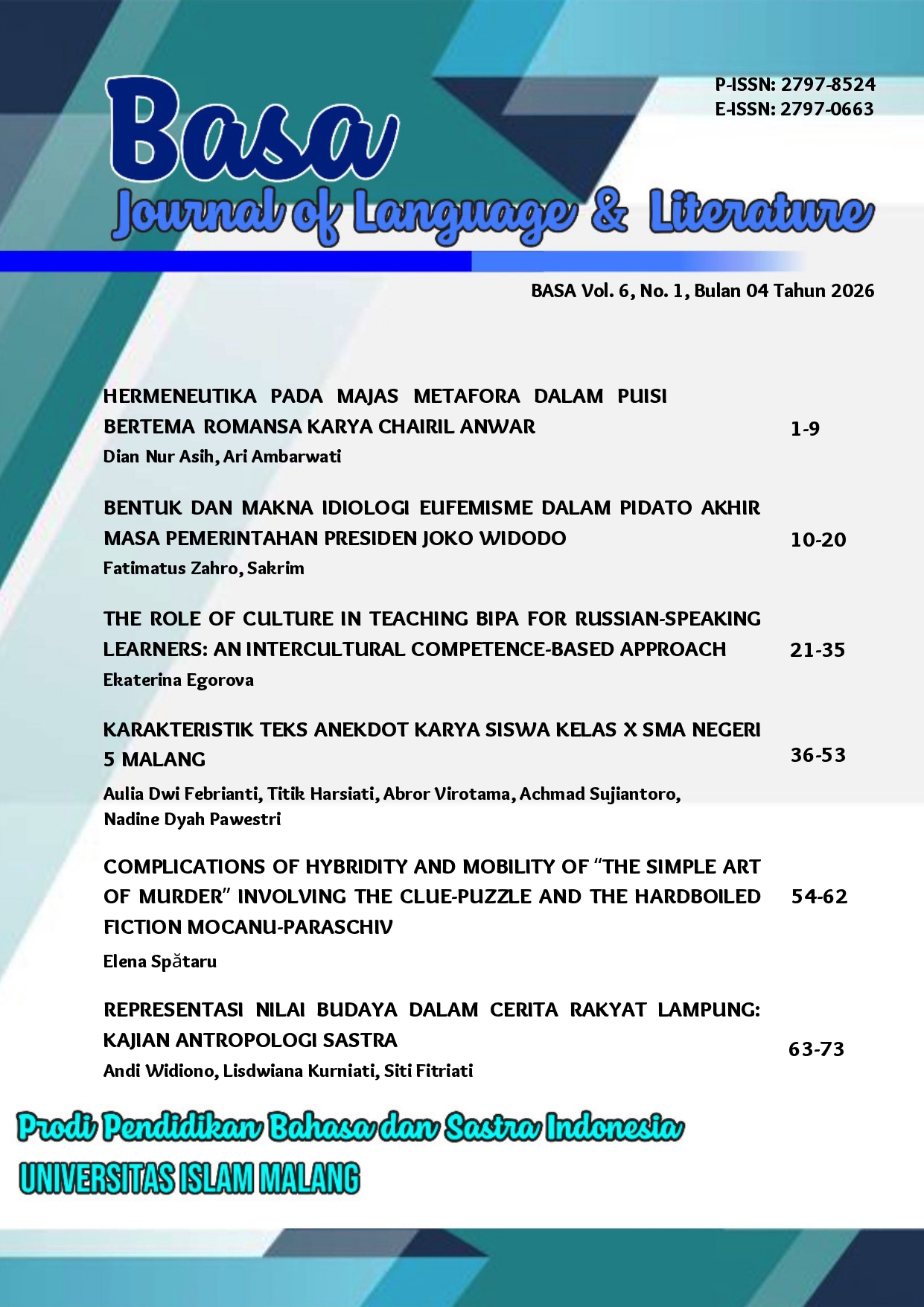
COMPLICATIONS OF HYBRIDITY AND MOBILITY OF “THE SIMPLE ART OF MURDER” INVOLVING THE CLUE-PUZZLE AND THE HARDBOILED FICTION
DOI:
https://doi.org/10.33474/basa.v6i1.25167Keywords:
crime fiction, clue-puzzle, hardboiled, hybridity, mobility.Abstract
This study examines the distinctions and intersections between clue-puzzle fiction by Agatha Christie and hardboiled narratives by Raymond Chandler within the context of genre hybridity and mobility. Previous studies tend to separate these subgenres rigidly, leaving a gap in understanding their interrelation during the interwar period. This research employs a qualitative descriptive design using textual analysis of selected works, namely The Mysterious Affair at Styles and The Simple Art of Murder. Data were collected through close reading and thematic coding, then analyzed using discourse analysis, psychoanalytic criticism, and comparative genre analysis. The findings reveal that Christie emphasizes structured narratives, rational detectives, and social order, while Chandler presents fragmented storytelling, morally complex detectives, and systemic corruption. However, both demonstrate intersections through psychological depth and evolving genre forms. The study concludes that crime fiction is inherently dynamic, shaped by socio-cultural contexts, and capable of integrating diverse narrative strategies, thereby reinforcing its adaptability and enduring relevance.
References
Chandler, R. (1950). The simple art of murder.
Cobley, P. (2012). The reactionary art of murder: Contemporary crime fiction, criticism and verisimilitude. Language and Literature, 21(3), 286–298.
Dubber, M. D., & Hörnle, T. (2014). The Oxford handbook of criminal law. OUP Oxford.
Forshaw, B. (2007). The rough guide to crime fiction. Penguin.
Horsley, L. (2005). Twentieth-century crime fiction. OUP Oxford.
King, S., Rolls, A., Information, M., & Africa, S. (2020). The Cambridge companion to world crime fiction.
Knight, S. (1980). Form and ideology in crime fiction. Springer.
Knight, S. (2010). Crime fiction since 1800: detection, death, diversity. Bloomsbury Publishing.
Mather, M. R. (2020). Watching the Detectives. San Francisco State University.
Messent, P. (2012). The crime fiction handbook. John Wiley & Sons.
Morris, R. B. (1962). Class Struggle and the American Revolution. The William and Mary Quarterly: A Magazine of Early American History, 4–29.
Pepper, A. (2016). Unwilling Executioner: Crime fiction and the state. Oxford University Press.
Rahmawati, R., Mala, W., & Rohmana, I. (2023). PHSYCOANALYSIS LACAN IN HEROINE CHARACTERIZATION ON “ BLOODY CHAMBER ” BY ANGELA CARTER. 3(1), 46–50.
Vlad, E., & Vlad, F. A. (2016). Literary Selves and Grand Narratives in the First American Century. Institutul European.
Worthington, H. (2011). Key concepts in crime fiction. Bloomsbury Publishing.
Young, G. P., Symonds, E. L., Allison, J. E., Cole, S. R., Fraser, C. G., Halloran, S. P., Kuipers, E. J., & Seaman, H. E. (2015). Advances in Fecal Occult Blood Tests : The FIT Revolution. 609–622. https://doi.org/10.1007/s10620-014-3445-3
Downloads
Published
Issue
Section
License
Copyright (c) 2026 Elena Spătaru

This work is licensed under a Creative Commons Attribution-ShareAlike 4.0 International License.