Indonesian Gen Z's English slang: The use and effects on digital communication
DOI:
https://doi.org/10.33474/j-reall.v7i2.24528Keywords:
digital communication, English slang, Indonesian Gen Z, languageAbstract
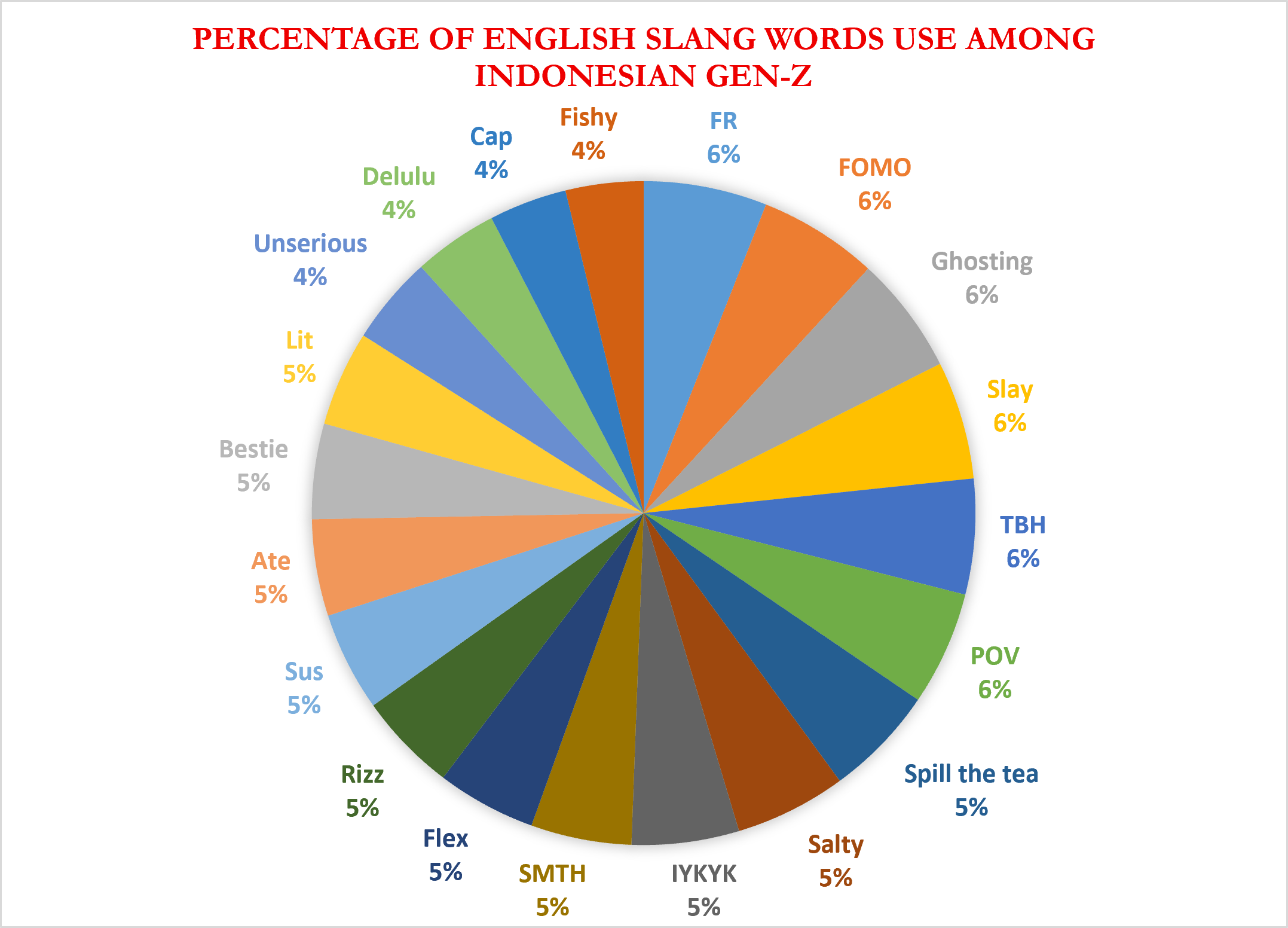
The rapid expansion of social media transformed communication, encouraging the emergence of slang as a creative, identity-driven linguistic practice among Generation Z (Gen Z). Previous studies extensively examined types, functions, and general impacts of slang, presenting contradictory conclusions, either its positive role or negative implications. These inconsistent findings make it difficult to understand the actual role of English slang in communication effectiveness. However, limited research examined how Indonesian Gen Z use English slang and how it affects communication effectiveness among Gen Z users with similar linguistic backgrounds and comparable English proficiency. Addressing this gap, the present study investigates the types of English slang used by Indonesian Gen Z majoring in English studies in communication and analyzes its effects on clarity and effectiveness. With a qualitative-descriptive approach, data were collected through questionnaires (N=65) and semi-structured interviews with selected participants (n=6). The collected slang was categorized using a slang taxonomy and analyzed in relation to perceived message clarity and effectiveness. The findings reveal four types of slang: fresh and creative, flippant, acronym, and clipping. Acronyms were reported as the most frequently used slang in communication. The interviews indicate participants perceive slang as having positive impacts on communication effectiveness, self-expression, vocabulary development, and strengthening solidarity. However, the use of slang causes misunderstandings for those unfamiliar with slang and may encourage its inappropriate use in formal contexts. Future research should involve more diverse participant groups and examine the long-term effects of English slang on language use and communication.
References
Allan, K., & Burridge, K. (2006). Forbidden words: Taboo and the censoring of language (1st ed.). Cambridge University Press. https://doi.org/10.1017/CBO9780511617881
Androutsopoulos, J. (2015). Networked multilingualism: Some language practices on Facebook and their implications. International Journal of Bilingualism, 19(2), 185–205. https://doi.org/10.1177/1367006913489198
Bandura, A. (1977). Social learning theory. Englewood Cliffs, N.J. : Prentice Hall
Bardi, Y., Namang, K. W., & Yefi, M. N. (2024). Pengaruh bahasa gaul pada kalangan remaja. Pragmatik : Jurnal Rumpun Ilmu Bahasa dan Pendidikan, 3(1), 136–145. https://doi.org/10.61132/pragmatik.v3i1.1257
Braun, V., & Clarke, V. (2006). Using thematic analysis in psychology. Qualitative Research in Psychology, 3(2), 77–101. https://doi.org/10.1191/1478088706qp063oa
Chai, J.-X., & Fan, K.-K. (2018). Constructing creativity: Social media and creative expression in design education. Eurasia Journal of Mathematics, Science and Technology Education, 14(1), 33–43. https://doi.org/10.12973/ejmste/79321
Craig, R. T. (1999). Communication theory as a field. Communication Theory, 9(2), 119-161. https://doi.org/10.1111/j.1468-2885.1999.tb00355.x
Creswell, J. W. (2014). Research design: Qualitative, quantitative, and mixed methods approaches. SAGE.
Eble, C. C. (1996). Slang & sociability: In-group language among college students. Univ of North Carolina Press.
Firmansyah, M. A. K., Zainuddin, M., & Lestari, I. W. (2024). The role of slang words in enhancing informal English communication skills. Innovations in Language Education and Literature, 1(2), 48–53. https://doi.org/10.31605/ilere.v1i2.3915
Hamida, H. (2019). Slang pada media sosial Instagram @awreceh.id. BAPALA: Jurnal Pendidikan Bahasa dan Sastra Indonesia, 6(1), 1-9. Retrieved from https://ejournal.unesa.ac.id/index.php/bapala/article/view/32931
Hapsari, H. R. (2025, May 6). Dominasi konten video pendek dalam aktivitas Gen-Z. https://yoursay.suara.com/kolom/2025/05/06/111808/dominasi-konten-video-pendek-dalam-aktivitas-digital-gen-z
Hutauruk, B. S., Agatha, A., Manurung, O. P., Sinaga, S. M., & Aryani, N. (2024). Slang language in social media X (Twitter). Journal of English Language Teaching, Literatures & Applied Linguistics (JELTLAL), 2(1), 11-19. https://doi.org/10.69820/jeltlal.v2i1.125
Indra, S. & Marhamah, M. (2024). An analysis of slang words used in social media Instagram. RETORIKA: Jurnal Ilmu Bahasa, 10(1), 347–352. Retrieved from https://www.ejournal.warmadewa.ac.id/index.php/jret/article/view/9710/5624
Jeresano, E. M., & Carretero, M. D. (2022). Digital culture and social media slang of Gen Z. United International Journal for Research & Technology (UIJRT), 3(4), 11-25. Retrieved from https://uijrt.com/articles/v3/i4/UIJRTV3I40002.pdf
Kandiawan, A. B. (2022). Code-switching and slang used by Gen Z Indonesians on social media. ELTR Journal, 7(1), 48–56. Retrieved from https://www.researchgate.net/publication/366683360_CODE-SWITCHING_AND_SLANG_USED_BY_GEN_Z_INDONESIANS_ON_SOCIAL_MEDIA
Khatimah, H., & Rohainy, N. A. (2024). Variasi bahasa slang dalam media sosial Instagram @Folkshitt. ISOLEK: Jurnal Pendidikan, Pengajaran, Bahasa, dan Sastra, 2(1), 226–236. https://doi.org/10.59638/isolek.v2i1.216
Lantto, H. (2014). Code-switching, swearing and slang: The colloquial register of Basque in Greater Bilbao. International Journal of Bilingualism, 18(6), 633–648. https://doi.org/10.1177/1367006912457274
Marzuki, M., Ahyar, J., & Azhari, T. (2025). Studi penggunaan bahasa slang pada platform media sosial Instagram. Dinamika Pembelajaran: Jurnal Pendidikan Dan Bahasa, 2(1), 73–97. https://doi.org/10.62383/dilan.v2i1.1094
Meilinda, N., Malinda, F., & Aisyah, S. M. (2020). Literasi digital pada remaja digital (Sosialisasi pemanfaatan media sosial bagi pelajar Sekolah Menengah Atas. Jurnal Abdimas Mandiri, 4(1), 62-69. https://doi.org/10.36982/jam.v4i1.1047
Murni, E., & Anjani, J. (2025). Speaking in hashtags: Slang, identity, and language change among generation Z on Instagram. Paradigma Lingua, 5(3), 91–110. Retrieved from https://openjournal.unpam.ac.id/index.php/Paradigma/article/view/47531
Nuraeni, F. W., & Pahamzah, J. (2021). An analysis of slang language used in teenager interaction. LITERA, 20(2), 313-322. https://doi.org/10.21831/ltr.v20i2.37058
Paino, N. P., Lubis, M. J., & Hutagalung, M. (2024). The influence of slang on the decline of language literacy in the young generation of Indonesia. International Journal of Language and Ubiquitous Learning, 2(4), 438–447. Retrieved from https://research.adra.ac.id/index.php/ijlul/article/view/1460
Rafiqoh, A. (2023). The effect of using slang among students towards the Indonesian language. Al’adzkiya International of Education and Social (AIoEs) Journal, 4(2), 38–41. Retrieved from https://aladzkiyajournal.com/index.php/AIoES/article/view/201/pdf
Rahma, N., & Moetia, M. (2024). An analysis of using slang word in social media X. Syntax Idea, 6(8), 3562–3570. https://doi.org/10.46799/syntax-idea.v6i8.4307
Rosyadi, Z. D., Andri, W., Purnamawati, N., Galuh, D. A., Aksendro, M., & Hejash, M. (2023). Slang as a medium of communication for adolescents in social interaction between others. JETA (Journal of English Teaching and Applied Linguistic, 4(1), 1–14. https://doi.org/10.52217/jeta.v4i1.1141
Siagian, A. D. R., Sinaga, N. T., & Lestari, F. D. (2024). An analysis of using slang language of gen Z based on TikTok videos: Sociolinguistics approach. J-Shelves of Indragiri (JSI), 6(1), 86–107. https://doi.org/10.61672/jsi.v6i1.2745
Stahl, C. C., & Literat, I. (2023). #GenZ on TikTok: The collective online self-portrait of the social media generation. Journal of Youth Studies, 26(7), 925–946. https://doi.org/10.1080/13676261.2022.2053671
Suler, J. (2004). The online disinhibition effect. Cyberpsychology & Behavior, 7(3), 321-326. https://doi.org/10.1089/1094931041291295
Syafa’ah, L. A., & Haryanto, S. (2024). Slang semantic analysis on TikTok social media generation Z. Proceeding ISETH (International Summit on Science, Technology, and Humanity), 476-484. https://doi.org/10.23917/iseth.3898
Tufail, S., Asgher, M., & Ali, D. I. (2024). Deciphering the digital vernacular: A study of generation Z slang on social media platforms. Pakistan Languages and Humanities Review, 8(2), 835–847. Retrieved from https://ojs.plhr.org.pk/journal/article/view/1004/885
Walther, J. B. (1996). Computer-mediated communication: Impersonal, interpersonal, and hyperpersonal interaction. Communication Research, 23(1), 3–43. https://doi.org/10.1177/009365096023001001
Wardhaugh, R., & Fuller, J. M. (2021). An introduction to sociolinguistics. John Wiley & Sons, Inc.
Wijayanti, S. H., & Sihotang, K. (2021). How Indonesian millennial generations communicate on social media. Review of International Geographical Education Online (RIGEO), 11(8). https://doi.org/https://rigeo.org/menu-script/index.php/rigeo/article/view/2213
Xursanovna, U. (2025). The widespread use of slang and abbreviations among youth on social media. CONVERSE Journal Communication Science, 1(3), 1-5. https://doi.org/10.47134/converse.v1i3.3674
Yusuf, Y. Q., Fata, I. A., & Aini, R. (2023). Gotchuu!”: The use of slang in social media by generation Z. LiNGUA: Jurnal Ilmu Bahasa Dan Sastra, 17(2), 167–174. https://doi.org/10.18860/ling.v17i2.17756
Downloads
Published
How to Cite
Issue
Section
License
Copyright (c) 2026 Elly Nurhaliza Putri, Nanang Zubaidi, Yusnita Febrianti, Alma Huwaida Ramadhani, Sibakhul Milad Malik Hidayatulloh

This work is licensed under a Creative Commons Attribution 4.0 International License.
Authors who publish this journal agree to the following terms:
- Authors retain copyright and grant the journal right of first publication with the work simultaneously licensed under a Creative Commons Attribution License that allows others to share the work with an acknowledgement of the work's authorship and initial publication in this journal.
- Authors can separately make additional contractual arrangements for non-exclusive distribution published by the journal (e.g., publish it in a book), with an acknowledgement of its initial publication in this journal.
- Authors are allowed and encouraged to send their work via online (e.g., in the institutional repositories or their website) after published by the journal.