Integration of green tourism values into the English for hospitality curriculum for tour guides
DOI:
https://doi.org/10.33474/j-reall.v7i2.24756Keywords:
English for hospitality, curriculum development, green tourism, nonformal education, tour guidesAbstract
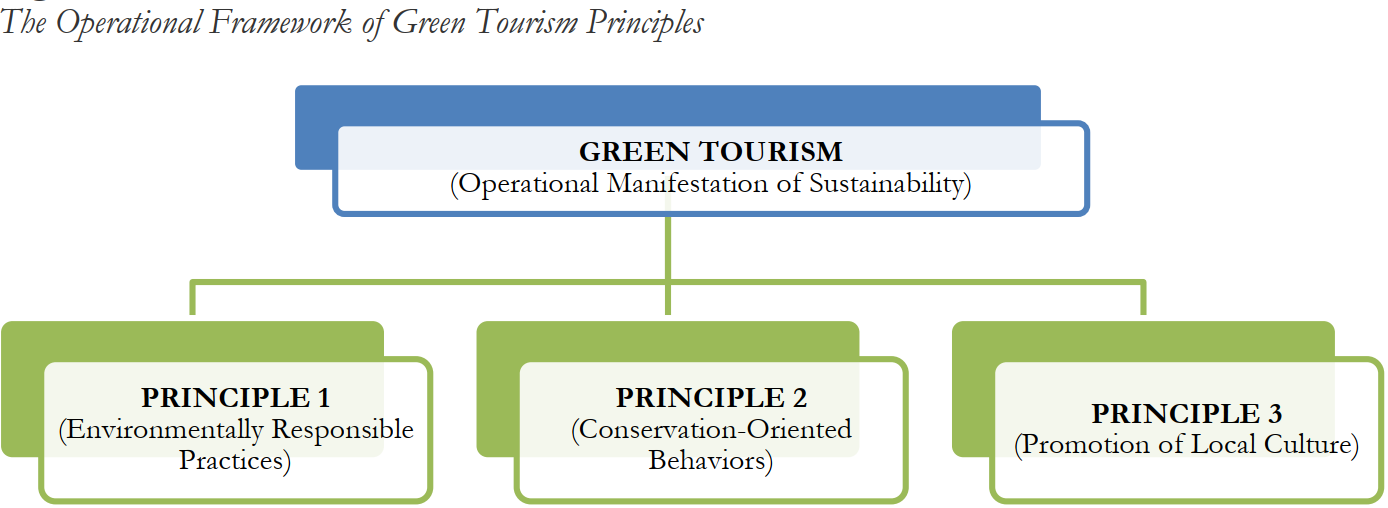
The growing demand for sustainable tourism requires tour guides to possess both effective English for hospitality skills and an understanding of green tourism principles. However, English for hospitality training in non-formal education has primarily focused on language competence with limited integration of sustainability values. This study aimed to develop and validate an English for hospitality curriculum that systematically incorporates green tourism principles for tour guides. The research employed a research and development (R&D) approach based on the 4D model. Data were collected through expert validation sheets, questionnaires, observations, and performance assessments involving tour guides and trainers. Quantitative data were analyzed using descriptive statistics, while qualitative data supported the interpretation of findings. The results showed that the developed curriculum was feasible and effective. Expert validation yielded a feasibility score of 89.6%, while 86.2% of participants reported that the learning activities were engaging and relevant to their professional needs. The curriculum also improved participants’ hospitality communication skills and their application of green tourism values, with mean performance scores increasing from 72.4 before implementation to 84.7 after implementation. This study contributes a curriculum model that integrates language training with sustainability competencies in the tourism sector. Although limited by a small sample and short implementation period, the validated curriculum offers a practical framework for policymakers and tourism institutions to develop environmentally responsible tour guides and promote sustainable tourism practices in local communities.
References
Ap, J., & Wong, K. K. F. (2001). Case study on tour guiding: Professionalism, issues and problems. Tourism Management, 22(5), 551-563. https://doi.org/10.1016/S0261-5177(01)00013-9
Bahtiar, I. R., Jubaidah, S., Sarip, M., & Failasuf, C. (2024). Microlearning-based tourism Arabic teaching material model for tourism awareness groups in tourism villages. KnE Social Sciences, 9(9), 78-92. https://doi.org/10.18502/kss.v9i9.15659
Bandura, A. (1986). Social foundations of thought and action: A social cognitive theory. Prentice-Hall.
Basturkmen, H. (2010). Developing courses in English for specific purposes. Palgrave Macmillan.
Beard, C., & Wilson, J. P. (2018). Experiential learning: A handbook for education, training and coaching (4th ed.). Kogan Page.
Bellato, L., Frantzeskaki, N., & Nygaard, C. A. (2022). Regenerative tourism: A conceptual framework leveraging theory and practice. Tourism Geographies, 25(4), 1026-1046. https://doi.org/10.1080/14616688.2022.2044376
Blue, G. M., & Harun, M. (2003). Hospitality language as a professional skill. English for Specific Purposes, 22(1), 73-91. https://doi.org/10.1016/S0889-4906(01)00031-X
Borg, W. R., & Gall, M. D. (1983). Educational research: An introduction (4th ed.). Longman.
Bramwell, B., & Lane, B. (2011). Critical research on the governance of tourism and sustainability. Journal of Sustainable Tourism, 19(4-5), 411-421. https://doi.org/10.1080/09669582.2011.580586
Braun, V., & Clarke, V. (2006). Using thematic analysis in psychology. Qualitative Research in Psychology, 3(2), 77–101. https://doi.org/10.1191/1478088706qp063oa
Buckley, R. (2012). Sustainable tourism: Research and reality. Annals of Tourism Research, 39(2), 528-546. https://doi.org/10.1016/j.annals.2012.02.003
Bybee, R. W. (2013). The BSCS 5E instructional model: Creating teachable moments. NSTA Press.
Chen, C. F., & Chen, F. S. (2010). Experience quality, perceived value, satisfaction and behavioral intentions for heritage tourists. Tourism Management, 31(1), 29-35. https://doi.org/10.1016/j.tourman.2009.02.008
Dodds, R., & Butler, R. (2019). Overtourism: Issues, realities and solutions. De Gruyter.
Drake, S. M., & Reid, J. L. (2020). Integrated curriculum as an effective way to teach 21st century capabilities. Asia Society.
Dudley-Evans, T., & St. John, M. J. (1998). Developments in English for specific purposes: A multi-disciplinary approach. Cambridge University Press.
Ellis, R. (2003). Task-based language learning and teaching. Oxford University Press.
Filho, W. L., Shiel, C., & Paço, A. (2019). Implementing and operationalising integrative approaches to sustainability in higher education. Journal of Cleaner Production, 212, 913-920. https://doi.org/10.1016/j.jclepro.2016.05.079
Galloway, N. (2018). Global Englishes and change in English language teaching. Routledge.
Gay, L. R., Mills, G. E., & Airasian, P. (2012). Educational research: Competencies for analysis and applications (10th ed.). Pearson.
Gössling, S., Peeters, P., Scott, D., Ceron, J. P., Dubois, G., Patterson, T., & Richardson, R. B. (2005). The eco-efficiency of tourism. Ecological Economics, 54(4), 417-434. https://doi.org/10.1016/j.ecolecon.2004.10.006
Hake, R. R. (1999). Analyzing change/gain scores. Unpublished manuscript. Indiana University.
Hall, C. M., Gössling, S., & Scott, D. (2015). The Routledge handbook of tourism and sustainability. Routledge.
Hamer, W., Evenddy, S., Prabowo, J., Rima, R., & Utomo, D.W. (2017). Involving local wisdom as values to develop English for tourism course material: A case of Baduy tribe in Lebak Banten. The Journal of English Language Studies, 2(1), 92-107. http://dx.doi.org/10.30870/jels.v2i1.1597
Hampton, M. P., & Jeyacheya, J. (2015). Power, ownership and tourism in small islands: Evidence from Indonesia. World Development, 90, 23-35. https://doi.org/10.1016/j.worlddev.2014.12.007
Huang, S., Weiler, B., & Assaker, G. (2015). Effects of interpretive guiding outcomes on tourist satisfaction and behavioral intention. Journal of Travel Research, 54(3), 344-358. https://doi.org/10.1177/0047287513517426
Hutchinson, T., & Waters, A. (1987). English for specific purposes: A learning-centred approach. Cambridge University Press.
Hyland, K. (2006). English for academic purposes: An advanced resource book. Routledge.
Knowles, M. S., Holton, E. F., & Swanson, R. A. (2015). The adult learner: The definitive classic in adult education and human resource development (8th ed.). Routledge.
Kolb, D. A. (2015). Experiential learning: Experience as the source of learning and development (2nd ed.). Pearson Education.
Long, M. (2015). Second language acquisition and task-based language teaching. Wiley Blackwell.
Lozano, R., Merrill, M. Y., Sammalisto, K., Ceulemans, K., & Lozano, F. J. (2017). Connecting competences and pedagogical approaches for sustainable development in higher education. Journal of Cleaner Production, 172, 316–328. Retrieved from https://ideas.repec.org/a/gam/jsusta/v9y2017i10p1889-d115748.html
Makrifah, I. A., & Saifudin, A. (2026). Tourism-based English tourism teaching materials to improve students’ literacy and tourist visits. Journal of Education Research and Evaluation, 10(1), 1–10. https://doi.org/10.23887/jere.v10i1.104538
Merriam, S. B., & Bierema, L. L. (2014). Adult learning: Linking theory and practice. Jossey-Bass.
Mertha, I. W., Yunita, P. I., & Tirtawati, N. M. (2025). Creating quality tourism destinations: The crucial role of community participation and government support. E-Journal of Tourism, 12(2), 178–197. https://doi.org/10.24922/eot.v12i2.2173
Milano, C., Novelli, M., & Cheer, J. M. (2019). Overtourism and tourismphobia: A journey through four decades of tourism development, planning and local concerns. Tourism Planning & Development, 16(4), 353-357. https://doi.org/10.1080/21568316.2019.1599604
Morita, M., Fahsani, D. H., & Mulyana, M. (2026). English communication competence of nature tourism guides in Indonesia: Challenges, needs, and development strategies. Jurnal Ilmiah Pariwisata Kesatuan, 7(2), 91–108. https://doi.org/10.37641/jipkes.v7i2.5555
Moscardo, G. (2015). Tourism and community leadership in rural regions: Linking mobility, entrepreneurship, tourism development and community well-being. Tourism Planning & Development, 12(4), 354–368. https://doi.org/10.1080/21568316.2014.890129
Nation, I. S. P., & Macalister, J. (2010). Language curriculum design. Routledge.
Oktadiana, H., Pearce, P. L., & Chon, K. (2016). Muslim travellers' needs: What don't we know? Tourism Management Perspectives, 20, 124-130. https://doi.org/10.1016/j.tmp.2016.08.004
Putra, I. N. D., & Hitchcock, M. (2016). The Bali bombs and the tourism development cycle. Progress in Development Studies, 6(2), 157-166. https://doi.org/10.1191/1464993406ps134oa
Putri, B. P., & Susanto, E. (2026). Domestic tourist travel patterns in greater Bandung area: A geography and human mobility-based analysis. Journal of Event, Travel and Tour Management, 58-84. https://doi.org/10.34013/jett.v6i1.2297
Richards, J. C. (2017). Curriculum development in language teaching (2nd ed.). Cambridge University Press.
Saarinen, J., Rogerson, C. M., & Hall, C. M. (2017). Geographies of tourism development and planning. Tourism Geographies, 19(3), 307-317. https://doi.org/10.1080/14616688.2017.1307442
Seraphin, H., Sheeran, P., & Pilato, M. (2018). Over-tourism and the fall of Venice as a destination. Journal of Destination Marketing & Management, 9, 374-376. https://doi.org/10.1016/j.jdmm.2018.01.011
Sida, A. (2025). Eksplorasi kontekstual wisata lokal sebagai bahan ajar English for tourism. Jurnal Ilmiah IPS Dan Humaniora (JIIH), 3(1), 1–6. Retrieved from https://jurnalcendekia.id/index.php/jiih/article/view/615
Sterling, S. (2010). Transformative learning and sustainability: sketching the conceptual ground (2011). In Learning and Sustainability in Dangerous Times: The Stephen Sterling Reader (pp. 149–162). Chapter, Agenda Publishing.
Suparlan, S., & Rizal , S. (2025). Developing English for sustainable tourism: A needs analysis of eco-tourism practitioners. Journal of Advance in Language, Literature, and Education, 1(1), 17-21. Retrieved from https://ejournal.dwipantara.org/index.php/joalle/article/view/6
Thiagarajan, S., Semmel, D. S., & Semmel, M. I. (1974). Instructional development for training teachers of exceptional children: A sourcebook. Indiana University.
UNESCO. (2020). Education for sustainable development: A roadmap. UNESCO Publishing.
UNWTO. (2018). Tourism highlights: 2018 edition. World Tourism Organization.
Vygotsky, L. S. (1978). Mind in society: The development of higher psychological processes. Harvard University Press.
Walker, K., & Moscardo, G. (2014). Encouraging sustainability beyond the tourist experience: Tour guide effectiveness. Journal of Sustainable Tourism, 22(8), 1175-1196. https://doi.org/10.1080/09669582.2014.918134
Wals, A. E. J., & Benavot, A. (2017). Can we meet the sustainability challenges? The role of education and lifelong learning. European Journal of Education, 52(4), 404-413. https://doi.org/10.1111/ejed.12250
Weaver, D. B. (2011). Contemporary tourism heritage as sustainable practice. Routledge.
Weiler, B., & Kim, A. K. (2011). Tour guides as agents of sustainability: Rhetoric, reality and implications for research. Tourism Recreation Research, 36(2), 113-125. https://doi.org/10.1080/02508281.2011.11081313
Wiek, A., Withycombe, L., & Redman, C. L. (2011). Key competencies in sustainability: A reference framework for academic program development. Sustainability Science, 6(2), 203–218. https://doi.org/10.1007/s11625-011-0132-6
Yakman, G, (2008). STEAM education: An overview of creating a model of integrative education. Pupils Attitudes towards Technology 2008 Annual Proceedings. Netherlands.
Downloads
Published
How to Cite
Issue
Section
License
Copyright (c) 2026 Yunita Miftahul Jannah, Kristining Seva, Mohamad Hakimi bin Mohammad Haidzir, Asnita Sirait, Antonius Edy Haryanto, Frisca Ayu Desi Widyaningrum, Julian Hia

This work is licensed under a Creative Commons Attribution 4.0 International License.
Authors who publish this journal agree to the following terms:
- Authors retain copyright and grant the journal right of first publication with the work simultaneously licensed under a Creative Commons Attribution License that allows others to share the work with an acknowledgement of the work's authorship and initial publication in this journal.
- Authors can separately make additional contractual arrangements for non-exclusive distribution published by the journal (e.g., publish it in a book), with an acknowledgement of its initial publication in this journal.
- Authors are allowed and encouraged to send their work via online (e.g., in the institutional repositories or their website) after published by the journal.