Socio-culturally responsive differentiated instruction in EFL classrooms: The mediating role of UDL in enhancing students’ higher-order thinking skills
DOI:
https://doi.org/10.33474/j-reall.v7i2.25297Keywords:
differentiated instruction, EFL classroom, higher-order thinking skills, socio-cultural learning, universal design for learningAbstract
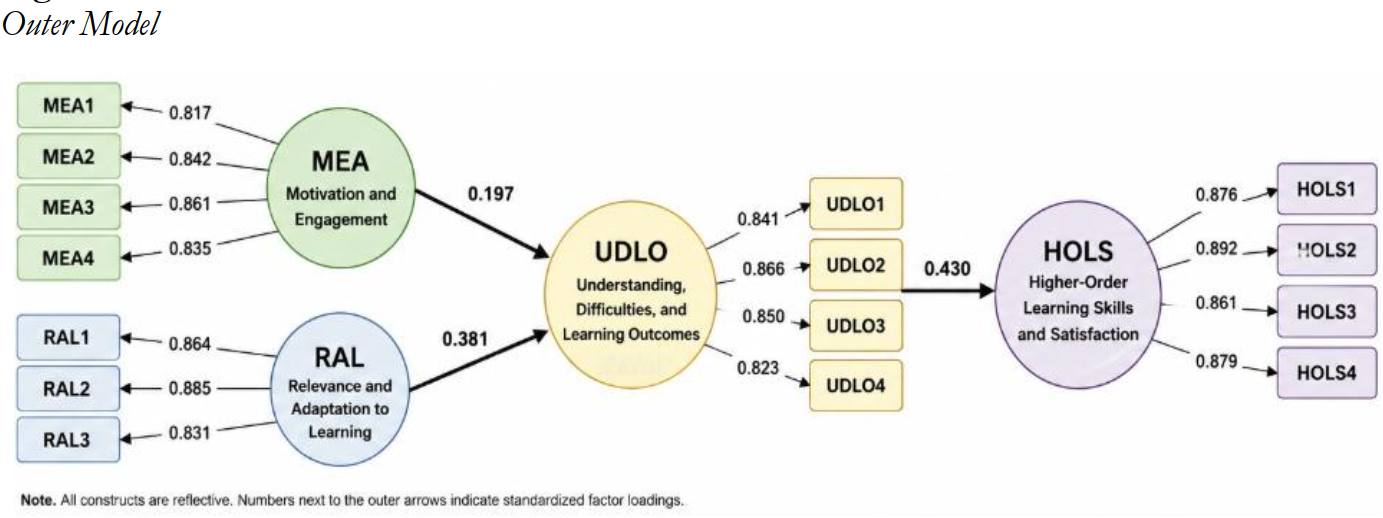
This study investigates the effectiveness and underlying mechanisms of socio-culturally responsive differentiated instruction in English as a foreign language (EFL) classrooms within the Merdeka Belajar curriculum. Although differentiated instruction has been widely adopted, its integration with students’ socio-cultural backgrounds and its contribution to higher-order thinking skills remain underexplored. This study integrates differentiated instruction, socio-cultural learning theory, and universal design for learning (UDL) within a quantitative explanatory design. Data were obtained from junior secondary students through academic records (n = 239) and survey responses (n = 184) and analyzed using the Wilcoxon Signed-Rank Test and partial least squares structural equation modeling (PLS-SEM). The findings show a significant improvement in students’ academic achievement following the implementation of socio-culturally responsive differentiated instruction (p < .001, r = .86). Motivation and engagement, and the relevance and contextual adaptation of learning significantly enhanced students’ understanding, which subsequently supported higher-order learning skills and learning satisfaction. Understanding and learning outcomes also mediated the relationships between the instructional predictors and higher-order outcomes. The findings suggest that meaningful EFL learning can be strengthened when differentiated instruction is responsive to learners’ socio-cultural contexts and supported by flexible and accessible learning pathways. The study contributes an integrated model for inclusive, context-sensitive, and cognitively enriching EFL practice, while acknowledging the need for validation across broader and more diverse settings.
References
Agra, G., Formiga, N. S., de Oliveira, P. S., Costa, M. M. L., Fernandes, M. G. M., & da Nobrega, M. M. L. (2019). Analysis of the concept of meaningful learning in light of the Ausubel’s theory. Rev Bras Enferm [Internet], 72(1), 248–255. https://doi.org/10.1590/0034-7167-2017-0691
Alim, H. S., Baglieri, S., Ladson-Billings, G., Paris, D., Rose, D. H., & Valente, J. M. (2017). Responding to “Cross-pollinating culturally sustaining pedagogy and universal design for learning: Toward an inclusive pedagogy that accounts for dis/ability. A Journal of Harvard Education Publishing Group, 87(1), 4–25. https://doi.org/https://doi.org/10.17763/1943-5045-87.1.4
Almeqdad, Q. I., Alodat, A. M., Alquraan, M. F., Mohammad, A., & Al-makhzoomy, A. K. (2023). The effectiveness of universal design for learning: A systematic review of the literature and meta-analysis. Cogent Education, 10(1). https://doi.org/10.1080/2331186X.2023.2218191
Anderson, L. W., & Krathwohl, D. R. (2001). A taxonomy for learning, teaching, and assessing: A revision of Bloom’s taxonomy of educational objectives: complete edition. In Livre (Vol. 8, p. 1990). http://eduq.info/xmlui/handle/11515/18824
Arranz-Sánchez, A., & Espada-Chavarría, R. (2025). Teachers’ attitudes and perceived barriers to inclusive education in Spain. Systematic review. Revista Românească Pentru Educaţie Multidimensională, 17(3), 754–785. https://doi.org/10.18662/rrem/17.3/1042
Baharum, H., Ismail, A., Awang, Z., McKenna, L., & Ibrahim, R. (2023). Validating an instrument for measuring newly graduated nurses’ adaptation. International Journal of Environmental Research and Publich Health, 20(4), 2860. https://www.mdpi.com/1660-4601/20/4/2860
Bi, X. (2025). Fostering inclusive learning environments through culturally responsive pedagogy for international students in U.S. higher education. Journal of International Students, 15(6), 21–38. https://doi.org/https://doi.org/10.32674/bd7brj48
Bucheli, M. G. V., Galan-Gómez, J., Mesa, M. L. C., & Catalan, L. L. (2024). Digital technologies as enablers of universal design for learning: Higher education students’ perceptions in the context of SDG4. Discover Sustainability, 5(473). https://doi.org/10.1007/s43621-024-00699-0
Caingcoy, M. (2023). Culturally responsive pedagogy: A systematic overview. Diversitas Journal, 8(4), 3203–3212. https://doi.org/10.48017/dj.v8i4.2780
Capp, M. J. (2017). The effectiveness of universal design for learning: A meta-analysis of literature between 2013 and 2016. International Journal of Inclusive Education, 21(8), 791–807. https://doi.org/10.1080/13603116.2017.1325074
Cast, T. P., Boesch, D. J., Smyth, K., Shaw, A. E., & Ghebrial, M. (2021). An autism-associated mutation impairs neuroligin-4 glycosylation and enhances excitatory synaptic transmission in human neurons. The Journal of Neuroscience, 41(3), 392–407. https://doi.org/10.1523/JNEUROSCI.0404-20.2020
Chen, C., Zhu, Y., Xiao, F., Que, M., & Chen, C. (2023). Academic motivation and social support: Mediating and moderating the life satisfaction and learning burnout link. Psychology Research and Behavior Management, 16, 4583–4598. https://doi.org/10.2147/PRBM.S438396
Cheung, G. W., Cooper, H. D., Rebecca, T., & Wang, L. C. (2024). Reporting reliability, convergent and discriminant validity with structural equation modeling: A review and best-practice recommendations. Asia Pacific Journal of Management, 41(2), 745-783. https://doi.org/10.1007/s10490-023-09871-y
Darling-Hammond, L., Oakes, J., Wojcikiewicz, S. K., Hyler, M. E., Guha, R., Podolsky, A., Kini, T., Cook-Harvey, C. M., Mercer, C. N. J., & Harrell, A. (2019). Preparing teachers for deeper learning. Learning Policy Institute, June, 1–12. https://learningpolicyinstitute.org/product/preparing-teachers-deeper-learning-brief
Dayton, A., Aceves-Azuara, I., & Rogoff, B. (2022). Collaboration at a microscale: Cultural differences in family interactions. The British Psychological Society, November, 1–25. https://doi.org/10.1111/bjdp.12398
dos Santos, P. M., & Cirillo, M. Â. (2021). Construction of the average variance extracted index for construct validation in structural equation models with adaptive regressions. Communications in Statistics-Simulation and Computation, 52(4), 1639–1650. https://doi.org/10.1080/03610918.2021.1888122
Dzin, M. H. N. & Lay, Y. F. (2021). Validity and reliability of adapted self-efficacy scales in Malaysian context using PLS-SEM approach. Education Sciences, 11, 676. https:// doi.org/10.3390/educsci11110676
Elfeky, A. I. M. (2019). The effect of personal learning environments on participants’ higher order thinking skills and satisfaction participants’ higher order thinking skills and satisfaction. Innovations in Education and Teaching International, 56(4), 505–516. https://doi.org/10.1080/14703297.2018.1534601
Elim, E. H. S. Y. (2026). Promoting cognitive skills in AI-supported learning environments: The integration of Bloom’s taxonomy. Education 3-13, 54(3), 612–622. https://doi.org/10.1080/03004279.2024.2332469
Engman, M. M., & Hermes, M. (2021). Land as interlocutor: A study of Ojibwe learner language in interaction on and with naturally occurring 'materials’. The Modern Language Journal, 105: 86-105. https://doi.org/10.1111/modl.12685
Erdiana, N., & Panjaitan, S. (2023). How is HOTS integrated into the Indonesian high school English textbook ? Studies in English Language and Education, 10(1), 60–77. https://doi.org/10.24815/siele.v10i1.26052
Espada-Chavarria, R., Gonz, R. H., Luis, L., & Miriam, D. (2023). Universal design for learning and instruction: Effective strategies for inclusive higher education. Education Sciences, 13, 620. https://doi.org/10.3390/educsci13060620
Feraco, T., Resnati, D., Fregonese, D., Spoto, A., & Meneghetti, C. (2023). An integrated model of school students’ academic achievement and life satisfaction. Linking soft skills, extracurricular activities, self-regulated learning, motivation, and emotions. European Journal of Psychology of Education, 38, 109–130. https://doi.org/10.1007/s10212-022-00601-4
Fithri, P., Hasan, A., & Games, D. (2024). Validation studies a questionnaire developed to measure incubator business technology performance using PLS-SEM approach. Andalasian International Journal, 4(1). https://doi.org/10.25077/aijaset.v4i1.132
Fitri, H. S. A., Agustin, E. P., Chuchai, S., Joronavalona, R., & Ali, S. (2025). Trends in culturally responsive teaching for science education: A bibliometric analysis. Journal of Technological Pedagogy and Educational Development, 1(2), 36–52. Retrieved from https://ejournal.jtped.org/ojs/index.php/jtped/article/view/13
Gay, G. (2002). Preparing for culturally responsive teaching. Journal of Teacher Education, 53(2), 106-116. https://doi.org/10.1177/0022487102053002003
Ginting, D. (2021). Student engagement and factors affecting active learning in English language teaching. Voices of English Language Education Society, 5(2), 215–228. https://doi.org/10.29408/veles.v5i2.3968
Griful-Freixenet, J., Struyven, K., & Vantieghem, W. (2021). Toward more inclusive education: An empirical test of the universal design for learning conceptual model among preservice teachers. Journal of Teacher Education, 72(3), 1–15. https://doi.org/10.1177/0022487120965525
Griful-Freixenet, J., Struyven, K., Vantieghem, W., & Gheyssens, E. (2020). Exploring the interrelationship between universal design for learning (UDL) and differentiated instruction (DI): A systematic review. Educational Research Review, 100306. https://doi.org/10.1016/j.edurev.2019.100306
Hair, J. F., Babin, B. J., Ringle, C. M., Sarstedt, M., & Becker, J. M. (2025). Covariance‑based structural equation modeling (CB‑SEM): A SmartPLS 4 software tutorial. Journal of Marketing Analytics, 13(3), 709–724. https://doi.org/10.1057/s41270-025-00414-6
Haji-Othman, Y. & Yusuff, M. S. S. (2022). Assessing Reliability and Validity of Attitude Construct Using Partial Least Squares Structural Equation Modeling Assessing Reliability and Validity of Attitude Construct Using Partial Least Squares Structural Equation Modeling ( PLS-SEM ). International Journal of Academic Research in Business and Social Sciences, 12(5), 378–385. https://doi.org/10.6007/IJARBSS/v12-i5/13289
Hien, N. T., Anh, D. D., Le, N. H., Yen, N. T., Phong, T. V, Nam, V. S., Duong, T. N., Nguyen, N. B., Huong, D. T. T., Hung, L. Q., Trinh, C. N. T., Hoang, N. V, Mai, V. Q., Nghia, L. T., Dong, N. T., Tho, L. H., Kutcher, S., Hurst, T. P., Montgomery, J. L., … Ryan, P. A. (2022). Environmental factors influence the local establishment of Wolbachia in Aedes aegypti mosquitoes in two small communities in central Vietnam [version 2; peer review: 2 approved] Gates Open Research, 5(May), 147. https://doi.org/10.12688/gatesopenres.13347.2
Kassab, S. E., El-sayed, W., & Hamdy, H. (2022). Student engagement in undergraduate medical education: A scoping review. Medical Education in Review, 56(March), 703–715. https://doi.org/10.1111/medu.14799
King-Sears, M. E., Stefanidis, A., Evmenova, A. S., Rao, K., Mergen, R. L., Owen, L. S., & Strimel, M. M. (2023). Achievement of learners receiving UDL instruction: A meta-analysis. Teaching and Teacher Education, 122(November), 1–15. https://doi.org/10.1016/j.tate.2022.103956
Kusrini, E., Sugirin, S., & Priyana, J. (2019). Incorporating higher order thinking skills in developing reading materials and tasks for EFL learners. Third International Conference of Arts, Language and Culture (ICALC), 279, 328–337. https://doi.org/10.2991/icalc-18.2019.47
Ladson-Billings, G. (1995). But that’s just good teaching! The case for culturally relevant pedagogy. Theory Into Practice, 34(3), 159–165. https://doi.org/10.1080/00405849509543675
Levicky-Townley, C., Stork, M. G., Zhang, J., & Weatherford, E. (2021). Exploring the impact of universal design for learning supports in an online higher education course. The Journal of Applied Instructional Design, 55–68. https://doi.org/10.59668/223.3751
Li, W., & Lay, Y. F. (2024). Examining the reliability and validity of measuring scales related to informatization and instructional leadership using the PLS-SEM approach. Humanities and Social Sciences Letters, 12(3), 461–480. https://doi.org/10.18488/73.v12i3.3789
Lu, K., Pang, F., & Shadiev, R. (2021). Understanding the mediating effect of learning approach between learning factors and higher order thinking skills in collaborative inquiry‑based learning. Educational Technology Research and Development, 0123456789. https://doi.org/10.1007/s11423-021-10025-4
Lu, K., Yang, H. H., Shi, Y., & Wang, X. (2021). Examining the key influencing factors on college students’ higher‑order thinking skills in the smart classroom environment. International Journal of Education Technology in Higher Education, 18(1), 1–13. https://doi.org/10.1186/s41239-020-00238-7
Moghadam, Z. B., Narafshan, M. H., & Tajadini, M. (2023). The effect of implementing a critical thinking intervention program on English language learners’ critical thinking, reading comprehension, and classroom climate. Asian-Pacific Journal of Second and Foreign Language Education, 8(15), 1–18. https://doi.org/10.1186/s40862-023-00188-3
Munandar, M. I. (2025). Interculturality, native-speakerism and authenticity: Paradoxes in Indonesia’s EFL pedagogy. Pedagogy, Culture & Society, 33(2), 689–709. https://doi.org/10.1080/14681366.2023.2298441
Munandar, M. I., & Newton, J. (2021). Indonesian EFL teachers’ pedagogic beliefs and classroom practices regarding culture and interculturality. Language and Intercultural Communication, 1, 1–16. https://doi.org/10.1080/14708477.2020.1867155
Panglipur, R., & Triayani, S. (2025). UP-think in UDL mathematics: Student participation and thinking analysis. Prisma Sains: Jurnal Pengkajian Ilmu dan Pembelajaran Matematika dan IPA IKIP Mataram, 13(4), 949–961. https://doi.org/10.33394/j-ps.v13i4.17486
Pinheiro, R., Reinert, F., & de Souza, M. J. B. (2024). Construction and initial validation of measures regarding human milk donation: An application of the theory of planned behavior. Revista de Gestão Social e Ambiental, 18(11), 1–19. https://doi.org/10.24857/rgsa.v18n11-245
Polman, J., Hornstra, L., & Volman, M. (2021). The meaning of meaningful learning in mathematics in upper‑primary education. Learning Environments Research, 24(3), 469–486. https://doi.org/10.1007/s10984-020-09337-8
Pradana, S., & Awanda, I. (2025). Bridging English instruction and critical thinking: A needs analysis at two Islamic higher education institutions in Indonesia. Indonesian EFL Journal (IEFLJ), 11(2), 169–182. https://doi.org/10.25134/ieflj.v11i2.11735
Puspitarini, B. I., Widodo, W., & Suprapto, N. (2025). Development of an interactive module based on socio-scientific issues (SSI) to improve students’ scientific literacy. International Journal of Emerging Research and Review, 3(3), 1–17. https://doi.org/10.56707/ijoerar.v3i3.120
Razak, N. A., Pangil, F., & Zin, L. M. (2019). Reflective–formative measurement model of social factors and willingness to share knowledge. Sains Humanika, 2, 15–21. https://doi.org/10.11113/sh.v11n2-2.1650
Root, J. R., Cox, S. K., Saunders, A., & Gilley, D. (2019). Applying the universal design for learning framework to mathematics instruction for learners with extensive support needs. Hammill Institute on Disabilities, 1114, 1–13. https://doi.org/10.1177/0741932519887235
Salzmann-Erikson, M., Eriksson, H., Björklund, O., & Hedlund, Å. (2025). Structuring higher-order thinking: A national analysis of learning outcomes in Swedish undergraduate nursing thesis courses. Salzmann-Erikson et Al. BMC Nursing, 24, 1149. https://doi.org/10.1186/s12912-025-03824-0
Salzmann-Erikson, M., & Olsson, A. (2025). Patterns of loneliness in digital narratives: A snapshot analysis of Reddit posts with implications for mental health nursing. Issues in Mental Health Nursing, 46(12), 1178–1187. https://doi.org/10.1080/01612840.2025.2587122
Sandoval, X. A., & Joseph, F. (2025). The positive impact of acquiring English as a foreign language (EFL). Ciencia Latina Revista Ciantifica Multidiscipliner, 9(4), 1815–1831. https://doi.org/10.37811/cl_rcm.v9i4.18726
Santoro, G., Bresciani, S., & Papa, A. (2020). Collaborative modes with cultural and creative industries and innovation performance: The moderating role of heterogeneous sources of knowledge and absorptive capacity. Technovation, 93(April). https://doi.org/10.1016/j.technovation.2018.06.003
Sarstedt, M., Hair, J. F., Ringle, C. M., Thiele, K. O., & Gudergan, S. P. (2016). Estimation issues with PLS and CBSEM: Where the bias lies!☆. Journal of Business Research, 69(10), 3998–4010. https://doi.org/10.1016/j.jbusres.2016.06.007
Schnitzler, K., Holzberger, D., & Seidel, T. (2021). All better than being disengaged: Student engagement patterns and their relations to academic self-concept and achievement. European Journal of Psychology of Education, 36, 627–652. https://doi.org/10.1007/s10212-020-00500-6
Selvianiresa, D., & Prabawanto, S. (2017). Contextual teaching and learning approach of mathematics in primary schools. Journal of Physics: Conference Series, 896, 1–8. https://doi.org/10.1088/1742-6596/895/1/012171
Shabrina, D. B., Basthomi, Y., & Zen, E. L. (2025). Exploring higher order and lower order thinking skills in Indonesian junior high school ELT textbooks. Englisia: Journal of Language, Education, and Humanities, 12(2), 323–340. https://doi.org/10.22373/ej.v12i2.29201
Stevani, M., Prayuda, M. S., Sari, D. W., & Tarigan, K. E. (2022). Evaluation of contextual clues: EFL proficiency in reading comprehension. English Review: Journal of English Education, 10(3), 993–1002. https://doi.org/10.25134/erjee.v10i3.7076
Suleymanov, F. (2022). Universal design for learning (UDL). Journal of Preschool and Primary Education, 238(I), 63–69. https://doi.org/10.29228/imcra.32
Sun, Y., & Xu, X. (2024). The development of personal learning environments in higher education: Promoting Culturally Responsive Teaching and Learner Autonomy (1st ed.). Routledge. https://doi.org/10.4324/9781003285243
Tanase, M. F. (2021). Culturally responsive teaching in urban secondary schools. Education and Urban Society, 54(4). https://doi.org/10.1177/00131245211026689
Tomlinson, C. A., & Imbeau, M. B. (2010). Assessment and student success in a differentiated classroom. https://www.polzleitner.com/epep/Uni/PPS3/articles-and-chapters/assessment-and-di-whitepaper.pdf
Tomlinson, C. A., & Imbeau, M. B. (2023). Leading and managing a differentiated classroom 2nd Edition. United State
Vygotsky, L. S., & Cole, M. (1978). Mind in Society: The development of higher psychological processes. Harvard University Press.
Wale, B. D., & Bishaw, K. S. (2020). Effects of using inquiry-based learning on EFL students’ critical thinking skills. Asian-Pacific Journal of Second and Foreign Language Education, 5(9), 1–14. https://doi.org/10.1186/s40862-020-00090-2
Walters-Williams, J. (2022). H-CUP: Increasing higher order thinking skills levels through a framework based on cognitive apprenticeship, universal design and project based learning. Creative Education, 13, 2878–2902. https://doi.org/10.4236/ce.2022.139181
Yuliantari, S., & Huda, T. (2023). Integration of culturally-responsive teaching in English learning. JPBI: Jurnal Pendidikan Bahasa Inggris, 8(2), 1–8. https://edu.pubmedia.id/index.php/jpbi/article/view/17
Zhussip, E., & Almukhambetov, B. (2026). A UDL-based differentiated lesson architecture for developing core learning competencies in primary school students. Frontiers in Education, June. https://doi.org/10.3389/feduc.2026.1754655
Downloads
Published
How to Cite
Issue
Section
License
Copyright (c) 2026 Muhamad Yahrif, Suharti Siradjuddin

This work is licensed under a Creative Commons Attribution 4.0 International License.
Authors who publish this journal agree to the following terms:
- Authors retain copyright and grant the journal right of first publication with the work simultaneously licensed under a Creative Commons Attribution License that allows others to share the work with an acknowledgement of the work's authorship and initial publication in this journal.
- Authors can separately make additional contractual arrangements for non-exclusive distribution published by the journal (e.g., publish it in a book), with an acknowledgement of its initial publication in this journal.
- Authors are allowed and encouraged to send their work via online (e.g., in the institutional repositories or their website) after published by the journal.