Constructing positive interaction in the EFL classroom: Positive discourse analysis study
DOI:
https://doi.org/10.33474/j-reall.v7i2.25460Keywords:
EFL classroom, case study, communication, PDA, peaceAbstract
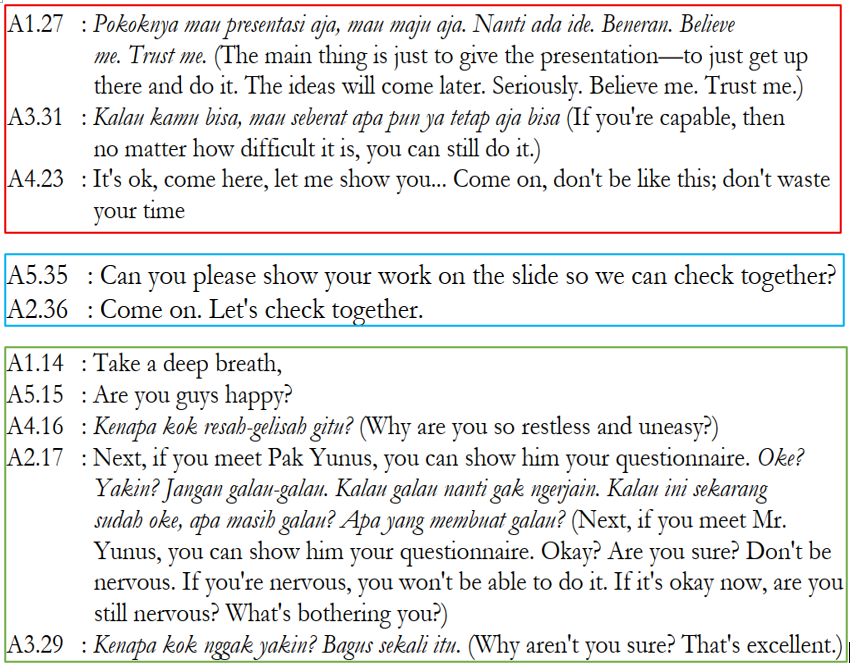
Positive interaction is one of the important factors that support students’ engagement and development in the classroom. The previous study focused on the use of positive language to promote the teachers’ ideas without deeply discussing how that language can contribute toward engagment dynamic of lecturers and students. This study examines how English lecturers use language that contributes to positive interaction in their classroom during the teaching and learning process. The researchers adopted a qualitative approach with a case study design. Data were collected through audio recordings of six English lecturers at a private university in Malang. Data analysis was conducted using the positive discourse analysis framework, focusing on coding based on communication strategies used and categorizing related to positive discourse. The analysis shows that lecturers contribute to using positive discourse and validate student contributions, provide effective scaffolding and mitigate criticism, empower through collaboration and inclusivity, enforce rules with politeness and contextual flexibility, and demonstrate contextual awareness. This finding can be a source for English lecturers and teachers to design a more supportive and polite approach used in everyday life. This research has some limitations, such as the number of participants and audio recording data, which do not capture face mimic, gestures, and body language that support building positive interactions. This limitation becomes a consideration to understand that these findings are contextual based which cannot be generalized. For further research, it is recommended to expand the scope of participants, cultural contexts, and multimodal data to capture the nonverbal dimension of positive discourse.
References
Adhari, S., Yendra, Y., & Sesmiyanti, S. (2022). Positive politeness strategies in classroom interaction at EFL class. Journal of Language Literature and English Teaching, 3(2), 43. https://doi.org/10.31629/juliet.v3i2.4172
Aldana-Gutiérrez, Y. (2021). Possible impossibilities of peace construction in ELT: Profiling the field. HOW, 28(1), 141–162. https://doi.org/10.19183/how.28.1.585
Aliabadi, R. B., & Weisi, H. (2023). Teachers’ strategies to promote learners’ engagement: Teachers’ talk in perspective. International Journal of Educational Research Open, 5(100262), 100262. https://doi.org/10.1016/j.ijedro.2023.100262
Allo, M. D. G., Taula’bi’, N., & Sudarsi, E. T. (2024). English as a foreign language lecturers’ language power bases in the high context culture of Toraja. International Journal of Evaluation and Research in Education, 13(3), 1832. https://doi.org/10.11591/ijere.v13i3.26260
Bartlett, T. (2012). Hybrid voices and collaborative change: Contextualising positive discourse analysis. Routledge.
Birch, B. M. (2022). Creating classrooms of peace in English language teaching. Routledge. https://doi.org/10.4324/9781003147039
Bowles, S., & Gintis, H. (1976). Schooling in capitalist America: Educational reform and the contradictions of economic life. Basic Books.
Bukhari, N. H. S., & Xiaoyang, W. (2013). Critical discourse analysis and educational research. IOSR Journal of Research & Method in Education, 3(1), 9. https://doi.org/10.9790/7388-0310917
Caldas-Coulthard, R., & Coulthard, M. (1996). Texts and practices: Readings in critical discourse analysis. Routledge.
Calle-Díaz, L., & Rogers, R. (2023). A framework-in-action for reconstructive analysis in language and literacy teacher education / Uma estrutura ativa para a análise reconstrutiva na educação de professores de linguas e literacidade. Pensares Em Revista, 27, 61. https://doi.org/10.12957/pr.2023.73959
Castillo, P. A. P., Donoso, A., & Ortega, K. (2020). Understanding the meaning of multicultural collaboration in a public-school EFL class. International Journal of Multicultural Education, 22(1), 1. https://doi.org/10.18251/ijme.v22i1.1929
Chu, J., & Zeng, X. (2021). The role of the negative 3-h trio in second language education. Frontiers in Psychology, 12. https://doi.org/10.3389/fpsyg.2021.736928
Ding, J. (2021). Exploring effective teacher-student interpersonal interaction strategies in English as a foreign language listening and speaking class. Frontiers in Psychology, 12, 765496. https://doi.org/10.3389/fpsyg.2021.765496
Efendi, A. N., Putikadyanto, A. P. A., & Susanto, M. A. (2023). Diversitas dan dialog lintas agama: Konstruksi wacana perdamaian pada siswa multi-agama di Sidoarjo [Diversity and interfaith dialogue: Constructing a peaceful discourse among multi-religious students in Sidoarjo]. NUANSA Jurnal Penelitian Ilmu Sosial dan Keagamaan Islam, 20(1), 75. Retrieved from https://ejournal.uinmadura.ac.id/index.php/nuansa/article/view/8111
El-Masry, M. M. S. (2024). Sustainable green future from a multimodal positive discourse analysis perspective: Investigating environmental metaphors in some selected cartoons. World Journal of English Language, 14(3), 14. https://doi.org/10.5430/wjel.v14n3p14
Febriansyah, R., Munir, A., Anam, A., & Setiawan, S. (2021). The power of politeness strategies in EFL student-teacher interaction: Teacher’s gender perspective. IJET (Indonesian Journal of English Teaching, 10(2), 125. https://doi.org/10.15642/ijet2.2021.10.2.125-135
Fu, J. (2021). Exploring peacebuilding strategies to develop teacher-student interpersonal relationships in English as a foreign language/English as a second language classrooms. Front. Psychol. 12:736315. doi: 10.3389/fpsyg.2021.736315
Garcia, P., Barreto, K., & Acosta, G. (2022). Reconstructing teachers’ discourse to build inclusive interactions using positive discourse analysis and formative intervention. Education and New Developments, 366–368. https://doi.org/10.36315/2023v2end081
Gu, C. (2023). Climate change concerns human survival...and justice in our international community’: A corpus-based positive discourse analysis (PDA) of the largest developing nation’s global involve/engagement discourses (re)told in interpreting. PLoS ONE, 18(4). https://doi.org/10.1371/journal.pone.0277705
Halliday, M. A. K., & Hasan, R. (1985). Language, context, and text: Aspects of language in a social-semiotic perspective. Oxford University Press.
Heriyawati, D. F., Siba, S. Y., & Sulistyo, T. (2019). Lecturers’ politeness strategies in EFL classroom with multicultural background. Litera, 18(3), 447. https://doi.org/10.21831/ltr.v18i3.26494
Ibrahim, W. M. A. (2023). A positive discourse approach to the Arabic Facebook posts of two Egyptian relationship skills coaches. Journal of Educational and Social Research, 13(2), 144. https://doi.org/10.36941/jesr-2023-0039
Katili, A. A. (2021). Building positive classroom interaction through positive discourse. JAMBURA Journal of English Teaching and Literature, 2(2), 52–59. https://doi.org/10.37905/jetl.v2i2.11825
Komarawan, Y., Febryanto, M., & Bakhti, K. Y. (2025). De-naturalizing the worldviews underlying representations of eco-awareness: A multimodal critical discourse analysis of Indonesian EFL textbooks. Journal of World Languages, 11(3). https://doi.org/10.1515/jwl-2024-0100
Macgilchrist, F. (2007). Positive discourse analysis: Contesting dominant discourses by reframing the issues. Critical Approaches to Discourse Analysis Across Disciplines, 1(1), 74–94. Retrieved from https://ugp.rug.nl/cadaad/article/view/42079
Mahmud, M. (2019). The use of politeness strategies in the classroom context by English university students. Indonesian Journal of Applied Linguistics, 8(3), 597. https://doi.org/10.17509/ijal.v8i3.15258
Martin, J. R. (2004). Positive discourse analysis: Solidarity and change. Revista Canaria de Estudios Ingleses, 49, 179–202.
Martin, J. R., & Rose, D. (2007). Working with discourse (2nd ed.). Continuum.
Morgan, B., & Vandrick, S. (2009). Imagining a peace curriculum: What second‐language education brings to the table. Peace & Change, 34(4), 510–532. https://doi.org/10.1111/j.1468-0130.2009.00598.x
Mosley, W., & Rogers, R. (2014). Designing Critical Literacy Education Through Critical Discourse Analysis: Pedagogical And Research Tools For Teacher Researchers. Routledge.
Mullet, D. R. (2018). A general critical discourse analysis framework for educational research. Journal of Advanced Academics, 29(2), 116. https://doi.org/10.1177/1932202x18758260
Nurmawati, N., Atmowardoyo, H., & Weda, S. (2019). An analysis of positive politeness strategies to promote effective interaction in the classroom. ELS Journal on Interdisciplinary Studies in Humanities, 2(2), 171. https://doi.org/10.34050/els-jish.v2i2.6340
Ozsezer, M. S. B., & Saban, A. I. (2016). An investigation on teacher candidates’ perspectives about behaviors positively affecting classroom atmosphere. Eurasian Journal of Educational Research. https://dergipark.org.tr/tr/pub/ejer/issue/42424/510874
Prayitno, H. D., Ngalim, A., & Jammaluddin, N. (2018). Pergeseran realisasi tindak kesantunan direktif mereduksi nilai kesantunan positif dan karakter di kalangan peserta didik [The shift in the realization of directive politeness acts reduces the value of positive politeness and character among students]. Bahastra, 38(2), 85. https://doi.org/10.26555/bahastra.v38i2.9689
Rifai, A. (2022). An analising EFL teacher’s politeness strategies in classroom interaction. FLIP Foreign Language Instruction Probe, 1(2), 101. https://doi.org/10.54213/flip.v1i2.176
Rogers, R. (2018). Reclaiming powerful literacies: New horizons for critical discourse analysis. Routledge.
Rusdiah, R. (2017). The integration of social skills in teaching speaking to undergraduate English language teaching students. ELT Worldwide Journal of English Language Teaching, 4(1), 1. https://doi.org/10.26858/eltww.v4i1.3201
Ruswandi, R., Arief, M., & Novitasari, N. (2024). Inspiring through interaction: The impact of teachers’ verbal and non-verbal communication in EFL classes. Voices of English Language Education Society, 8(2). https://doi.org/10.29408/veles.v8i2.26821
Safitri, V., Alek, A., Hidayat, D. N., & Husna, N. (2023). Teacher and students’ oral interaction in EFL classroom: A structural discourse analysis. Edukatif Jurnal Ilmu Pendidikan, 5(6), 2582. https://doi.org/10.31004/edukatif.v5i6.5487
Shi, X. (2021). The role of positive 3-H words in peacebuilding and engagement in EFL/ESL classes. Frontiers in Psychology, 12. https://doi.org/10.3389/fpsyg.2021.745645
Stibbe, A. (2017). Positive discourse analysis. Routledge. https://doi.org/10.4324/9781315687391-12
Sunarwi, S., & Amin, F. (2025). Dampak dan tantangan implementasi wawasan multikultural terhadap penurunan konflik antar siswa di lingkungan sekolah [The impact and challenges of implementing multicultural insight on reducing conflict between students in the school environment]. RIGGS Journal of Artificial Intelligence and Digital Business, 4(2), 5728. https://doi.org/10.31004/riggs.v4i2.1496
Taylor, L. A., & Hikida, M. (2023). Guest editorial: Introduction: Reconstructive discourse analysis as an approach to redressing racism in critical studies of literacy. English Teaching Practice & Critique, 22(1), 1–10. https://doi.org/10.1108/etpc-04-2023-197
Trinaldi, A., Harjono, H. S., & Rustam, R. (2022). Wujud kesantuan guru sebagai bentuk pengintegrasian pendidikan karakter di sekolah: Tinjauan pragmatik [The form of teacher politeness as a form of character education integration in schools: A pragmatic review]. Jurnal Basicedu, 6(6), 9474. https://doi.org/10.31004/basicedu.v6i6.4112
Van Dijk, T. A. (1990). Social cognition and discourse. In H. Giles & W. P. Robinson (Eds.), Handbook of language and social psychology (pp. 163–183). John Wiley & Sons.
Winanta, A., Rochsantiningsih, D., & Supriyadi, S. (2020). Exploring EFL classroom interaction: An analysis of teacher talk at senior high school level. ELS Journal on Interdisciplinary Studies in Humanities, 3(3), 328. https://doi.org/10.34050/elsjish.v3i3.11061
Downloads
Published
How to Cite
Issue
Section
License
Copyright (c) 2026 Durotun Nasihah, Abdul Rani, Jauharoh Kamila, Hasbulloh Nadaraning

This work is licensed under a Creative Commons Attribution 4.0 International License.
Authors who publish this journal agree to the following terms:
- Authors retain copyright and grant the journal right of first publication with the work simultaneously licensed under a Creative Commons Attribution License that allows others to share the work with an acknowledgement of the work's authorship and initial publication in this journal.
- Authors can separately make additional contractual arrangements for non-exclusive distribution published by the journal (e.g., publish it in a book), with an acknowledgement of its initial publication in this journal.
- Authors are allowed and encouraged to send their work via online (e.g., in the institutional repositories or their website) after published by the journal.