AI integration in EFL curriculum and pedagogical practices: A systematic literature review and bibliometric analysis
DOI:
https://doi.org/10.33474/j-reall.v7i2.25571Keywords:
AI, bibliometric analysis, EFL curriculum, pedagogical practices, systematic literature reviewAbstract
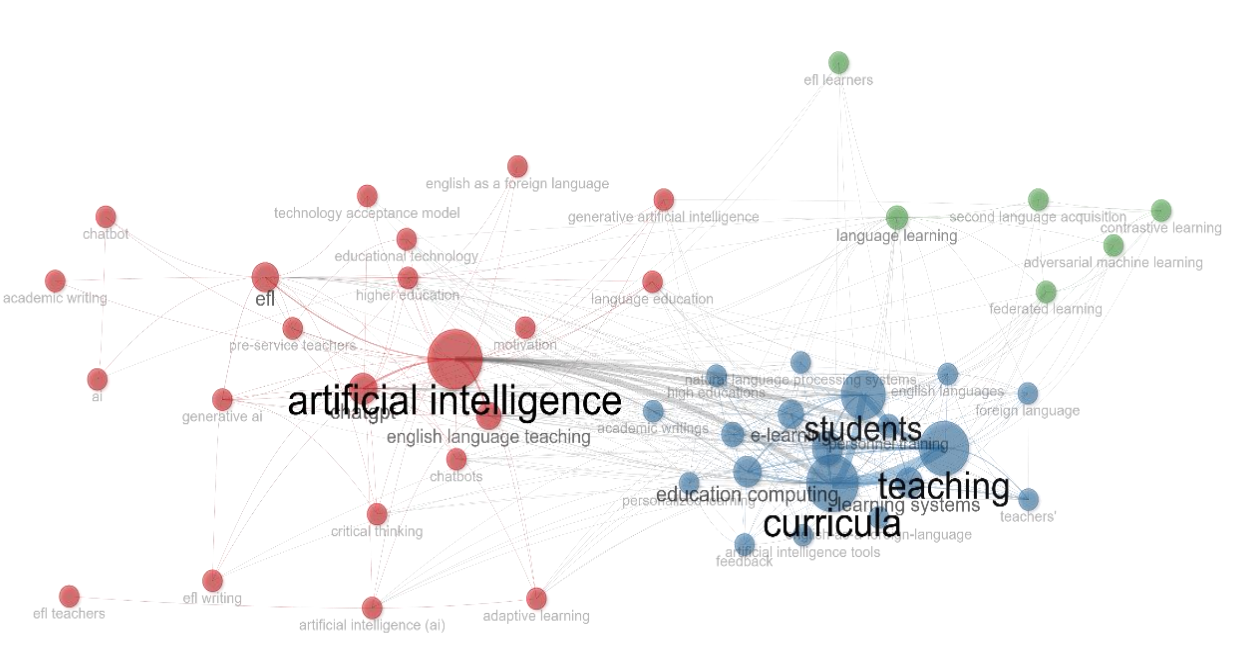
The rapid adoption of artificial intelligence (AI) is reshaping English as a foreign language (EFL) education, particularly in teaching, assessment, feedback, and personalized learning. Existing reviews have largely focused on individual AI tools or isolated pedagogical outcomes, offering limited understanding of how AI is integrated across curriculum objectives, instructional activities, learning progression, assessment, and teacher AI literacy. Addressing this gap, this study analyzes 190 Scopus-indexed articles and reviews published between January 2020 and April 2026 using an integrated bibliometric and systematic literature review (SLR). Using Biblioshiny in RStudio for bibliometric mapping and PRISMA 2020 for article selection and reporting (n = 40), the study addresses three research questions concerning publication growth, source distribution, geographical contribution, and thematic structure (RQ1), dominant pedagogical approaches and curriculum frameworks (RQ2), and emerging gaps and future research directions (RQ3). Findings reveal a sharp increase in publications after 2023, with China, Saudi Arabia, and Indonesia as the most productive contributing countries. Thematic analysis identified five major domains: teacher readiness and AI literacy, AI-supported pedagogical practices, curriculum integration and instructional design, learning outcomes and assessment, and ethical and implementation challenges. The integrated findings indicate that publication growth aligns structurally with the thematic emphasis on curriculum reform and AI literacy, while persistent gaps in longitudinal research, methodological diversity, and contextual governance remain. The review is limited to Scopus-indexed, open-access publications within the January 2020–April 2026 search period. Implications for EFL curriculum development, teacher education policy, and institutional governance are discussed.
References
AbdAlgane, M., Ali, R., Othman, K., Ibrahim, I. Z. A., Alhaj, M. K. M., Ali, E. M. T., & Allehyani, F. S. (2026). Exploring AI generated texts vs. human written texts in EFL academic writing: A Case study of Qassim University in Saudi Arabia. World Journal of English Language, 16(2), 114–131. https://doi.org/10.5430/wjel.v16n2p114
Al-khresheh, M. H. (2024). Bridging technology and pedagogy from a global lens: Teachers’ perspectives on integrating ChatGPT in English language teaching. Computers and Education: Artificial Intelligence, 6. https://doi.org/10.1016/j.caeai.2024.100218
Alhajji, R. A. Y., Almansoori, A. G., & Alyammahi, A. (2025). Harnessing AI for EFL educational advancement: A reflection on policy, practice, and pedagogy within the ministry of education in the UAE. Forum for Linguistic Studies, 7(3), 231–251. https://doi.org/10.30564/fls.v7i3.8492
Alhamam, A. A. (2025). Investigating the role of AI tool interactions in enhancing English language acquisition among Saudi college students. Arab World English Journal, 16(3), 426–440. https://doi.org/10.24093/awej/vol16no3.26
Alkhateeb, A., Hezam, A. M. M., & Almuraikhi, A. A. (2025). Assessing the use of AI tools for EFL exam preparation at Saudi universities: Efficiency, benefits, and challenges. Cogent Education, 12(1). https://doi.org/10.1080/2331186X.2025.2507553
Almahboob, T. (2025). Exploring the impact of AI technologies on EFL writing proficiency. Forum for Linguistic Studies, 7(7), 270–282. https://doi.org/10.30564/fls.v7i7.9952
Alshammari, H. (2026). Leveraging AI tools to improve Saudi EFL students’ academic writing skills: Instructor perceptions. Journal of Curriculum and Teaching, 15(1). https://doi.org/10.5430/jct.v15n1p267
Altamimi, D. H. F. (2025). AI integrating in EFL classrooms: A study on lecturers’ adaptation and student outcomes. Arab World English Journal, 2025-July, 364–379. https://doi.org/10.24093/awej/call11.22
Aria, M., & Cuccurullo, C. (2017). Bibliometrix: An R-tool for comprehensive science mapping analysis. Journal of Informetrics, 11(4), 959–975. https://doi.org/10.1016/j.joi.2017.08.007
Avenali, A., Daraio, C., Di Leo, S., Matteucci, G., & Nepomuceno, T. (2023). Systematic reviews as a metaknowledge tool: Caveats and a review of available options. International Transactions in Operational Research, 30, 2761–2806. https://doi.org/10.1111/itor.13309
Bataineh, R. F., Obeiah, S. F., & Bataineh, R. F. (2026). Tuning in with technology: AI-enhanced listening instruction in the Jordanian EFL classroom. Journal of Information Technology Education: Innovations in Practice, 25(Article 7). https://doi.org/10.28945/5699
Bhar, S. K. (2026). Artificial intelligence in EFL speaking instruction: A systematic review of pedagogical design, affective conditions and instructional input. Encyclopedia, 6(4). https://doi.org/10.3390/encyclopedia6040074
Brown, T. B., Mann, B., Ryder, N., Subbiah, M., Kaplan, J., Dhariwal, P., Neelakantan, A., Shyam, P., Sastry, G., Askell, A., Agarwal, S., Herbert-Voss, A., Krueger, G., Henighan, T., Child, R., Ramesh, A., Ziegler, D. M., Wu, J., Winter, C., … Amodei, D. (2020). Language models are few-shot learners. ArXiv Preprint ArXiv:2005.14165. https://arxiv.org/abs/2005.14165
Busso, A., & Sanchez, B. (2024). Advancing communicative competence in the digital age: A case for AI tools in Japanese EFL education. Technology in Language Teaching and Learning, 6(3). https://doi.org/10.29140/tltl.v6n3.1211
Chae, S.-I., & Yoo, I. W. (2026). Explicit pronunciation instruction, IPA literacy, and AI practice: A conceptual framework for adult L2 listening and speaking development. Journal of Asia TEFL, 23(1), 99–108. https://doi.org/10.18823/asiatefl.2026.23.1.7.99
Chiu, T. K. F., Ahmad, Z., Ismailov, M., & Sanusi, I. T. (2024). What are artificial intelligence literacy and competency? A comprehensive framework to support them. Computers and Education Open, 6, 100171. https://doi.org/10.1016/j.caeo.2024.100171
Chiu, T. K. F., Xia, Q., Zhou, X., Chai, C. S., & Cheng, M. (2023). Systematic literature review on opportunities, challenges, and future research recommendations of artificial intelligence in education. Computers and Education: Artificial Intelligence, 4, 100118. https://doi.org/10.1016/j.caeai.2022.100118
Chua, H. W., & Annamalai, N. (2025). A bibliometric analysis and systematic review in AI chatbots in language teaching and learning. International Journal of Technology in Education (IJTE), 8(2), 274–331. https://doi.org/10.46328/ijte.1035
Chung, A. Q. (2025). AI integration in pronunciation instruction: Insights from secondary school EFL teachers. Technology in Language Teaching and Learning, 7(4). https://doi.org/10.29140/tltl.v7n4.103014
Crompton, H., & Burke, D. (2023). Artificial intelligence in higher education: the state of the field. International Journal of Educational Technology in Higher Education, 20(1), 22. https://doi.org/10.1186/s41239-023-00392-8
Doğan, Y., & Talan, T. (2025). Artificial intelligence in foreign language learning: A bibliometric analysis. Journal of Pedagogical Research, 9, 206–230. https://doi.org/10.33902/JPR.202427734
Donthu, N., Kumar, S., Mukherjee, D., Pandey, N., & Lim, W. M. (2021). How to conduct a bibliometric analysis: An overview and guidelines. Journal of Business Research, 133, 285–296. https://doi.org/10.1016/j.jbusres.2021.04.070
Ekizer, F. N. (2025). Exploring the impact of artificial intelligence on English language teaching: A meta-analysis. Acta Psychologica, 260, 105649. https://doi.org/10.1016/j.actpsy.2025.105649
Elmotri, B., Osman, W. A. E. A. E., Al-Humari, M. A., Amri, F., Elyasa, Y. M., Malik, F. H., Garrouri, S., & Hassanein, O. H. S. (2025). Possibilities for improving ESP curriculum design and assessment strategies for Saudi universities with ChatGPT. Arab World English Journal, 2025(Special Issue), 234–250. https://doi.org/10.24093/awej/AI.13
Eyal, L. (2025). Developing and validating an AI-TPACK assessment framework: Enhancing teacher educators’ professional practice through authentic artifacts. Education Sciences, 15(11). https://doi.org/10.3390/educsci15111452
Godwin-Jones, R. (2024). Distributed agency in language learning and teaching through generative AI. Language Learning & Technology, 28(2), 5–30. https://doi.org/10.64152/10125/73570
Han, J., & Li, M. (2024). Exploring ChatGPT-supported teacher feedback in the EFL context. System, 126, 103502. https://doi.org/10.1016/j.system.2024.103502
Harakchiyska, T. (2025). Predictors of pre-service EFL teachers’ predisposition towards AI adoption in language teaching. Education Sciences, 15(9). https://doi.org/10.3390/educsci15091112
Huang, W., Hew, K. F., & Fryer, L. K. (2022). Chatbots for language learning---Are they really useful? A systematic review of chatbot-supported language learning. Journal of Computer Assisted Learning, 38(1), 237–257. https://doi.org/10.1111/jcal.12610
Isaee, H., & Barjesteh, H. (2026). Exploring teachers’ and learners’ perceptions of AI-supported pedagogical tools in English language teaching. Discover Artificial Intelligence, 6(1), 224. https://doi.org/10.1007/s44163-026-00933-w
Jiang, S., & Li, J. (2026). Triadic instructional design: The impact of structured AI training on pre-service teachers’ intelligent-TPACK, attitudes, and lesson planning skills. Education Sciences, 16(2). https://doi.org/10.3390/educsci16020315
Karaduman, C. (2025). Pre-service EFL teachers’ perceived AI literacy and competency: the integration of ChatGPT into English language teacher education. Sage Open, 15(3), 21582440251379710. https://doi.org/10.1177/21582440251379712
Karakaya, K., Alpat, M. F., Uçar, H., Karakaya, O., & Bozkurt, A. (2025). Preparing teachers for the algorithmic educational landscape: A critical mapping of generative AI integration in language teacher education. Technology in Language Teaching and Learning, 7(2). https://doi.org/10.29140/tltl.v7n2.102841
Kasneci, E., Seßler, K., Küchemann, S., Bannert, M., Dementieva, D., Fischer, F., & Kasneci, G. (2023). ChatGPT for good? On opportunities and challenges of large language models for education. Learning and Individual Differences, 103, 102274. https://doi.org/10.1016/j.lindif.2023.102274
Kılıçkaya, F., & Kic-Drgas, J. (2025). Enhancing collaborative learning practices via chatbots: Insights from an EFL context. SAGE Open, 15(3). https://doi.org/10.1177/21582440251369189
Kohnke, L., Moorhouse, B., & Zou, D. (2023). ChatGPT for language teaching and learning. RELC Journal, 54(2), 537–550. https://doi.org/10.1177/00336882231162868
Kohnke, L., & Ulla, M. B. (2024). Embracing generative artificial intelligence: The perspectives of English instructors in Thai higher education institutions. Knowledge Management and E-Learning, 16(4), 653–670. https://doi.org/10.34105/j.kmel.2024.16.030
Kuhail, M. A., Alturki, N., Alramlawi, S., & Alhejori, K. (2023). Interacting with educational chatbots: A systematic review. Education and Information Technologies, 28(1), 973–1018. https://doi.org/10.1007/s10639-022-11177-3
Lai, Z. C.-C. (2025). Enhancing EFL oral proficiency through a ChatGPT-integrated BOPPPS learning framework. International Journal of Online Pedagogy and Course Design, 15(1). https://doi.org/10.4018/IJOPCD.383301
Landis, J. R., & Koch, G. G. (1977). The measurement of observer agreement for categorical data. Biometrics, 33(1), 159–174. https://doi.org/10.2307/2529310
Law, L. (2024). Application of generative artificial intelligence (GenAI) in language teaching and learning: A scoping literature review. Computers and Education Open, 6, 100174. https://doi.org/10.1016/j.caeo.2024.100174
Lee, Y.-J., Davis, R. O., & Choi, J.-I. (2025). Integrating generative AI into EFL writing: University students’ strategies and perceptions. Online Journal of Communication and Media Technologies, 15(4). https://doi.org/10.30935/ojcmt/17545
Lee, Y.-J., & Jeong, S.-H. (2026). Exploring university ELLs’ AI literacy: An exploratory descriptive study. Journal of Educational and Social Research, 16(1), 94–105. https://doi.org/10.36941/jesr-2026-0241
Liu, M., Zhang, L. J., & Zhang, D. (2025). Enhancing student GAI literacy in digital multimodal composing through development and validation of a scale. Computers in Human Behavior, 166, 108569. https://doi.org/10.1016/j.chb.2025.108569
Long, D., & Magerko, B. (2020). What is AI literacy? Competencies and design considerations. Proceedings of the 2020 CHI Conference on Human Factors in Computing Systems, CHI ’20, 1–16. https://doi.org/10.1145/3313831.3376727
Lu, B. D., & Watanapokakul, S. (2025). How active is ‘active’? Overcoming misconceptions and optimizing pedagogical practices of active learning in EFL classrooms. REFLections, 32(1), 595–612. https://doi.org/10.61508/refl.v32i1.280462
Naseer, F., & Khawaja, S. (2025). Mitigating conceptual learning gaps in mixed-ability classrooms: A learning analytics-based evaluation of AI-driven adaptive feedback for struggling learners. Applied Sciences (Switzerland), 15(8). https://doi.org/10.3390/app15084473
Ning, Y., Zhang, C., Xu, B., Zhou, Y., & Wijaya, T. T. (2024). Teachers’ AI-TPACK: Exploring the relationship between knowledge elements. Sustainability (Switzerland), 16(3). https://doi.org/10.3390/su16030978
Nualprasert, B., Punkhoom, W., & Jehma, H. (2025). Reframing digital literacy in ELT: Integrating SAMR, AI-TPACK, and connectivism in the Global South. International Journal of Interactive Mobile Technologies, 19(20), 55–68. https://doi.org/10.3991/ijim.v19i20.56333
Page, M. J., McKenzie, J. E., Bossuyt, P. M., Boutron, I., Hoffmann, T. C., Mulrow, C. D., Shamseer, L., Tetzlaff, J. M., Akl, E. A., Brennan, S. E., Chou, R., Glanville, J., Grimshaw, J. M., Hróbjartsson, A., Lalu, M. M., Li, T., Loder, E. W., Mayo-Wilson, E., McDonald, S., … Moher, D. (2021). The PRISMA 2020 statement: An updated guideline for reporting systematic reviews. PLOS Medicine, 18(3), e1003583. https://doi.org/10.1371/journal.pmed.1003583
Park, Y., & Derakhshan, A. (2026). From Gutenberg to the classroom: Large-scale generation and validation of vocabulary-controlled EFL reading materials. Language Testing in Asia, 16(1). https://doi.org/10.1186/s40468-026-00429-5
Pitychoutis, K. M. (2024). Harnessing AI chatbots for EFL essay writing: A paradigm shift in language pedagogy. Arab World English Journal, 2024-April(Special Issue), 197–209. https://doi.org/10.24093/awej/ChatGPT.13
Plate, D., Melick, E., Hutson, J., & Edele, S. (2024). Generative AI in the English composition classroom: Practical and adaptable strategies. In Generative AI in the English Composition Classroom: Practical and Adaptable Strategies. Taylor and Francis. https://doi.org/10.4324/9781003507949
Qoyyimah, U., & Bargallie, D. (2025). Scientific knowledge structures: problematising AI-powered translation tools in EFL academic writing. LLT Journal: Journal on Language and Language Teaching, 28(2), 634–651. https://doi.org/10.24071/llt.v28i2.9833
Qutub, M. M. T., Bukhari, S. S. F., Fadel, S. A., & Aljuhani, H. S. A. (2023). The future of English as a foreign language teaching and learning in view of the fourth industrial revolution in the MENA Region. Arab World English Journal, 2023-July, 67–86. https://doi.org/10.24093/awej/call9.5
Rafida, T., Suwandi, S., & Ananda, R. (2024). EFL students’ perception in Indonesia and Taiwan on using artificial intelligence to enhance writing skills. Jurnal Ilmiah Peuradeun, 12(3), 987–1016. https://doi.org/10.26811/peuradeun.v12i3.1520
Slamet, J. (2024). Potential of ChatGPT as a digital language learning assistant: EFL teachers’ and students’ perceptions. Discover Artificial Intelligence, 4(1), 46. https://doi.org/10.1007/s44163-024-00143-2
Snyder, H. (2019). Literature review as a research methodology: An overview and guidelines. Journal of Business Research, 104, 333–339. https://doi.org/10.1016/j.jbusres.2019.07.039
Tan, X., Cheng, G., & Ling, M. H. (2025). Investigating the mediating role of TPACK on teachers’ AI competency and their teaching performance in higher education. Computers and Education: Artificial Intelligence, 9, 100461. https://doi.org/10.1016/j.caeai.2025.100461
Tatipang, D. P., Irwan, A., Wasamba, L. R., Bora, B., Akil, M. A., Yusuf, N. A. A., & Yuningsi, N. (2026). University lecturers vs. the AI-implemented ELT curriculum in an Indonesian context: A needs analysis. Theory and Practice in Language Studies, 16(2), 697–706. https://doi.org/10.17507/tpls.1602.35
Teng, M. F. (2024). A systematic review of ChatGPT for English as a foreign language writing: Opportunities, challenges, and recommendations. International Journal of TESOL Studies, 6(3), 36–57. https://doi.org/10.58304/ijts.20240304
Tran, T. G. (2026). Using AI in designing language tests: Perspectives and practices of pre-service EFL teachers. Journal of Asia TEFL, 23(1), 109–116. https://doi.org/10.18823/asiatefl.2026.23.1.8.109
Tseng, Y.-C., & Lin, Y.-H. (2024). Enhancing English as a foreign language (EFL) learners’ writing with ChatGPT: A university-level course design. Electronic Journal of E-Learning, 22(2), 78–97. https://doi.org/10.34190/ejel.21.5.3329
Uysal, D. (2026). Integrating an educational chatbot in an undergraduate-level linguistics course: Cognitive load and student engagement. Thinking Skills and Creativity, 60. https://doi.org/10.1016/j.tsc.2025.102099
Wang, H., Abdul Aziz, A., & Kutty, F. M. (2025). Integrating AI into Asian tertiary EFL learners’ speaking instruction: A systematic literature review. Forum for Linguistic Studies, 7(3), 104–119. https://doi.org/10.30564/fls.v7i3.8263
Wang, S., Wang, F., Zhu, Z., Wang, J., Tran, T., & Du, Z. (2024). Artificial intelligence in education: A systematic literature review. Expert Systems with Applications, 252, 124167. https://doi.org/10.1016/j.eswa.2024.124167
Woo, D. J., Wang, D., Guo, K., & Susanto, H. (2024). Teaching EFL students to write with ChatGPT: Students’ motivation to learn, cognitive load, and satisfaction with the learning process. Education and Information Technologies, 29(18), 24963–24990. https://doi.org/10.1007/s10639-024-12819-4
Woo, D., Kizilates, S., Guo, K., & Wang, D. (2026). Developing English academic writing and AI literacy in an EFL co-curricular secondary school context. Innovation in Language Learning and Teaching. https://doi.org/10.1080/17501229.2026.2636962
Woo, J. H., & Choi, H. (2021). Systematic review for AI-based language learning tools. Journal of Digital Contents Society, 22, 1783–1792. https://doi.org/10.9728/dcs.2021.22.11.1783
Xin, J. J. (2024). Investigating EFL teachers’ use of generative AI to develop reading materials: A practice and perception study. Language Teaching Research, 0(0), 13621688241303320. https://doi.org/10.1177/13621688241303321
Xu, G., Yu, A., Gao, A., & Trainin, G. (2025). Developing an AI-TPACK framework: Exploring the mediating role of AI attitudes in pre-service TCSL teachers’ self-efficacy and AI-TPACK. Education and Information Technologies, 30(15), 22471–22495. https://doi.org/10.1007/s10639-025-13630-5
Yan, L., Sha, L., Zhao, L., Li, Y., Martinez-Maldonado, R., Chen, G., Li, X., Jin, Y., & Gasevic, D. (2024). Practical and ethical challenges of large language models in education: A systematic scoping review. British Journal of Educational Technology, 55(1), 90–112. https://doi.org/10.1111/bjet.13370
Yeh, H.-C. (2024). Revolutionizing language learning: Integrating generative AI for enhanced language proficiency. Educational Technology and Society, 27(3), 335 – 353. https://doi.org/10.30191/ETS.202407_27(3).TP01
Yıldız, T. A. (2025). Sustainability education in L2 writing: AI-based multimodal awareness and engagement. Sustainability (Switzerland), 17(21). https://doi.org/10.3390/su17219376
Zawacki-Richter, O., Marín, V. I., Bond, M., & Gouverneur, F. (2019). Systematic review of research on artificial intelligence applications in higher education – where are the educators? International Journal of Educational Technology in Higher Education, 16(1). https://doi.org/10.1186/s41239-019-0171-0
Zheng, Y. (Danson), & Stewart, N. (2024). Improving EFL students’ cultural awareness: Reframing moral dilemmatic stories with ChatGPT. Computers and Education: Artificial Intelligence, 6. https://doi.org/10.1016/j.caeai.2024.100223
Zhou, B., Pek, L. S., Kabir, N., Yang, J., Bouteraa, M., & He, X. (2026). Artificial intelligence in English-speaking education: A WoS-based bibliometric analysis of technology, pedagogy, and ethics (2021-2025). International Journal of Learning, Teaching and Educational Research, 25(3), 853–873. https://doi.org/10.26803/ijlter.25.3.37
Zhu, M., & Wang, C. (2025). A systematic review of AI in language education: Current status and future implications. Language Learning & Technology, 29(1), 1–29. https://doi.org/10.64152/10125/73606
Downloads
Published
How to Cite
Issue
Section
License
Copyright (c) 2026 Alka Fajari, Dwi Puji Hastuti, Anugrah Imani

This work is licensed under a Creative Commons Attribution 4.0 International License.
Authors who publish this journal agree to the following terms:
- Authors retain copyright and grant the journal right of first publication with the work simultaneously licensed under a Creative Commons Attribution License that allows others to share the work with an acknowledgement of the work's authorship and initial publication in this journal.
- Authors can separately make additional contractual arrangements for non-exclusive distribution published by the journal (e.g., publish it in a book), with an acknowledgement of its initial publication in this journal.
- Authors are allowed and encouraged to send their work via online (e.g., in the institutional repositories or their website) after published by the journal.