
Exploring undergraduate students’ exposure to extramural English activities
DOI:
https://doi.org/10.33474/j-reall.v7i2.25665Keywords:
extramural English activities, higher education, language acquisition, informal learningAbstract
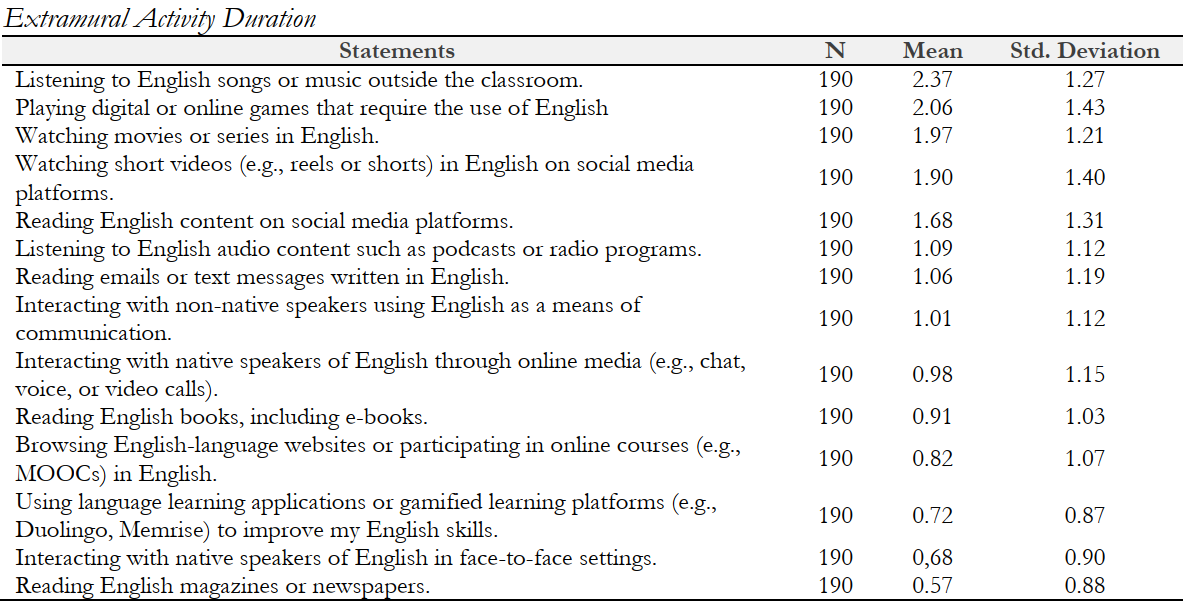
While digital media have made English exposure outside the classroom increasingly accessible, little is known about how undergraduate learners engage with it or perceive its contribution to their language development. Previous studies have tended to examine either the frequency and duration of extramural English activities or their relationship to language outcomes, but rarely both alongside learners' own perceptions, limiting a more contextualized understanding of informal engagement. This quantitative descriptive study addressed this gap by examining the types, frequency, duration, and perceived benefits of extramural English activities among 190 undergraduate students enrolled in a general English course at a private Indonesian university. Data were collected through a structured questionnaire and analyzed descriptively. Results showed that exposure was predominantly entertainment-oriented and digitally mediated, with listening to English songs (M = 4.31) and watching short social media videos (M = 4.20) reported as the most frequent activities, while music (M = 2.37) and online gaming (M = 2.06) accounted for the longest engagement durations. Despite this largely receptive, entertainment-driven pattern, students perceived these activities as beneficial, particularly for improving listening skills (M = 4.13) and reading skills (M = 4.09). These findings suggest that informal English exposure among undergraduates is substantial yet unevenly distributed, concentrated in accessible entertainment activities, while still perceived as valuable for language learning. This points to a need for educators to better integrate students' existing out-of-class practices into formal instruction through authentic, multimodal, and interaction-oriented learning opportunities that connect informal exposure with purposeful language learning.
References
Al-Zoubi, S. M. (2018). The impact of exposure to English language on language acquisition. Journal of Applied Linguistics and Language Research, 5(4), 151–162. Retrieved from https://www.jallr.com/index.php/JALLR/article/view/851
Aziz, M. A., Ahmad Tauchid, Moh. Zainuddin, & Mohammad Fatoni. (2025). Exploring university EFL learners’ experiences in using podcasts for listening and vocabulary development. INTENS (International Journal of English Education and Linguistics), 2(02), 1–14. https://doi.org/10.32665/intens.v2i02.5145
Benson, P. (2011). Teaching and researching: Autonomy in language learning (2nd ed.). Routledge.
Chaudron, C. (1985). Intake: On models and methods for discovering learners’ processing of input. Studies in Second Language Acquisition, 7(1), 1–14. https://doi.org/10.1017/S027226310000512X
Chaves-Yuste, B., & de-la Peña, C. (2023). Podcasts’ effects on the EFL classroom: A socially relevant intervention. Smart Learning Environments, 10(1). https://doi.org/10.1186/s40561-023-00241-1
Dallinger, S., Jonkmann, K., Hollm, J., & Fiege, C. (2016). The effect of content and language integrated learning on students’ English and history competences—Killing two birds with one stone? Learning and Instruction,41,23–31. https://doi.org/10.1016/j.learninstruc.2015.09.003
D’Ydewalle, G., & De Bruycker, W. (2007). Eye movements of children and adults while reading television subtitles. European Psychologist, 12(3), 196–205. https://doi.org/10.1027/1016-9040.12.3.196
Fachriyany, A., & Murtafi’ah, B. (2024). A survey of an exposure to extramural English activities among EFL undergraduate students. EDULANGUE, 6(2), 167–186. https://doi.org/10.20414/edulangue.v6i2.8770
Fadillah, R., Susanto, F., & Efrizal, D. (2025). The effect of educational video-based multimedia toward students’ English vocabulary mastery (A quasi experimental on 7th grade students at SMPN 52 North Bengkulu academic year 2024–2025). Jurnal Penelitian Ilmu Pendidikan Indonesia, 4(3), 1295–1303. https://doi.org/10.31004/jpion.v4i3.562
Febria, D., & Marsevani, M. (2024). The post-pandemic reflection on students’ speaking anxiety: A case in higher education. Linguists: Journal of Linguistics and Language Teaching, 10(1), 1-14. https://doi.org/10.29300/ling.v10i1.4492
Ghaderpanahi, L. (2012). Using authentic aural materials to develop listening comprehension in the EFL classroom. English Language Teaching, 5(6), 146–153. https://doi.org/10.5539/elt.v5n6p146
Grosjean, F., & Miller, J. L. (1994). Going in and out of languages: An example of bilingual flexibility. Psychological Science, 5(4), 201–206. https://doi.org/10.1111/j.1467-9280.1994.tb00501.x
Khasinah, S. (2014). Factors influencing second language acquisition. Englisia: Journal of Language, Education, and Humanities, 1(2), 256–269. https://doi.org/10.22373/ej.v1i2.187
Krashen, S. D. (1985). Principles and practice in second language acquisition. Pergamon.
Kuppens, A. H. (2010). Incidental foreign language acquisition from media exposure. Learning, Media and Technology, 35(1), 65–85. https://doi.org/10.1080/17439880903561876
Lee, J. S., Chen, J., & Drajati, N. A. (2024). Informal digital learning of English and perceptions of using EIL materials: attitude toward varieties of English as a mediator. Journal of Multilingual and Multicultural Development, 45(5), 1762–1777. https://doi.org/10.1080/01434632.2021.2021213
Mayer, R. E. (2021). Multimedia learning (3rd ed.). Cambridge University Press. https://doi.org/10.1017/9781316941355
Muñoz, C., & Cadierno, T. (2021). How do differences in exposure affect English language learning? A comparison of teenagers in two learning environments. Studies in Second Language Learning and Teaching, 11(2), 185–212. https://doi.org/10.14746/ssllt.2021.11.2. 2
Neagu, T., Eklöf, H., Laukaityte, I., & Wedman, J. (2025). Reading, watching and gaming: exploring the relationships between extramural English activities and academic L2 English reading comprehension in a Swedish university admissions test context. Education Inquiry, 1-16. https://doi.org/10.1080/20004508.2025.2556572
Nie, K., Fu, J., Rehman, H., & Zaigham, G. H. K. (2022). An empirical study of the effects of incidental vocabulary learning through listening to songs. Frontiers in Psychology, 13:891146. https://doi.org/10.3389/fpsyg.2022.891146
Ogba, T. I., Awa, J. O., Ngwoke, R. I., & Ajemba, O. A. (2020). Language learning and language acquisition: A study of formal and informal communication situations in the English language. IOSR Journal of Humanities and Social Science, 25(7), 27–33. Retrieved from https://www.iosrjournals.org/iosr-jhss/papers/Vol.25-Issue7/Series-12/D2507122733.pdf
Pavia, N., Webb, S., & Faez, F. (2019). Incidental vocabulary learning through listening to songs. Studies in Second Language Acquisition, 41(4), 745–768. https://doi.org/10.1017/S0272263119000020
Pebiana, P., & Febria, D. (2023). The increasing student motivation for speaking skills with MALL (Mobile-Assisted Language Learning). SALEE: Study of Applied Linguistics and English Education, 4(2), 424–439. https://doi.org/10.35961/salee.v4i2.820
Rose, H., & Galloway, N. (2019). Global Englishes for language teaching. Cambridge University Press.
Schmidt, R. W. (1983). Interaction, acculturation, and the acquisition of communicative competence: A case study of an adult. In N. Wolfson & E. Judd (Eds.), Sociolinguistics and language acquisition (pp. 137–174). Newbury House.
Schmidt, R. (1990). The role of consciousness in second language learning. Applied Linguistics, 11(2), 129–158. https://doi.org/10.1093/applin/11.2.129
Schmidt, R. (2010). Attention, awareness, and individual differences in language learning. In W. M. Chan, S. Chi, K. N. Cin, J. Istanto, M. Nagami, J. W. Sew, T. Suthiwan, & I. Walker (Eds.), Proceedings of CLaSIC 2010: Individual characteristics and subjective variables in language learning (pp. 721–737). National University of Singapore, Centre for Language Studies.
Schurz, A. (2025). Exploring the potential of extramural English in the development of implicit, automatized, and explicit knowledge of grammar. Language Learning, 76: 597-632. https://doi.org/10.1111/lang.70008
Sirivedin, P., Soopunyo, W., Srisuantang, S., & Wongsothorn, A. (2018). Effects of Facebook usage on English learning behavior of Thai English teachers. Kasetsart Journal of Social Sciences, 39(2), 183–189. https://doi.org/10.1016/j.kjss.2018.03.007
Smith, M. S. (1981). Consciousness-raising and the second language learner. Applied Linguistics, II(2), 159-168. https://doi.org/10.1093/applin/II.2.159
Sundqvist, P. (2009). Extramural English matters: Out-of-school English and its impact on Swedish ninth graders’ oral proficiency and vocabulary [Doctoral dissertation, Karlstad University]. Karlstad University Studies, 2009:55.
Sundqvist, P. (2019). Commercial-off-the-shelf games in the digital wild and L2 learner vocabulary. Language Learning & Technology, 23(1), 87–113. https://doi.org/10125/44674
Sundqvist, P. (2024). Extramural English as an individual difference variable in L2 research: methodology matters. Annual Review of Applied Linguistics, 44, 79–91. https://doi.org/10.1017/S0267190524000072
VanPatten, B. (1990). Attending to form and content in the input: An experiment in consciousness. Studies in Second Language Acquisition, 12(3), 287–301. https://doi.org/10.1017/S0272263100009177
VanPatten, B. (2004). Processing instruction theory, research, and commentary. Routledge.
Wang, C. (2024). Six-minute flipped classroom: The effect of using podcasts and collaborative learning on Taiwanese freshmen’s English communicative competence. Teaching English Language, 18(1), 1–23. https://doi.org/10.22132/tel.2024.444021.1571
Wicaksono, J. A., Indrastana, N. S., Taufan, G. T., & Rinda, R. K. (2023). Examining the effect of textual enhancement on the students’ grammar achievement. Journey: Journal of English Language and Pedagogy, 6(3), 733–742. https://doi.org/10.33503/journey.v6i3.699
Widahyu, C. (2021). The effectiveness of using video as a learning media online learning to improve students’ learning motivation and creative thinking at home during the COVID-19 pandemic. Retrieved from https://www.researchgate.net/publication/348296038_THE_EFFECTIVENESS_OF_USING_VIDEO_AS_A_LEARNING_MEDIA_ONLINE_LEARNING_TO_IMPROVE_STUDENTS_'LEARNING_MOTIVATION_AND_CREATIVE_THINKING_AT_HOME_DURING_THE_COVID-19_PANDEMIC
Winaldo, M. D., & Oktaviani, L. (2022). Influence of video games on the acquisition of the English language. Journal of English Language Teaching and Learning, 3(2), 21–26. Retrieved from https://www.researchgate.net/publication/369179732_INFLUENCE_OF_VIDEO_GAMES_ON_THE_ACQUISITION_OF_THE_ENGLISH_LANGUAGE
Zachos, G., Paraskevopoulou-Kollia, E.-A., & Anagnostopoulos, I. (2018). Social media use in higher education: A review. Education Sciences, 8(4), 194. https://doi.org/10.3390/educsci8040194
Zhong, Z., & Benati, A. G. (2024). An investigation into the effects of structured input, referential activities, and affective activities on the acquisition of English causative forms. Languages, 9(2). https://doi.org/10.3390/languages9020039
Downloads
Published
How to Cite
Issue
Section
License
Copyright (c) 2026 Desty Febria, Hardy Christ, Hilarius Raditya Priambada Purba

This work is licensed under a Creative Commons Attribution 4.0 International License.
Authors who publish this journal agree to the following terms:
- Authors retain copyright and grant the journal right of first publication with the work simultaneously licensed under a Creative Commons Attribution License that allows others to share the work with an acknowledgement of the work's authorship and initial publication in this journal.
- Authors can separately make additional contractual arrangements for non-exclusive distribution published by the journal (e.g., publish it in a book), with an acknowledgement of its initial publication in this journal.
- Authors are allowed and encouraged to send their work via online (e.g., in the institutional repositories or their website) after published by the journal.