Developing an ADDIE-based e-module for analytical exposition text: A validity, feasibility, and practicality study
DOI:
https://doi.org/10.33474/j-reall.v7i2.25691Keywords:
ADDIE model, analytical exposition text, EFL, e-module development, English language learningAbstract
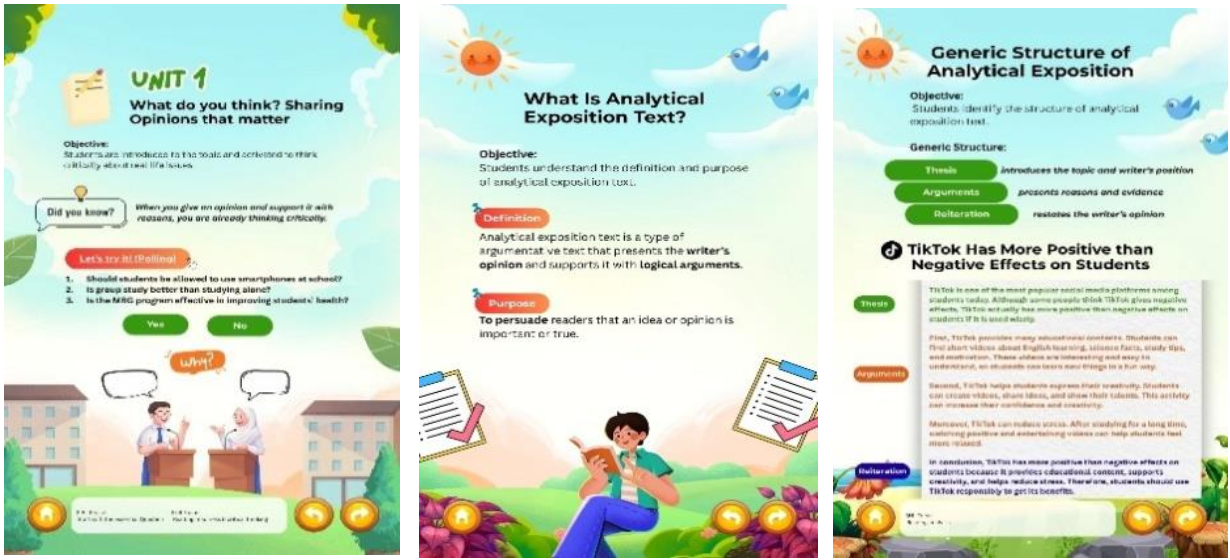
Integrating digital learning media has become increasingly important for supporting student-centred learning and enhancing English language instruction in the context of the Merdeka Curriculum. However, teaching analytical exposition text in Indonesian senior high schools remains challenging because students struggle to organize arguments, understand text structures, and apply language features, while existing learning resources are often limited and insufficiently interactive. This study aimed to develop an ADDIE-based e-module integrating project-based learning (PjBL) for teaching analytical exposition text and to evaluate its validity, feasibility, and practicality for Grade XI students. The study used a research and development (R&D) design based on the ADDIE model. Five English teachers participated in the needs analysis, nine experts validated the e-module, and one English teacher and 25 Grade XI students participated in the product evaluation and limited classroom implementation at a senior high school in Pekanbaru. Data were collected through needs analysis questionnaires, expert validation sheets, and teacher and student response questionnaires. The e-module achieved an overall expert validity score of 87.50% (very valid). Feasibility scores were 88.33% for teachers and 82.22% for students, while practicality scores were 87.50% and 85.11%, respectively; all were categorized as very feasible and very practical. The findings indicate that the e-module can serve as a suitable supplementary resource for teaching analytical exposition text and supporting student-centred learning. However, the limited sample and single-school implementation restrict the generalizability of the findings. Future research should involve larger samples and multiple schools to further examine its applicability.
References
Amalia, W., & Emilia, E. (2025). A transitivity analysis of tertiary Indonesian EFL students' analytical expositions: A case study. LLT Journal: A Journal on Language and Language Teaching, 28(2), 860–881. Retrieved from https://e-journal.usd.ac.id/index.php/LLT/article/view/8732
Anderson, L. W., & Krathwohl, D. R. (2001). A taxonomy for learning, teaching, and assessing: A revision of Bloom’s taxonomy of educational objectives. Longman.
Arosyad, M., Jazeri, M., & Maunah, B. (2021). The development of English e-modules based on multicultural and contextual teaching-learning approach to improve student learning outcomes. Jurnal Teknologi Pembelajaran (JTeP), 1(42), 42–53. Retrieved from https://journal.iaimnumetrolampung.ac.id/index.php/jtep/article/view/1841
Branch, R. M. (2009). Instructional design: The ADDIE approach. Springer. https://doi.org/10.1007/978-0-387-09506-6
Charlina, C., Septyanti, E., Mustika, T. P., & Rahmi, A. (2022). Electronic module as learning needs to write exposition texts for junior high school students. Journal of Education and Learning (EduLearn), 16(2), 219–225. https://doi.org/10.11591/edulearn.v16i2.20402
Daud, A., Linda, R., Harfal, Z., Nabila, O., Suryani, A., & Tahirah, Z. (2024). Multimodal text-powered interactive e-module for enhancing English structure learning. REiLA: Journal of Research and Innovation in Language, 6(1), 1–20. https://doi.org/10.31849/reila.v6i1.15988
Deng, X. (2026). Working memory in technology-enhanced language learning: A systematic review from interactive to AI-mediated contexts. Frontiers in Psychology, 17, 1758104. https://doi.org/10.3389/fpsyg.2026.1758104
Derewianka, B. (2015). The contribution of genre theory to literacy education in Australia. In J. Turbill, G. Barton, & C. Brock (Eds.), Teaching writing in today's classrooms: Looking back to looking forward (pp. 69–86). Australian Literary Educators' Association.
Derewianka, B., & Jones, P. (2016). Teaching language in context (2nd ed.). Oxford University Press.
Emilia, E. (2011). Pendekatan genre-based dalam pengajaran bahasa Inggris: Petunjuk untuk guru [A genre-based approach to teaching English: A guide for teachers]. Rizqi Press.
Fadilah, D. (2024). Developing e-module as supplementary material for seventh grade students of SMP Negeri 14 Tarakan [Master's thesis, Tarakan Borneo University].
Firiani, R., & Fadhilawati, D. (2022). Developing digital module for assisting the seventh grade students to write descriptive texts easily. JARES (Journal of Academic Research and Sciences), 7(2), 11–25. https://doi.org/10.35457/jares.v7i2.2316
Gerot, L., & Wignell, P. (1994). Making sense of functional grammar: An introductory workbook. Gerd Stabler.
Gilakjani, A. P. (2012). A study on the impact of using multimedia to improve the quality of English language teaching. Journal of Language Teaching and Research, 3(6), 1208–1215. https://doi.org/10.4304/jltr.3.6.1208-1215
Hitimala, H., Damayanti, I. L., & Yusuf, F. N. (2024). Genre-based approach in writing explanation text: A systematic literature review. EduLite: Journal of English Education, Literature, and Culture, 9(1), 32–49. https://doi.org/10.30659/e.9.1.32-49
Hyland, K. (2004). Second language writing. Cambridge University Press.
Hyland, K. (2007). Genre pedagogy: Language, literacy and L2 writing instruction. Journal of Second Language Writing, 16(3), 148–164. https://doi.org/10.1016/j.jslw.2007.07.005
Islami, A. P., Eliwarti, & Syarfi, M. (2022). Developing an interactive e-module as multimodal learning strategy in fostering English proficiency for high school students. Journal of Educational Sciences, 6(1), 200–214. https://doi.org/10.31258/jes.6.1.p.200-214
Kalzan, N. A. I., Jismulatif, & Prawati, A. (2021). Analyzing the second year students' difficulties on reading analytical exposition text at SMA Negeri 9 Pekanbaru. Jurnal PAJAR (Pendidikan dan Pengajaran), 5(4), 863–869. Retrieved from https://pajar.ejournal.unri.ac.id/index.php/PJR/article/view/775
Kusumaningrum, S. R., Dewi, R. S. I., Mardhatillah, Pristiani, R., Rizal, M. S., & Mustakim, S. S. (2024). Multimodal texts implementation in Indonesian primary and secondary EFL classrooms: Prospects and challenges. Jurnal Pendidikan Progresif, 14(3), 1475–1488. https://doi.org/10.23960/jpp.v14.i3.2024102
Majid, A. (2021). Strategi pembelajaran [Learning Strategies]. PT Remaja Rosdakarya.
Martin, J. R., & Rose, D. (2008). Genre relations: Mapping culture. Equinox Publishing.
Mayer, R. E. (2003). The promise of multimedia learning: Using the same instructional design methods across different media. Learning and Instruction, 13(2), 125–139. https://doi.org/10.1016/S0959-4752(02)00016-6
Mayer, R. E. (2009). Multimedia learning (2nd ed.). Cambridge University Press. https://doi.org/10.1017/CBO9780511811678
Ministry of Education, Culture, Research, and Technology. (2025). Kementerian pendidikan dasar dan menengah [Ministry of Primary and Secondary Education].
Mustofa, M. I., & Gustine, G. G. (2025). Ideational metaphor in exposition texts in an EFL textbook and its pedagogical significance. Studies in English Language and Education, 12(2), 1052–1067. https://doi.org/10.24815/siele.v12i2.34906
Nieveen, N. (1999). Prototyping to reach product quality. In J. van den Akker, R. M. Branch, K. Gustafson, N. Nieveen, & T. Plomp (Eds.), Design approaches and tools in education and training (pp. 125–136). Springer. https://doi.org/10.1007/978-94-011-4255-7_10
Nurhikmah, H., Hakim, A., & Wahid, M. S. (2021). Interactive e-module development in multimedia learning. AL-ISHLAH: Jurnal Pendidikan, 13(3), 2293–2300. https://doi.org/10.35445/alishlah.v13i3.863
Nurlatifah, L., & Yusuf, F. N. (2022). Students' problems in writing analytical exposition text in EFL classroom context. English Review: Journal of English Education, 10(3), 801–810. https://doi.org/10.25134/erjee.v10i3.6633
Padmadewi, N. N., Artini, L. P., Ratminingsih, N. M., Suhardiana, I. P. A., Zamzam, A., & Juniarta, P. A. K. (2023). Designing project-based learning in research proposal writing: Its effect, problems, and scaffolding utilized. Studies in English Language and Education, 10(2), 841–862. https://doi.org/10.24815/siele.v10i2.27408
Purwanti, I. T., Eliwarti, & Jismulatif. (2023). E-module of meaning in interpersonal context in online learning: Implementation and students' feedback. AL-ISHLAH: Jurnal Pendidikan, 15(1), 271–286. https://doi.org/10.35445/alishlah.v15i1.2566
Riduwan, R. (2015). Skala pengukuran variabel-variabel penelitian [Measurement scales for research variables]. Bandung: Alfabeta.
Susianti, E. N. (2023). Improving students' ability to develop ideas in writing analytical exposition text through project-based learning. Proceedings of UNNES-TEFLIN National Conference, 5, 235–243. Retrieved from https://proceeding.unnes.ac.id/utnc/article/view/2613/2069
Syahrianita, S., & Kalsum, K. (2025). Design and development of an e-module for vocabulary learning in junior high schools. Al-Irsyad: Journal of Education Science, 4(2), 367–382. https://doi.org/10.58917/aijes.v4i2.238
Talitha, S., Nurjaman, A., Budiana, S., Fadillah, V., Aziz, H. A., & Dzakwaniah, A. (2025). Interactive e-module based on Canva to improve students' negotiation text competence. International Journal of Education and Teaching Zone, 4(3), 323–340. https://doi.org/10.57092/ijetz.v4i3.440
Thomas, J. W. (2000). A review of research on project-based learning. The Autodesk Foundation.
Tomlinson, B. (2012). Materials development for language learning and teaching. Language Teaching, 45(2), 143–179. https://doi.org/10.1017/S0261444811000528
Vygotsky, L. S. (1978). Mind in society: Development of higher psychological processes. Harvard University Press. https://doi.org/10.2307/j.ctvjf9vz4
Wardani, H. K., Pramartaningthyas, E. K., Rohman, T., & Alimin, A. (2025). Development of interactive e-module to foster EFL students' critical thinking in essay writing. Jurnal Kependidikan, 11(1), 190–202. https://doi.org/10.33394/jk.v11i1.13577
Yuliani, Y., & Lengkanawati, N. S. (2017). Project-based learning in promoting learner autonomy in an EFL classroom. Indonesian Journal of Applied Linguistics, 7(2), 285–293. https://doi.org/10.17509/ijal.v7i2.8131
Zebua, S., & Rozimela, Y. (2020). The implementation of genre-based approach in teaching writing analytical exposition text at SMAN 8 Padang. Proceedings of the 7th International Conference on English Language and Teaching (ICOELT) (pp. 104–107). Atlantis Press. https://doi.org/10.2991/assehr.k.200306.018
Çeken, B., & Taşkın, N. (2022). Multimedia learning principles in different learning environments: A systematic review. Smart Learning Environments, 9, Article 19. https://doi.org/10.1186/s40561-022-00200-2
Downloads
Published
How to Cite
Issue
Section
License
Copyright (c) 2026 Tasya Herdiyanti, Hadriana Hadriana, Eliwarti Eliwarti, Jismulatif Jismulatif

This work is licensed under a Creative Commons Attribution 4.0 International License.
Authors who publish this journal agree to the following terms:
- Authors retain copyright and grant the journal right of first publication with the work simultaneously licensed under a Creative Commons Attribution License that allows others to share the work with an acknowledgement of the work's authorship and initial publication in this journal.
- Authors can separately make additional contractual arrangements for non-exclusive distribution published by the journal (e.g., publish it in a book), with an acknowledgement of its initial publication in this journal.
- Authors are allowed and encouraged to send their work via online (e.g., in the institutional repositories or their website) after published by the journal.