Children’s semiotic and multimodal meaning-making in numerical story problems
DOI:
https://doi.org/10.33474/jpm.v12i1.25275Keywords:
Multimodality, Child Semiotics, Meaning-Making, Numerical Story Problems, Early Childhood MathematicsAbstract
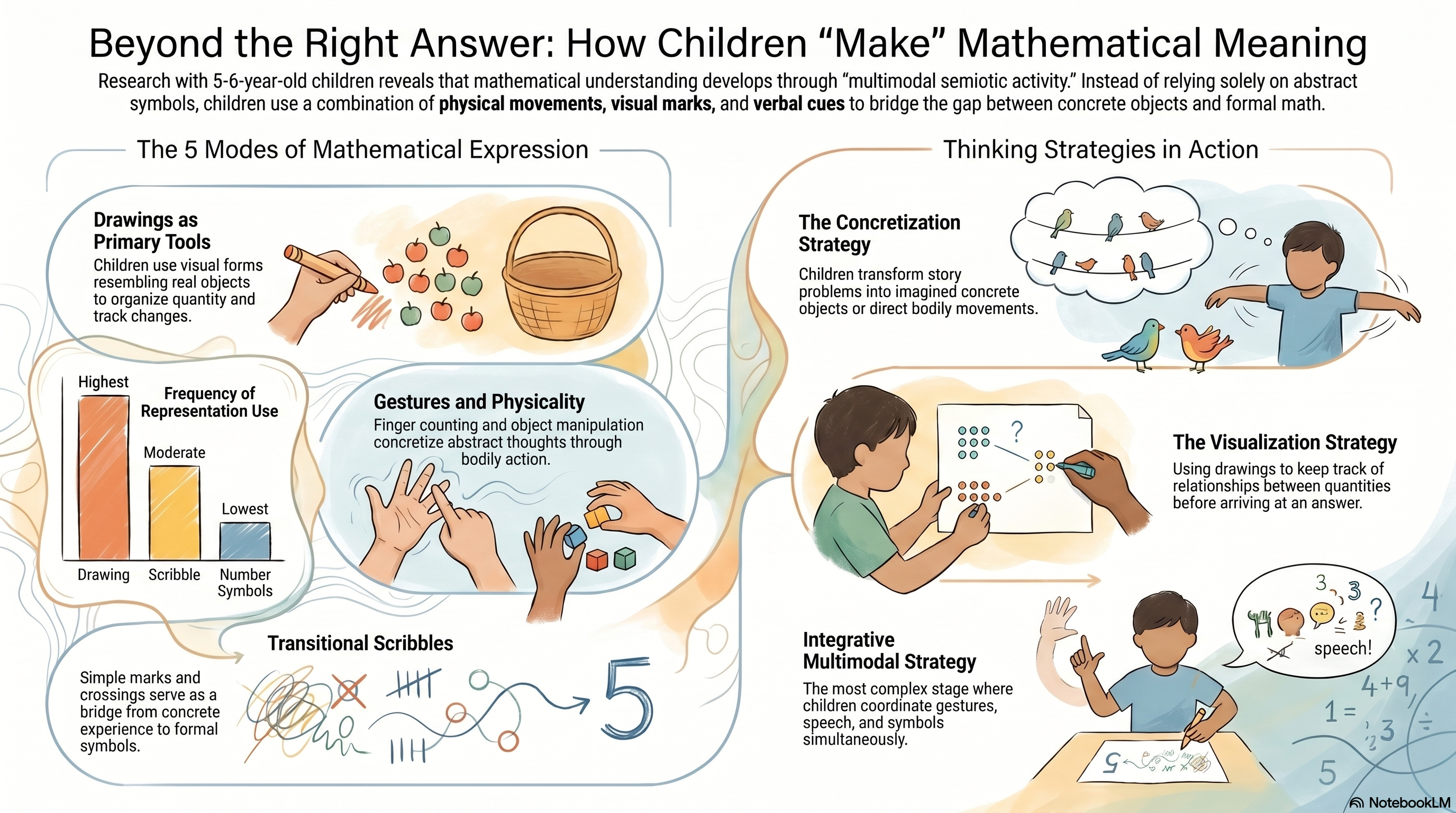
This study addresses a gap in early childhood mathematics research, while previous studies have largely emphasized number-symbol representation and correct answers, limited attention has been paid to children’s semiotic, multimodal, and meaning-making processes when solving numerical story problems. This study employs a descriptive qualitative approach. Data were collected through observation of children while working on numerical story problems, interviews with teachers regarding how children learn, and documentation of scribbles, drawings, and mathematical symbols produced by children. This study was conducted with 25 kindergarten children aged 5–6 years (Group B) at RA Anggrek. Data were collected through classroom observations, contextual interviews with children and teachers, and documentation of children’s drawings, scribbles, gestures, verbal counting, and mathematical symbols. The findings show that children predominantly used drawings as primary semiotic representations, accompanied by gestures, verbal counting, scribbles, and emerging use of number symbols. These modes did not appear separately; rather, they interacted dynamically as thinking tools in the children’s meaning-making process. The child's meaning-making process toward the signs they created shows that these representations function as thinking tools. From Vygotsky's perspective, the Zone of Proximal Development (ZPD) emerges when children transition from concrete to abstract thinking, whereas according to Piaget, children are in the preoperational stage, which still relies on concrete objects. This study highlights that children’s mathematical understanding develops through multimodal semiotic activity, not merely through formal symbols or final answers. Pedagogically, the findings suggest that early childhood numeracy instruction should provide space for drawing, moving, marking, and talking as legitimate parts of mathematical thinking.
References
Azhari, T. S., & Indah, R. N. (2025). Early childhood vocabulary acquisition through multimodal strategies : a semiotic study of miss rachel. Aulad : Journal on Early Childhood, 8(3), 1483–1492. https://doi.org/10.31004/aulad.v8i3.1195
Björklund, C., van den Heuvel-Panhuizen, M., & Kullberg, A. (2020). Research on early childhood mathematics teaching and learning. ZDM Mathematics Education, 52, 607–619. https://doi.org/10.1007/s11858-020-01177-3
Björklund, C., & Palmér, H. (2022). Teaching toddlers the meaning of numbers—connecting modes of mathematical representations in book reading. Educational Studies in Mathematics, 110, 525–544. https://doi.org/10.1007/s10649-022-10147-3
Braun, V., & Clarke, V. (2021). One size fits all? What counts as quality practice in (reflexive) thematic analysis? Qualitative Research in Psychology, 18(3), 328–352. https://doi.org/10.1080/14780887.2020.1769238
Byrne, E. M., Jensen, H., Thomsen, B. S., & Ramchandani, P. G. (2023). Educational interventions involving physical manipulatives for improving children’s learning and development: A scoping review. Review of Education, 11(2), 3400. https://doi.org/10.1002/rev3.3400
Campbell, K., & Cunningham, A. E. (2025). Examining young children’s transitions from drawing into early writing. Early Childhood Research Quarterly, 72, 317–327. https://doi.org/10.1016/j.ecresq.2025.04.007
Cartwright, K. (2024). Interpreting young children’s multiplicative strategies through their drawn representations. Mathematics Education Research Journal, 36, 367–397. https://doi.org/10.1007/s13394-023-00450-4
Clements, D. H., Lizcano, R., & Sarama, J. (2023). Research and pedagogies for early math. Education Sciences, 13(8), 839. https://doi.org/10.3390/educsci13080839
Congdon, E. L., & Levine, S. C. (2023). Unlocking the power of gesture: using movement-based ınstruction to ımprove first grade children’s spatial unit misconceptions. Journal of Intelligence (Vol. 11, Issue 10, p. 200). https://doi.org/10.3390/jintelligence11100200
Creswell, J. W., & Creswell, J. D. (2023). Research design: Qualitative, quantitative, and mixed methods approaches (6th ed.). SAGE.
Deguara, J., & Nutbrown, C. (2018). Signs, symbols and schemas: understanding meaning in a child’s drawings. International Journal of Early Years Education, 26(1), 4–23. https://doi.org/10.1080/09669760.2017.1369398
Gil, P., Martínez, V., Toro, W., & Castañeda, W. (2025). Children’s Drawing and Graphic Development: An Empirical Study of the Developmental Stages According to Lowenfeld. Education Sciences, 15, 681. https://doi.org/10.3390/educsci15060681
Graven, M., & Jorgensen, R. (2024). Early numeracy opportunities through number stories with marginalised families. ZDM Mathematics Education, 56, 319–333. https://doi.org/10.1007/s11858-023-01537-9
Hundeland, P. S., Carlsen, M., & Erfjord, I. (2020). Qualities of mathematical discourses in kindergartens. ZDM Mathematics Education, 52, 691–702. doi: 10.1007/s11858-020-01146-w. https://doi.org/10.1007/s11858-020-01146-w
Liang, Z., Tay, L. O., & Dennis, S. (2026). Private speech: similarities between a large language model and children. Frontiers in Artificial Intelligence, 9, https://doi.org/10.3389/frai.2026.1691074
Liu, T., Gomez, G., & Shipman, F. M. (2025). Investigating children’s multimodal enactment in digitally augmented tabletop storytelling. International Journal of Child-Computer Interaction, 46, 100770. https://doiorg/10.1016/j.ijcci.2025.100770
Marwaha, S., Goswami, M., & Vashist, B. (2017). Prevalence of Principles of Piaget’s Theory Among 4-7-year-old Children and their Correlation with IQ. Journal of Clinical and Diagnostic Research : JCDR, 11(8), ZC111–ZC115. https://doi.org/10.7860/JCDR/2017/28435.10513
Miles, M. B., Huberman, A. M., & Saldaña, J. (2020). Qualitative data analysis: A methods sourcebook (4th ed.). Sage.
Monteira, S. F., Jiménez-Aleixandre, M. P., & Martins, I. (2024). Cultural semiotic resources in young children’s science drawings. Cultural Studies of Science Education, 19(2), 295–315. https://doi.org/10.1007/s11422-024-10214-6
Mustofa, M., Jamil, A., & Ulum, B. (2021). Pengaruh bercerita terhadap kemampuan numerasi anak usia 5-6 tahun [The effect of storytelling on the numeracy abilities of children aged 5–6 years]. Jurnal Pendidikan Anak Usia Dini Undiksha, 9(2), 154–162. https://doi.org/10.23887/paud.v9i2.35421
Nichols, D. L., Neal, T., & Hand, B. (2025). A hierarchical typology of multimodal scientific writing in early primary grades. Frontiers in Communication, Volume 10-2025. https://doi.org/10.3389/fcomm.2025.1603737
Outhwaite, L. A., Aunio, P., Leung, J. K. Y., & Van Herwegen, J. (2024). Measuring mathematical skills in early childhood: a systematic review of the psychometric properties of early maths assessments and screeners. Educational Psychology Review, 36, 110. https://doi.org/10.1007/s10648-024-09950-6
Piaget, J. (1952). The child’s conception of number. Routledge & Kegan Paul.
Purwasih, R., Dahlan, J. A., & Irawan, E. (2023). Semiotic perspective in mathematics problem-solving. Journal of Didactic Studies Published, 1(1), 36–46. https://doi.org/10.17509/jds.v1i1.59022
Quane, K. (2025). The confluence of attitudes towards mathematics and pedagogical practice: Evaluating the use of mathematical manipulatives. Mathematics Education Research Journal, 37, 369–398. https://doi.org/10.1007/s13394-024-00494-0
Rahayu, P., & Hartati, S. (2022). Scaffolding dalam pembelajaran matematika anak usia dini berbasis pendekatan konstruktivisme [Scaffolding in constructivist-based early childhood mathematics learning]. Jurnal Pendidikan Usia Dini, 16(1), 59–75. https://doi.org/10.21009/JPUD.161.04
Vygotsky, L. S. (1978). Mind in Society: The Development of Higher Psychological Processes. Harvard University Press.
Warmansyah, J., Yuningsih, R., Nirwana, E. S., Ravidah, Putri, R., Amalina, & Masril. (2023). The effect of mathematics learning approaches and self-regulation to recognize the concept of early numbers ability. Jurnal Pendidikan Usia Dini, 17(1), 55–81. https://doi.org/10.21009/JPUD.171.05
Worthington, M., Dobber, M., & van Oers, B. (2019). The development of mathematical abstraction in the nursery. Educational Studies in Mathematics, 102(1), 91–110. https://doi.org/10.1007/s10649-019-09898-3
Worthington, M., Dobber, M., & van Oers, B. (2024). Intertextuality and the advance of mathematisation in young children’s inscriptions. Research Papers in Education, 39(5), 797–821. https://doi.org/10.1080/02671522.2023.2238286
Yulsyofriend, Mafardi, Novela, T., Anggraini, V., & Priyanto, A. (2023). Stimulating children’s numerical literacy: The effectiveness of singing favorite food songs. Jurnal Pendidikan Usia Dini, 17(1), 144–154. https://doi.org/10.21009/JPUD.171.11
Downloads
Published
How to Cite
Issue
Section
License
Copyright (c) 2026 Sukmawati Firdaus Sagran, Sukmiyati Firdaus Sagran, Lisa Gildner

This work is licensed under a Creative Commons Attribution 4.0 International License.


_-_Copy.jpg)
.jpg)
.jpg)
.jpg)