Beliefs and instructional practices of pre-service mathematics teachers: A systematic literature review
DOI:
https://doi.org/10.33474/jpm.v12i1.25317Keywords:
Belief–Practice Alignment, Instructional Practices, Pre-Service Mathematics Teachers, Systematic Literature Review, Teacher BeliefsAbstract
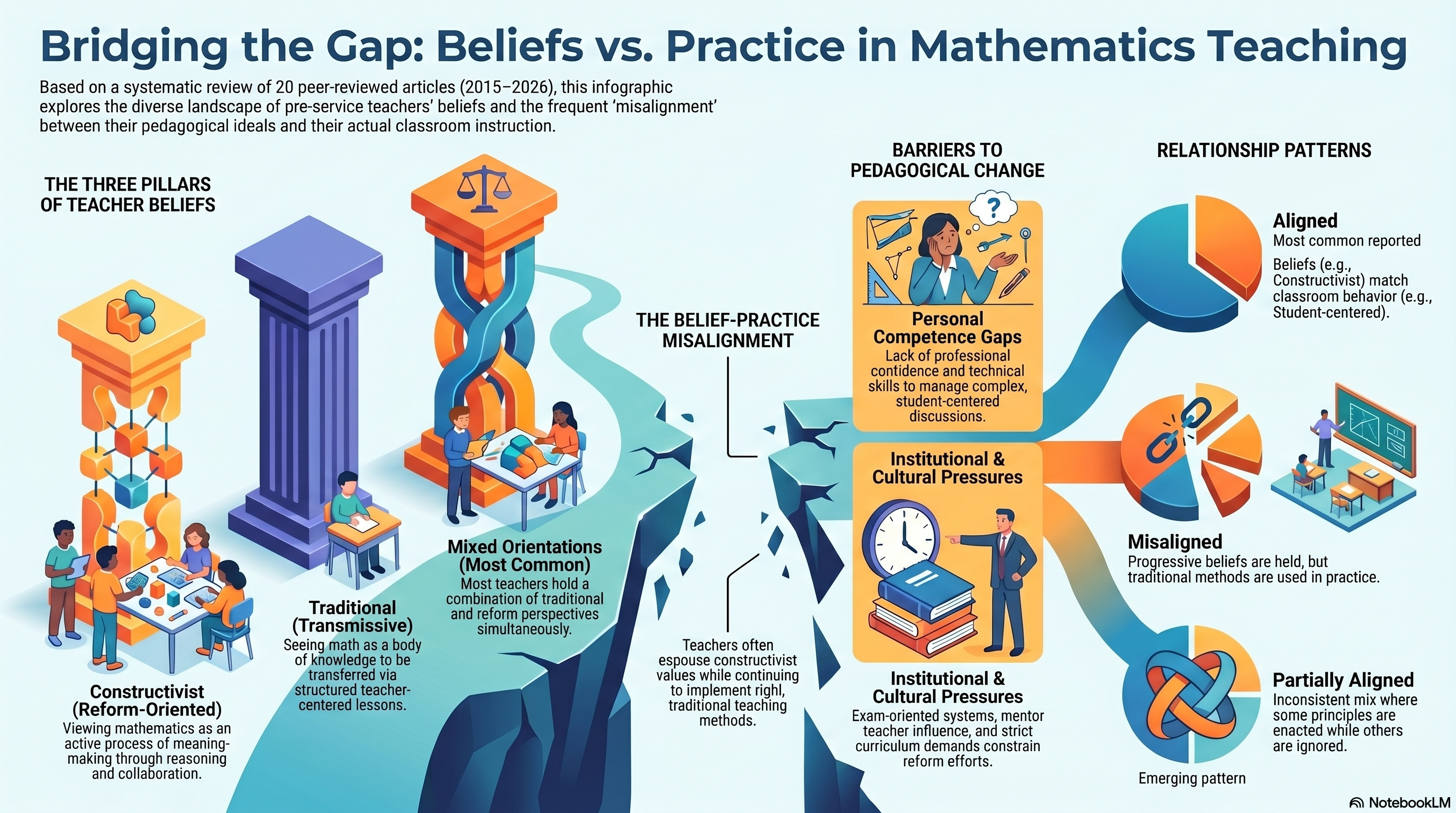
Pre-service mathematics teachers’ beliefs play a crucial role in shaping instructional practices; however, inconsistencies between beliefs and classroom implementation remain a persistent issue. This study aims to systematically review the literature on pre-service mathematics teachers’ beliefs and examine how these beliefs influence instructional practices. Specifically, it addresses two research questions: “What beliefs are held by pre-service mathematics teachers?” and “How do these beliefs influence their instructional practices?” A systematic literature review approach was employed to ensure a rigorous and transparent synthesis of existing research. Articles were retrieved from the Scopus database, focusing on peer-reviewed journal publications from 2015 to 2026. Using the keyword “beliefs” and applying predefined inclusion and exclusion criteria, 20 articles were selected for qualitative analysis. Data were extracted using a structured framework covering beliefs, instructional practices, and their relationship. The findings reveal three dominant belief categories: traditional, constructivist, and mixed. Instructional practices were categorized as teacher-centered and student-centered. Notably, the results indicate a recurring misalignment between beliefs and practices: pre-service teachers espouse constructivist beliefs yet continue to implement traditional approaches. This study concludes that beliefs alone are insufficient to drive pedagogical change.
References
Afrillia, Y. M., & Purnomo, Y. W. (2025). Pre-service teacher’s beliefs in mathematics: A systematic literature review 2020-2024. Primary : Jurnal Pendidikan Guru Sekolah Dasar, 14(2), 134–148. https://doi.org/10.33578/jpfkip-v14i2.p134-148
Apkarian, N., Habre, S., Latona, T., & Chris, T. (2023). Prospective secondary teachers ’ emergent knowledge and beliefs: Inquiry‑oriented differential equations contributing to teacher preparation. ZDM – Mathematics Education, 55(4), 823–835. https://doi.org/10.1007/s11858-023-01469-4
Ayalew, M. (2025). The theory-practice gap in constructivist pedagogy: Instructors’ beliefs and practices at the college of social sciences, University of Gondar. Bahir Dar Journal of Education, 25(3), 27–43. https://dx.doi.org/10.4314/bdje.v25i3.3
Blundell, C. N. (2025). Using design thinking to embrace the complexities of teacher learning-practice with digital technologies. Professional Development in Education, 51(3), 386–404. https://doi.org/10.1080/19415257.2024.2422063
Coles, A. (2023). Towards a socio-ecological practice of mathematics teacher education. AIEM - Avances de Investigación en Educación Matemática, 23, 19–35. https://doi.org/10.35763/aiem23.5489
Daly, C., & Langdon, F. (2020). How do ecological perspectives help understand schools as sites for teacher learning? Professional Development in Education, 46(4). https://doi.org/10.1080/19415257.2020.1787208
Depaepe, F., Verschaffel, L., & Star, J. (2020). Expertise in developing students’ expertise in mathematics: Bridging teachers’ professional knowledge and instructional quality. ZDM – Mathematics Education, 0123456789. https://doi.org/10.1007/s11858-020-01148-8
Dunekacke, S., Meyer-jenßen, L., & Eid, M. (2025). One model to fit them all? A mixture Ddstribution path analysis of preservice early childhood teachers’ beliefs, emotions, and knowledge. ZDM – Mathematics Education, 57, 1177–1189. https://doi.org/10.1007/s11858-025-01686-z
Eckerskorn, F., Kleine, M., Frenzel, A. C., Wuensch, M., Pekrun, R., & Brings, L. (2026). Confronted with mathematics: The impact of pre-service elementary school teachers’ self-concept on emotional and physiological responses tomathematics exposure. ZDM – Mathematics Education. https://doi.org/10.1007/s11858-026-01779-3
Ehrenfeld, N., & Brady, C. (2025). Learning to teach across departments: An ecological perspective on the learning experiences of mathematics pre-service teachers. J Math Teacher Educ 29, 669–702. https://doi.org/10.1007/s10857-025-09733-y
Emery, N., Maher, J. M., & Ebert-may, D. (2021). Environmental influences and individual characteristics that affect learner-centered teaching practices. PLoS ONE, 16(4), 1–25. https://doi.org/10.1371/journal.pone.0250760
Fukaya, T., Fukuda, M., & Suzuki, M. (2024). Relationship between mathematical pedagogical content knowledge, beliefs, and motivation of elementary school teachers. Frontiers in Education, 8(1276439). https://doi.org/10.3389/feduc.2023.1276439
Fukuda, M., Fukaya, T., & Kusumi, T. (2024). Differences and relationships between teachers’ pedagogical beliefs and teaching strategies used at different school levels in japan. Sage Open, 1–14. https://doi.org/10.1177/21582440241281852
Gao, S. (2025). Pre-service mathematics teachers’ epistemological beliefs and instructional practices in Northwest China. International Journal of Research and Innovation in Social Science, 9(10), https://doi.org/10.47772/IJRISS.2025.910000293.
Gough, D., Oliver, S., & Thomas, J. (2017). An introduction to systematic reviews (J. Seaman (ed.)). SAGE.
Haavold, P., Roksvold, J., & Sriraman, B. (2024). Pre-service teachers’ knowledge of and beliefs about direct and indirect proofs. Investigations in Mathematics Learning, 16(4), 336–355. https://doi.org/10.1080/19477503.2024.2363710
Hanin, V., & Holm, J. (2023). How permeable are the beliefs of future secondary school mathematics teachers to pre-service experiences? looking across their years of training. SAGE Open, 1–27. https://doi.org/10.1177/21582440231216836
Hatisaru, V., Collins, J., & Rott, B. (2025). New insights into the beliefs of secondary pre-service teachers about mathematics. EURASIA Journal of Mathematics, Science and Technology Education, 21(8). https://doi.org/10.29333/ejmste/16656
Hoth, J., Larrain, M., & Kaiser, G. (2022). Identifying and dealing with student errors in the mathematics classroom: Cognitive and motivational requirements. Frontiers in Education, 1–16. https://doi.org/10.3389/fpsyg.2022.1057730
Jacobson, E. D. (2017). Field Experience and Prospective Teachers’ Mathematical Knowledge and Beliefs. Journal for Research in Mathematics Education, 48(2), 148–190. https://doi.org/10.5951/jresematheduc.48.2.0148
Kim, S. (2018). Technological, pedagogical, and content knowledge (TPACK) and beliefs of preservice secondary mathematics teachers: Examining the relationships. EURASIA Journal of Mathematics, Science and Technology Education, 14(10). https://doi.org/https://doi.org/10.29333/ejmste/93179
Lee, H., & Vongkulluksn, V. W. (2022). Enhancing mathematics teacher professional learning through a contextualized professional development program. Teacher Development. https://doi.org/10.1080/13664530.2022.2134195
Letwinsky, K. M., Cavender, M., Shifting, M., Letwinsky, K. M., & Cavender, M. (2018). Shifting preservice teachers’ beliefs and understandings to support pedagogical change in mathematics. International Journal of Research and Innovation in Social Science (IJRES), 4(1), 106–120. https://doi.org/10.21890/ijres.382939
Lloyd, M. E. R., & Howell, M. (2019). Positioning pre-service teacher beliefs along the traditional-reform continuum: An examination of normative beliefs and discursive claims let us know how access to this document benefits you . The Mathematics Enthusiast, 16(1), 155–210. https://doi.org/10.54870/1551-3440.1454
Lo, W. Y. (2023). The complexities of mathematical knowledge and beliefs within initial teacher education: An analysis of three cases. educational sciences, 13(7), 627. https://doi.org/10.3390/educsci13070697
Mainali, B. (2022). Investigating pre-service teachers ’ beliefs towards mathematics: A case study. European Journal of Science and Mathematics Education, 10(4), 412–435.
Manderfeld, K., & Siller, H. (2019). Pre-service mathematics teachers’ beliefs regarding topics of mathematics education. LUMAT: International Journal on Math, Science and Technology Education, 7(2), 66–79. https://doi.org/10.31129/ LUMAT.7.2.332
Min, M., Whitehead, A., Wells, C., & Akerson, V. (2023). Unpacking elementary preservice teachers’ beliefs on culturally and linguistically responsive mathematics and science teaching for english language learners. International Journal of Research and Innovation in Social Science (IJRES), 9(2), 444–460. https://doi.org/10.46328/ijres.3068
Muhtarom, Happy, N., Nursyahidah, F., & Casanova, A. (2019). Pre-service teacher’s beliefs and knowledge about mathematics. Al-Jabar: Jurnal Pendidikan Matematika, 10(1), 101–110. https://doi.org/10.24042/ajpm.v10i1.3617
Nguyen, L. Q., & Le, H. Van. (2024). Challenges in EFL constructivist classrooms from teachers’ perspectives: A case study in Vietnam. SAGE Open, 1–16. https://doi.org/10.1177/21582440241245187
Novikasari, I., & Dede, Y. (2021). Turkish pre-service mathematics teachers’ beliefs in multiplication. Journal on Mathematics Education, 12(3), 469–486. Retrieved from https://jme.ejournal.unsri.ac.id/index.php/jme/article/view/3647
Page, M. J., Mckenzie, J. E., Bossuyt, P. M., Boutron, I., Hoffmann, C., Mulrow, C. D., Shamseer, L., Tetzlaff, J. M., Akl, E. A., Brennan, S. E., Chou, R., Glanville, J., Grimshaw, J. M., Hróbjartsson, A., Lalu, M. M., Li, T., Loder, E. W., Mayo-wilson, E., Mcdonald, S., … Moher, D. (2021). The PRISMA 2020 statement: An updated guideline for reporting systematic reviews systematic. BMJ, 372. https://doi.org/10.1136/bmj.n71
Pagiling, S. L., & Taufik, A. R. (2022). Unveiling belief and pedagogical content knowledge of prospective secondary mathematics teachers. Jurnal Elemen, 8(2), 411–426. https:/doi.org/10.29408/jel.v8i2.5096
Purnomo, Y. W. (2017). The complex relationship between teachers’ mathematics-related beliefs and their practices in mathematics class. The New Educational, 204–210. https://doi.org/10.15804/tner.2017.47.1.16
Purnomo, Y. W., Suryadi, D., & Darwis, S. (2016). Examining pre-service elementary school teacher beliefs and instructional practices in mathematics class. International Electronic Journal of Elementary Education, 8(4), 629–642. https://iejee.com/index.php/IEJEE/article/view/137
Putri, A. A., Zahroh, A., Rahmawati, A. P., Rosida, A., Rahmawati, A. L., Cahyp, D. N., & Radzi, S. N. M. (2026). Preservice teacher’s enactment of growth mindset in mathematics instruction: A qualitative study from classroom interaction. J-PRIMa: Journal of Philosophy and Research in Islamic Mathematics Education, 2(1), 1–11. Retrieved from https://riset.unisma.ac.id/index.php/j-prima/article/view/25342
Scherer, P., & Bertram, J. (2024). Professionalisation for inclusive mathematics—teacher education programs and changes in pre-service teachers’ beliefs and self-efficacy. ZDM – Mathematics Education, 56, 447–459. https://doi.org/10.1007/s11858-024-01580-0
Schoen, R. C., & LaVenia, M. (2019). Teacher beliefs about mathematics teaching and learning: Identifying and clarifying three constructs. Cogent Education, 6(1).
Segarra, J., & Julià, C. (2022). Mathematics teaching efficacy belief and attitude of pre-service Teachers and academic achievement. European Journal of Science and Mathematics Education, 10(1), 1–14. https://doi.org/10.30935/scimath/11381
Skott, J. (2015). Beliefs and Brownies: In Search for a New Identity for “Belief” Research. In L. Sumpter (Ed.), Current state of research on mathematical beliefs XX: Proceedings of the MAVI-20 Conference (hal. 33–45). International Conference on Mathematical Views (MAVI). http://urn.kb.se/resolve?urn=urn:nbn:se:lnu:diva-51514
Sunzuma, G., & Luneta, K. (2023). Zimbabwean mathematics pre-service teachers’ implementation of the learner-centered curriculum during teaching practice. EURASIA Journal of Mathematics, Science and Technology Education, 19(5), 2–14. https://doi.org/10.29333/ejmste/13131
Tamba, K. P., Cendana, W., & Adegbite, A. (2021). Pre-service primary school mathematics teachers’ beliefs on mathematics assessment. Jurnal Prima Edukasia, 9(2), 158–167. https://doi.org/10.21831/jpe.v9i2.36815
Tran, D., Bull, R., & Waschl, N. (2025). Measuring preservice teacher beliefs about mathematics and mathematics teaching: An evaluation of the TEDS‑M beliefs scale. Mathematics Education Research Journal, 38(1), 219–240. https://doi.org/10.1007/s13394-025-00526-3
Vesga-Bravo, G.-J., Angel-Cuervo, Z.-M., & Chacón-Guerrero, G.-A. (2022). Beliefs about mathematics, its teaching, and learning: Contrast between pre-service and in-service teachers. International Journal of Science and Mathematics Education, 20, 769–791. https://doi.org/10.1007/s10763-021-10164-3
Viquez, A. H., & Joutsenlahti, J. (2021). Mathematical beliefs held by Costa Rican pre-service teachers and teacher Educators. Education Sciences, 11(70), 2–17. https://doi.org/https:// doi.org/10.3390/educsci11020070
Wadanambi, G. M., & Leung, F. K. S. (2019). Exploring the influence of pre-service mathematics teachers’ professed beliefs on their practices in the Sri Lankan context. LUMAT: International Journal on Math, Science and Technology Education, 7(2), 134–149. https://doi.org/10.31129/ LUMAT.7.2.405
Wellberg, S. (2025). An examination of pre‑service mathematics teachers’ course‑taking, beliefs, and preferred assessment practices. Journal of Mathematics Teacher Education, 28(7), 1567–1606. https://doi.org/10.1007/s10857-024-09640-8
Woltron, F. (2026). Prospective teachers’ mathematical world views and beliefs about mathematics teaching and learning goals. International Journal of Mathematical Education in Science and Technology, 57(2), 237–252. https://doi.org/10.1080/0020739X.2024.2427833
Yang, X., Deng, J., König, J., & Kaiser, G. (2026). Relationships between Chinese preservice mathematics teachers’ knowledge, pedagogical beliefs, and noticing. ZDM – Mathematics Education, 58, 163–175. https://doi.org/10.1007/s11858-025-01760-6
Yang, X., Kaiser, G., König, J., & Blömeke, S. (2020). Relationship between pre‑service mathematics teachers’ knowledge, beliefs and instructional practices in China. ZDM – Mathematics Education, 52(2), 281–294. https://doi.org/10.1007/s11858-020-01145-x
Downloads
Published
How to Cite
Issue
Section
License
Copyright (c) 2026 Alfina Lutfi Rahmawati, Alfiatur Rosida, Anggi Adelia Putri, Anita Zahroh, Annisa Putri Rahmawati, Dwi Nur Cahyo, Syazlin Nadia Mat Radzi

This work is licensed under a Creative Commons Attribution 4.0 International License.


_-_Copy.jpg)
.jpg)
.jpg)
.jpg)