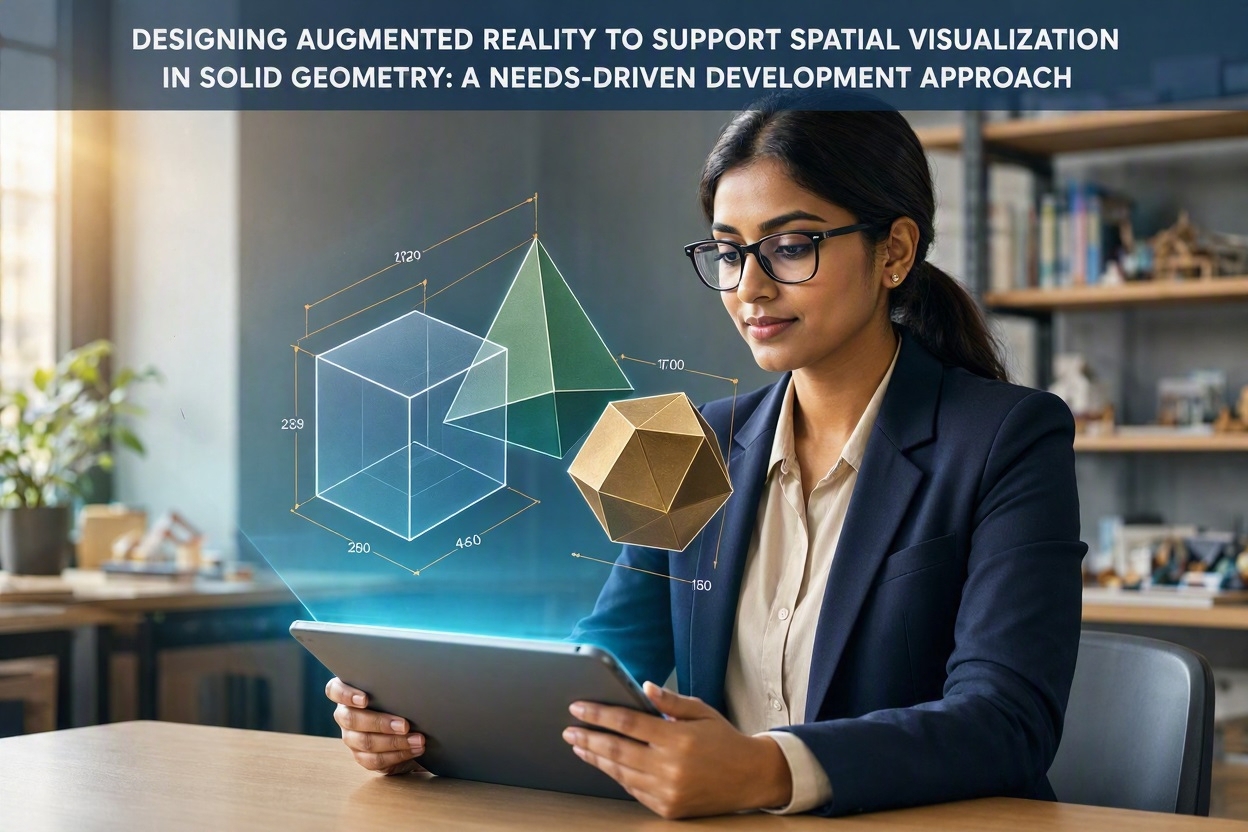
Designing augmented reality to support spatial visualization in solid geometry: A needs-driven development approach
DOI:
https://doi.org/10.33474/jpm.v12i2.25706Keywords:
Augmented Reality, Spatial Visualization, Flat-Sided Solid Geometry, ADDIE, Unity, Mathematics EducationAbstract
This study developed and evaluated a Unity-based Augmented Reality (AR) learning medium designed to support eighth-grade students' spatial visualization in flat-sided solid geometry (cubes, cuboids, prisms, and pyramids). Using a Research and Development (R&D) approach structured by the ADDIE (Analysis, Design, Development, Implementation, and Evaluation) model. The media was built with Unity, Blender, Canva, and Vuforia. The distinctive feature is an interactive net-representation function that lets learners watch a solid unfold into its net and fold back, externalizing the net-to-solid transition that needs analysis identified as students' central difficulty. The product was validated by two material experts, two media experts, and two practitioner-teachers, and trialed with 12 students (small group) and 34 students (field). Validation placed the media in the "very feasible" category (material experts 96% and 91%; media experts 100% and 94%; practitioners 92% and 97%), and student responses in both trials were consistently positive for usability and practicality. Because the study assessed feasibility and practicality rather than learning outcomes, it does not claim measured gains in achievement or spatial visualization. Instead, it establishes a validated, classroom-ready medium whose effectiveness should be tested experimentally in future work.
References
Ateş, H., & Garzón, J. (2023). An integrated model for examining teachers' intentions to use augmented reality in science courses. Education and Information Technologies, 28(2), 1299–1321. https://doi.org/10.1007/s10639-022-11239-6
Avila-Garzon, C., Bacca-Acosta, J., Kinshuk, Duarte, J., & Betancourt, J. (2021). Augmented reality in education: An overview of twenty-five years of research. Contemporary Educational Technology, 13(3), ep302. https://doi.org/10.30935/cedtech/10865
Buchner, J., Buntins, K., & Kerres, M. (2022). The impact of augmented reality on cognitive load and performance: A systematic review. Journal of Computer Assisted Learning, 38(1), 285–303. https://doi.org/10.1111/jcal.12617
Çeken, B., & Taşkın, N. (2025). Examination of multimedia learning principles in augmented reality and virtual reality learning environments. Journal of Computer Assisted Learning, 41(1), e13097. https://doi.org/10.1111/jcal.13097
Eryigit, C. D, Kucuk, S., & Tasgin, A. (2025). Impact of augmented reality technology on geometry skills and motivation of preschool children. Education and Information Technologies, 30(16), 22753–22778. https://doi.org/10.1007/s10639-025-13631-4
Elford, D., Lancaster, S. J., & Jones, G. A. (2022). Exploring the effect of augmented reality on cognitive load, attitude, spatial ability, and stereochemical perception. Journal of Science Education and Technology, 31(3), 322–339. https://doi.org/10.1007/s10956-022-09957-0
Flavin, E., Hwang, S., & Flavin, M. T. (2025). Augmented Reality for Mathematics Achievement: A Meta-Analysis of Main and Moderator Effects: Flavin et al. International Journal of Science and Mathematics Education, 23(7), 2305–2330. https://doi.org/10.1007/s10763-025-10546-x
Gargrish, S., Kaur, D. P., Mantri, A., Singh, G., & Sharma, B. (2021). Measuring effectiveness of augmented reality‐based geometry learning assistant on memory retention abilities of the students in 3D geometry. Computer Applications in Engineering Education, 29(6), 1811–1824. https://doi.org/10.1002/cae.22424
Hafizah, N. (2023). Media Pembelajaran Digital Generasi Alpha Era Society 5.0 Pada Kurikulum Merdeka [Digital Learning Media for Generation Alpha in the Society 5.0 Era within the Independent Curriculum]. Al-Madrasah: Jurnal Ilmiah Pendidikan Madrasah Ibtidaiyah, 7(4), 1675–1688. https://doi.org/10.35931/am.v7i4.2699
Herman, H., Zalukhu, A., Hulu, D. B. T., Zebua, N. S. A., Manik, E., & Situmorang, A. S. (2023). Augmented reality (AR) pada geogebra meningkatkan kemampuan spasial dan pemecahan masalah matematis pada materi dimensi tiga [Augmented reality (AR) in GeoGebra enhances spatial and mathematical problem-solving abilities regarding three-dimensional topics]. Journal on Education, 5(3), 6032–6039. https://doi.org/10.31004/joe.v5i3.1368
Hidayat, R., Samsudin, S., Wang, X., & Rahman, S. N. A. (2026). Augmented Reality in Science, Technology, Engineering and Mathematics Education: A Meta‐Analysis. Journal of Computer Assisted Learning, 42(1), e70164. https://doi.org/10.1002/jcal.70164
Hrp, F. P. L., Ibna, F. A., Purba, T., Panjaitan, A., Saragih, L. D., Abyansyah, N., & Sihombing, W. L. (2025). Analisis miskonsepsi geometri bangun datar dan bangun ruang pada buku matematika tingkat SMP sederajat [Analysis of misconceptions regarding 2D and 3D shapes in mathematics textbooks for the junior high school level (or equivalent)]. Pendas: Jurnal Ilmiah Pendidikan Dasar, 10(03), 260–273. https://journal.unpas.ac.id/index.php/pendas/article/view/33388/16877
Hussain, A., Shakeel, H., Hussain, F., Uddin, N., & Ghouri, T. L. (2020). Unity game development engine: A technical survey. Univ. Sindh J. Inf. Commun. Technol, 4(2), 73–81. https://sujo.usindh.edu.pk/index.php/USJICT/article/view/1800
Kifthiyyah, M., Hariastuti, R. M., Listiwikono, E. (2024). Kemampuan visual spasial siswa smp pada materi bangun ruang sisi datar ditinjau dari jenis kelamin [Visuospatial abilities of junior high school students regarding solid shapes with flat faces, analyzed by gender]. Differential: Journal on Mathematics Education, 1(2), 110–125. https://doi.org/10.32502/differential.v1i2.102
Lee, W. W., & Owens, D. L. (2004). Multimedia-based instructional design: Computer-based training, web-based training, distance learning (2nd ed.). Pfeiffer
Li, G., Luo, H., Chen, D., Wang, P., Yin, X., & Zhang, J. (2025). Augmented reality in higher education: A systematic review and meta-analysis of the literature from 2000 to 2023. Education Sciences, 15(6), 678. https://doi.org/10.3390/educsci15060678
Ma’rufi, M., & Alam, S. (2025). Analisis kesulitan siswa dalam menyelesaikan masalah bangun ruang sisi datar ditinjau dari gaya kognitif field independent [Analysis of students' difficulties in solving problems involving polyhedra with flat faces, viewed from a field-independent cognitive style]. Proximal: Jurnal Penelitian Matematika Dan Pendidikan Matematika, 8(2), 653–664. https://doi.org/10.30605/proximal.v8i2.6065
Nadzeri, M., Musa, M., Cheng Meng, C., & Ismail, N. (2024). The effects of augmented reality geometry learning applications on spatial visualization ability for lower primary school pupils. International Journal of Interactive Mobile Technologies, 18(16), 104–118. https://doi.org/10.3991/ijim.v18i16.47079
Nazarudin, M. F., Asmoro, D. P. T., & Sianipar, A. Z. (2024). Pembuatan aplikasi mobile augmented reality untuk visualisasi rumah adat berbasis Unity [Development of a Unity-based mobile augmented reality application for visualising traditional houses]. Jurnal Manajemen Informatika Jayakarta, 4(4), 315–342. https://doi.org/10.52362/jmijayakarta.v4i4.1615
Nindiasari, H., Pranata, M. F., Sukirwan, S., Sugiman, S., Fathurrohman, M. Ruhimat, A., & Yuhana, Y. (2024). The use of augmented reality to improve students' geometry concept problem-solving skills through the STEAM approach. Infinity Journal, 13(1), 119–138. https://doi.org/10.22460/infinity.v13i1.p119-138
Ozcakir, B., & Cakiroglu, E. (2021). An augmented reality learning toolkit for fostering spatial ability in mathematics lesson: Design and development. European Journal of Science and Mathematics Education, 9(4), 145–167. https://doi.org/10.30935/scimath/11204
Pakpahan, S. P., Sapta, A., & Nisa, U. K. (2023). Development of augmented reality in understanding the nets and ribs of spatial buildings. Jurteksi, 10(1), 115-122. https://doi.org/10.33330/jurteksi.v10i1.2972
Papakostas, C., Troussas, C., Krouska, A., & Sgouropoulou, C. (2022). Personalization of the learning path within an augmented reality spatial ability training application based on fuzzy weights. Sensors, 22(18), 7059. https://doi.org/10.3390/s22187059
Pujiastuti, H., & Haryadi, R. (2024). The effectiveness of using augmented reality on the geometry thinking ability of junior high school students. Procedia Computer Science, 234, 1738–1745. https://doi.org/10.1016/j.procs.2024.03.180
Riduwan, M. B. A. (2022). Skala pengukuran variabel-variabel penelitian [Measurement scales of research variables]. Alfabeta
Rodriguez-Saavedra, M. O., Benavides, L. G. B., Galindo, I. C., Ascuna, L. M. C., Gonzales, A. V. M., López, J. W. M., & Arguedas-Catasi, R. W. (2025). Augmented reality as an educational tool: Transforming teaching in the digital age. Information, 16(5), 372. https://doi.org/10.3390/info16050372
Rohendi, D., Ramadhan, M. O., Syrene, S., Rahim, A., Zulnaedi, H. (2025). Enhancing students' interactivity and responses in learning geometry by using augmented reality. Eurasia Journal of Mathematics, Science and Technology Education, 21(1), em2559. https://doi.org/10.29333/ejmste/15796
Su, Y.-S., Cheng, H.-W., & Lai, C.-F. (2022). Study of virtual reality immersive technology enhanced mathematics geometry learning. Frontiers in Psychology, 13, 760418. https://doi.org/10.3389/fpsyg.2022.760418
Tarng, W., Huang, J.-K., & Ou, K.-L. (2024). Improving elementary students' geometric understanding through augmented reality and its performance evaluation. Systems, 12(11), 493. https://doi.org/10.3390/systems12110493
Uriarte-Portillo, A., Zataraín-Cabada, R., Barrón-Estrada, M. L., Ibáñez, M., & González-Barrón, L.-M. (2023). Intelligent augmented reality for learning geometry. Information, 14(4), 245. https://doi.org/10.3390/info14040245
Voulgari, N., Panagopoulos, M., & Garneli, V. (2025). A systematic review of augmented reality in mathematics education: Fostering learning through art integration. Arts & Communication, 3(2), 4446. https://doi.org/10.36922/ac.4446
Wong, J., Yu, K., & Giacaman, N. (2021). Scaffolding spatial ability with augmented reality and virtual reality. International Journal of Mobile Learning and Organisation, 15(1), 50–69. https://doi.org/10.1504/ijmlo.2021.111597
Yang, Y., Wenfei, D., Mavrikis, M., & Geraniou, E. (2025). Spatial skill development through augmented reality in mathematics education: A scoping review. Digital Experiences in Mathematics Education, 12, 277–310. https://doi.org/10.1007/s40751-025-00187-8
Yu, J., Denham, A. R., & Searight, E. (2022). A systematic review of augmented reality game-based learning in STEM education. Educational Technology Research and Development, 70(4), 1169–1194. https://doi.org/10.1007/s11423-022-10122-y
Downloads
Published
How to Cite
Issue
Section
License
Copyright (c) 2026 Muhamad Rifky Permadi, Satya Santika, Yeni Heryani ; Teerapat Piyaket

This work is licensed under a Creative Commons Attribution 4.0 International License.


_-_Copy.jpg)
.jpg)
.jpg)
.jpg)