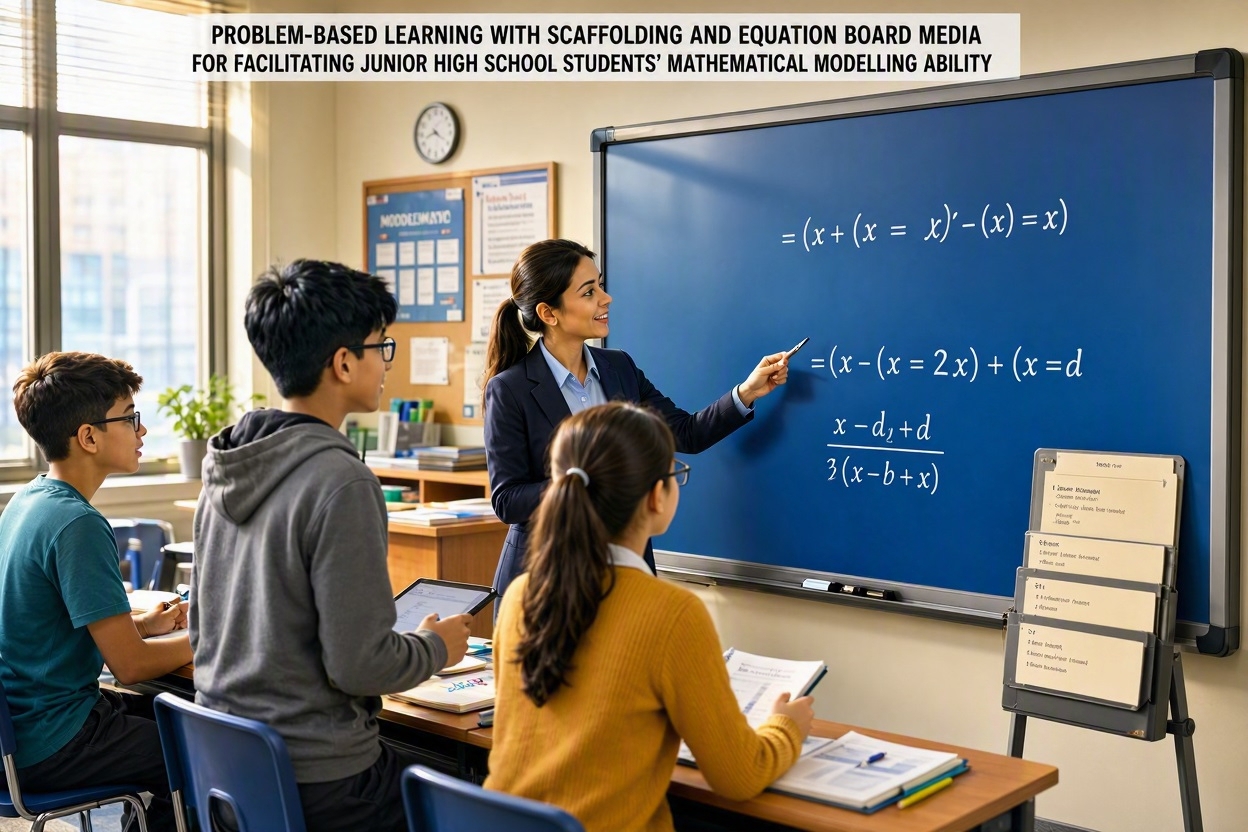
Problem-based learning with scaffolding and equation board media for facilitating junior high school students’ mathematical modelling ability
DOI:
https://doi.org/10.33474/jpm.v12i2.25814Keywords:
Problem-Based Learning, Scaffolding, Equation Board, Mathematical Modelling, Linear Equation of Two Variable SystemsAbstract
This study was motivated by classroom observations and interviews with mathematics teachers at SMP Nahdlatul Ulama (NU) Simo (a private Junior High School), which revealed that students experienced difficulties in mathematical modelling, particularly in the topic of Two-Variable Linear Equation Systems (SPLDV). These challenges were associated with teacher-centered instruction and the limited use of learning media that engaged students. To address these issues, Problem-Based Learning (PBL) integrated with the scaffolding method and supported by equation board media was implemented. This study aimed to describe students’ mathematical modelling achievement, learning responses, and classroom participation after the implementation of the instructional approach. A descriptive quantitative method with a one-shot case study design, classified as a one-group posttest-only pre-experimental design, was employed and supported by classroom observations. The participants were 26 students of 8th grade at SMP NU Simo. Data were collected through mathematical modelling tests, student response questionnaires, and classroom observations. The data were analyzed descriptively using test scores, questionnaire percentages, and observation results to determine students’ achievement categories. The findings showed that students’ mathematical modelling ability was categorized as good, with an average score of 80. Student responses toward the learning process were classified as very good, with an average percentage of 89%, while classroom participation reached the good category, with an average percentage of 79%. These findings indicate that implementing PBL integrated with scaffolding and equation board media was associated with students’ mathematical modelling achievement, positive learning responses, and active classroom participation.
References
Arsyad, A. (2019). Media pembelajaran [Learning resources]. Jakarta: Rajawali Pers, 89. https://perpus-bpmpkepri.kemendikdasmen.go.id/index.php?p=show_detail&id=
387&keywords=
Asmana, A. T., Rohim, A., Aini, K. N., & Winata, V. P. (2023). Development of Problem-Based Learning-Based independent curriculum LKPD to improve students’ HOTS. Mathline : Jurnal Matematika Dan Pendidikan Matematika, 8(4), 1415–1436. https://doi.org/10.31943/mathline.v8i4.514
Blum, W., & Borromeo Ferri, R. (2009). Mathematical modelling: Can it be taught and learnt?, Journal of Mathematical Modelling and Application, 1(1), 45-58 https://eclass.uoa.gr/modules/document/file.php/MATH601/3rd%20&%204rth%20unit/3rd%20unit_Modelling%20cycle.pdf
Cevikbas, M., Kaiser, G., & Schukajlow, S. (2022). A systematic literature review of the current discussion on mathematical modelling competencies: state-of-the-art developments in conceptualizing, measuring, and fostering. Educational Studies in Mathematics, 109(2), 205-236. https://doi.org/10.1007/s10649-021-10104-6
Chrisdiyanto, E., & Hamdi, S. (2023). Efektivitas problem based learning dan problem solving terhadap kemampuan berpikir kritis dan kemandirian belajar matematika [The effect of problem-based learning and problem-solving on critical thinking skills and independent learning in mathematics]. Jurnal Riset Pndidikan Matematika, 10(2), 165–174. https://doi.org/10.21831/jrpm.v10i2.65754
Dewi, E. R., & Nurjanah, A. (2022). Problem-based learning and case-based learning: Which is more effective for fostering mathematical connection?. Jurnal Riset Pendidikan Matematika, 9(2), 124–136. https://doi.org/10.21831/jrpm.v9i2.53276
Ernawati, M. D. W., Rusdi, M., Asrial, A., Muhaimin, M., Wulandari, M., & Maryani, S. (2022). Analysis of problem based learning in the scaffolding design: Students’ creative-thinking skills. Cypriot Journal of Educational Sciences, 17(7), 2333–2348. https://doi.org/10.18844/cjes.v17i7.7551
Fajriani, R. W., Naswir, M., & Harizon, H. (2021). Pemberian scaffolding dalam bahan belajar berbasis masalah untuk meningkatkan kemampuan berpikir tingkat tinggi siswa[The provision of scaffolding in problem-based learning materials to enhance pupils’ higher-order thinking skills]. PENDIPA Journal of Science Education, 5(1), 108–114. https://doi.org/10.33369/pendipa.5.1.108-114
Fitriyah, I. M., Putro, N. H. P. S., & Apino, E. (2022). Meta analysis study: Effectiveness of problem based learning on Indonesian students’ mathematical reasoning ability. Jurnal Riset Pendidikan Matematika, 9(1), 36–45. https://doi.org/10.21831/jrpm.v9i1.46447
Lindl, A., Durandt, R., & Blum, W. (2025). Fostering mathematical modelling competency in different learning environments and educational contexts – an exploratory comparative analysis of four intervention studies. ZDM - Mathematics Education, 57(1), 351–364. https://doi.org/10.1007/s11858-025-01680-5
Lusiana, R., Suprapto, E., & Sukristini, I. (2021). Effectiveness of Problem Based Learning (PBL) on mathematics learning achievement in terms of student Adversity Quotient (AQ). Edumatica : Jurnal Pendidikan Matematika, 11(2), 55–63.. https://doi.org/10.22437/edumatica.v11i02.7670
Mita, M., & Ihsanudin, I. (2024). Pengaruh Problem Based Learning berbantuan scaffolding terhadap kemampuan berpikir kritis matematis dan self-concept peserta didik.[ The effect of scaffolded problem-based learning on pupils’ mathematical critical thinking skills and self-concept]. Jurnal Cendekia: Jurnal Pendidikan Matematika, 8(2), 1211–1224. https://doi.org/10.31004/cendekia.v8i2.3198
Mitrayana, M., & Juandi, D. (2023). Penerapan problem based learning dalam pembelajaran matematika: Systematic literature review [The application of problem-based learning in mathematics education: A systematic literature review]. EduMatSains: Jurnal Pendidikan, Matematika Dan Sains, 8(1), 90–103. https://doi.org/10.33541/edumatsains.v8i1.4834
Salam, M., Ndia, L., Misu, L., Jafar, J., Suhar, S., & Hasnawati, H. (2024). Applying scaffolding technique in Problem Based Learning (PBL) model on students’ mathematics problem solving ability. World Journal of Advanced Research and Reviews, 21(3), 1372–1379. https://doi.org/10.30574/wjarr.2024.21.3.0846
Nugraha, A. A., Purwati, H., Ariyanto, L., & Sumarti. (2023). Problem-based learning integrated with flipped classrooms assisted by google sites to improve student mathematics learning achievement. Jurnal Pijar MIPA, 18(5), 670–675.. https://doi.org/10.29303/jpm.v18i5.5428
Nurdyansyah, N., & Fahyuni, E. F. (2020). Media pembelajaran inovatif. UMSIDA Press, 14-17. https://doi.org/10.21070/2019/978-602-5914-71-3
Nurochmah, Y., & Kharisudin, I. (2023). Mathematical modeling problem solving viewed from students’ mathematical self-concept on means-ends analysis based on blended learning. Unnes Journal of Mathematics Education, 12(2), 167–176.. https://doi.org/10.15294/ujme.v12i2.74003
OECD. (2022). PISA 2022 results (Volume I): The state of learning and equity in education. OECD Publishing, 56-71. https://doi.org/10.1787/53f23881-en
Permatasari, I., & Marlina, R. (2023). Pengaruh model pembelajaran problem based learning terhadap kemampuan pemecahan masalah matematis [The effect of the problem-based learning model on mathematical problem-solving skills]. Jurnal Didactical Mathematics, 5(2), 295–304.. https://doi.org/10.31949/dm.v5i2.5528
Prasetyo, N. A., Yasin, H., & Warsito, B. (2020). Early detection of Dengue Hemorrhagic Fever (DHF) using feed forward neural network with gravitational search algorithm optimization. Journal of Physics: Conference Series, 1655(1). https://doi.org/10.1088/1742-6596/1655/1/012094
Putri, F. M., Buchori, A., Ariyanto, L., & Ernawati, I. (2024). Model problem based learning dengan strategi scaffolding untuk meningkatkan prestasi belajar matematika siswa [A problem-based learning model incorporating scaffolding strategies to improve pupils’ achievement in mathematics]. JP3M (Jurnal Penelitian Pendidikan Dan Pengajaran Matematika), 10(1), 1–12.. https://doi.org/10.37058/jp3m.v10i1.8296
Rohim, A., & Asmana, A. T. (2018). Efektivitas pembelajaran di luar kelas (outdoor learning) dengan pendekatan PMRI pada materi SPLDV [The effectiveness of outdoor learning using the PMRI approach for the SPLDV curriculum]. Jurnal Elektronik Pembelajaran Matematika, 5(3), 217–229. https://jurnal.uns.ac.id/jpm/article/view/26062
Rohmah, A. A., Rohim, A., & Asmana, A. T. (2024). Pengaruh strategi pembelajaran aktif berbasis pendekatan PMRI untuk meningkatkan pemahaman konsep siswa [The effect of an active learning strategy based on the PMRI approach on improving students’ conceptual understanding]. JEDMA Jurnal Edukasi Matematika, 5(1), 19–29. https://doi.org/10.51836/jedma.v5i1.754
Siller, H.-S., Nitzan-Tamar, O., & Kohen, Z. (2023). Scaffolding practices for modelling instruction in STEM-related contexts. ZDM Mathematics Education, 55(7), 1351–1364. https://doi.org/10.1007/s11858-023-01529-9
Tazkia, S., & Siswono, T. Y. E. (2023). Scaffolding in supporting senior high school students’ critical thinking skills in sequences and series problems. MATHEdunesa, 12(1), 207–220.. https://doi.org/10.26740/mathedunesa.v12n1.p207-220
Tiyasari, S., & Suparman, S. (2022). Pengembangan kemampuan pemecahan masalah melalui penggunaan e-modul berbasis problem based learning [Developing problem-solving skills through the use of e-modules based on problem-based learning]. Jurnal Pengembangan Pembelajaran Matematika (JPPM), 4(2), 123–133.https://doi.org/10.14421/jppm.2022.42.123-133
Trisnawati, R. A., & Mahmudi, A. (2024). The influence of the scaffolding approach on critical thinking skills and student collaboration on mathematics learning. JPPI (Jurnal Penelitian Pendidikan Indonesia), 10(4), 290–295. https://doi.org/10.29210/020243526
Vygotsky, L. S. (1978). Mind in society: The development of higher psychological processes. Cambridge, MA: Harvard University Press. https://books.google.com/books?id=RxjjUefze_oC
Wahyuni, N., Mulyono, D., & Mawardi, D. N. (2024). Kemampuan pemecahan masalah matematika siswa melalui model problem based learning berbantuan media pembelajaran Scratch [Pupils’ mathematical problem-solving skills through a problem-based learning model supported by the Scratch learning tool]. Jurnal Penelitian Pembelajaran Matematika Sekolah (JP2MS), 8(2), 153–166. https://doi.org/10.33369/jp2ms.8.2.153-166
Wakhidah, L. Z., & Winarti, E. R. (2024). Students’ mathematical problem solving ability reviewed from learning motivation through problem based learning model assisted by nearpod. Unnes Journal of Mathematics Education, 13(2), 185–198. https://doi.org/10.15294/ujme.v13i2.12690
Downloads
Published
How to Cite
Issue
Section
License
Copyright (c) 2026 Firdyana Dwi Ayustin, Zaenal Arifin, Arezqi Tunggal Asmana

This work is licensed under a Creative Commons Attribution 4.0 International License.


_-_Copy.jpg)
.jpg)
.jpg)
.jpg)