Mathematical conceptual understanding under geogebra-assisted MASTER learning: The role of students’ self-efficacy
DOI:
https://doi.org/10.33474/jpm.v12i2.25859Keywords:
GeoGebra, MASTER Learning, Mathematical Conceptual Understanding, Self EfficacyAbstract
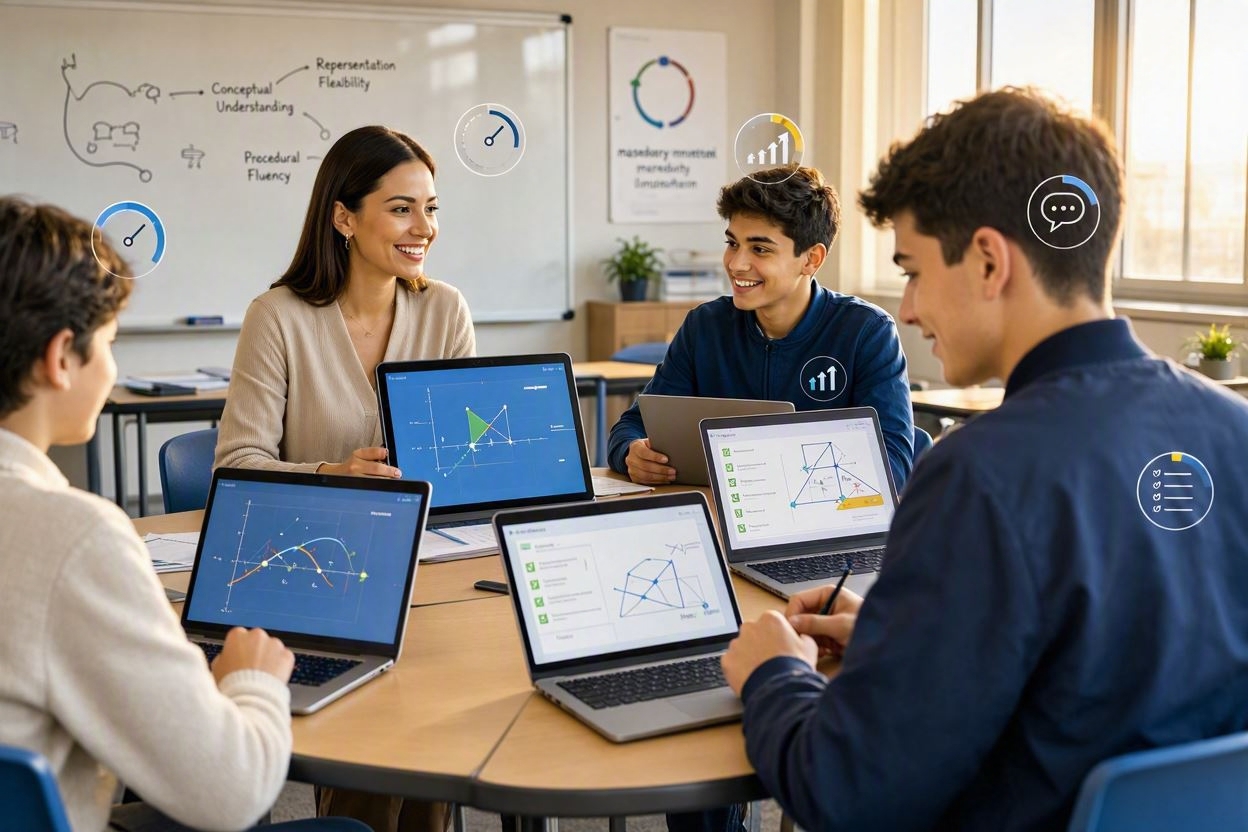
This study examines differences in students’ mathematical conceptual understanding across instructional conditions, the role of self-efficacy in mathematical conceptual understanding, and the interaction between the GeoGebra assisted MASTER learning model and self-efficacy. The study used a quantitative, quasi-experimental design. The study population is all grade VIII students of Public Junior High School (SMP Negeri) 1 Bukit Kemuning. The sample comprised two experimental classes and one control class selected through cluster random sampling. Data were obtained using a mathematical conceptual understanding test and a self-efficacy questionnaire. The mathematical topic was circles. The intervention was conducted for five sessions in each class, with each session lasting 2 × 45 minutes. The data were first examined for normality and homogeneity before testing the hypotheses using two-way ANOVA in a 3 × 3 factorial design. The findings showed significant differences in students’ mathematical conceptual understanding across instructional conditions (p < .001). Self-efficacy was also significantly related to students’ mathematical conceptual understanding (p < .001). However, the interaction between the learning model and self-efficacy was not statistically significant (p = .170). Thus, the GeoGebra-assisted MASTER learning model may serve as an alternative instructional approach to support students’ mathematical conceptual understanding.
References
Bandura, A. (1997). Self-efficacy: The exercise of control. W. H. Freeman.
Chauliac, M. C., Willems, J. W., Gijbels, D., & Donche, V. (2023). The prevalence of careless response behaviour and its consequences on data quality in self-report questionnaires on student learning. Frontiers in Education, 8, 1–15. https://doi.org/10.3389/feduc.2023.1197324
Fadila, A., Hakim, R., Putra, R. W. Y., & Ambarwati, Rs. (2024). Development of teaching materials oriented to numeracy literacy and socio-cultural literacy for Madrasah Ibtidaiyah. Jurnal Pendidikan Matematika (Kudus), 7(2), 227–248. https://doi.org/10.21043/jpmk.v7i2.29232
Farida, M., Wahyuni, F., & Wibowo, S. (2025). Analisis dinamika interaksi guru dan siswa dalam pembelajaran matematika [Analysis of the dynamics of teacher–student interaction in mathematics learning]. PEMBELAJAR: Jurnal Ilmu Pendidikan, Keguruan, dan Pembelajaran, 9(1), 65–70. https://doi.org/10.26858/pembelajar.v9i1.69393
Gurmu, F., Tugea, C., & Hunde, A. B. (2024). Effects of GeoGebra-assisted instructional methods on students’ conceptual understanding of geometry. Cogent Education, 11(1), 2379745. https://doi.org/10.1080/2331186X.2024.2379745
Haslinda, H., Kadir, A., & Patta, R. (2021). Hubungan interaksi guru dengan siswa terhadap hasil belajar matematika siswa SD kelas V [The relationship between teacher–student interaction and elementary school students’ mathematics learning outcomes]. JPPSD: Jurnal Pendidikan dan Pembelajaran Sekolah Dasar, 1(2), 253–262. https://ojs.unm.ac.id/jppsd/article/view/24536
Hidayat, R., Noor, W. N. W. M., Nasir, N., & Ayub, A. F. M. (2024). The role of GeoGebra software in conceptual understanding and engagement among secondary school students. Infinity Journal, 13(2), 317–332. https://doi.org/10.22460/infinity.v13i2.p317-332
Izdahara, D., & Irvan, I. (2025). A systematic literature review on the effectiveness of GeoGebra in mathematics education in the digital era. Journal of Mathematics Education and Application, 4(3), 103–109. https://jurnal.umsu.ac.id:444/index.php/mtika/article/view/26825
Juandi, D., Kusumah, Y. S., Tamur, M., Perbowo, K. S., & Wijaya, T. T. (2021). A meta-analysis of geogebra software decade of assisted mathematics learning: what to learn and where to go? Heliyon, 7(5), 6953. https://doi.org/10.1016/j.heliyon.2021.e06953
Juandi, J., Sugiatno, S., & Noviani, E. (2025). Enhancing students’ conceptual understanding of trigonometric functions through GeoGebra-based learning. Al-Jabar: Jurnal Pendidikan Matematika, 16(1), 55–70. https://doi.org/10.24042/ajpm.v16i1.25653
Kaustsari, D., Anggoro, B. S., & Dewi, N. R. (2024). Analisis kemampuan berfikir kritis matematis dan self-efficacy dalam pembelajaran matematika [Analysis of mathematical critical thinking ability and self-efficacy in mathematics learning]. Pendas: Jurnal Ilmiah Pendidikan Dasar, 9(4). https://journal.unpas.ac.id/index.php/pendas/article/view/20234
Khairunnisa, A., Juandi, D., & Gozali, S. M. (2022). Systematic literature review: kemampuan pemahaman matematis siswa dalam menyelesaikan masalah matematika [Students’ mathematical understanding in solving mathematical problems]. Jurnal Cendekia: Jurnal Pendidikan Matematika, 6(2), 1846–1856. https://doi.org/10.31004/cendekia.v6i2.1405
Maharani, M. T., Dewi, P. K., & Hartawan, I. G. N. Y. (2023). Pengaruh model pembelajaran MASTER (Motivating, Acquiring, Searching, Triggering, Exhibiting, and Reflecting) berbantuan geogebra terhadap kemampuan pemahaman konsep matematika siswa kelas VII di SMP Negeri 8 Singaraja [The geogebra-assisted MASTER learning model (Motivating, Acquiring, Searching, Triggering, Exhibiting, and Reflecting) on students’ mathematical conceptual understanding in grade VII at Public Junior High School (SMP Negeri) 8 Singaraja]. Jurnal Pendidikan Matematika Undiksha, 14(2), 94–102. https://ejournal.undiksha.ac.id/index.php/JJPM/article/view/65521
Martika, D. A., Anggoro, B. S., & Dewi, N. R. (2025). Pengembangan media pembelajaran komik digital dengan pendekatan green education untuk meningkatkan kemampuan pemahaman konsep matematis peserta didik kelas VII SMP [Development of digital comic learning media using a green education approach to improve the mathematical conceptual understanding of grade vii junior high school students]. Pendas: Jurnal Ilmiah Pendidikan Dasar, 10(2). https://journal.unpas.ac.id/index.php/pendas/article/view/26451
Mutammimah, S., Rukmigarsari, E., & Zauri, A. S. (2026). Pengaruh motivasi belajar terhadap pemahaman konsep matematis melalui self-regulated learning dan kemampuan numerasi [The effect of learning motivation on mathematical conceptual understanding through self-regulated learning and numeracy skills]. Cartesian: Jurnal Pendidikan Matematika, 5(2), 166–178. https://doi.org/10.33752/cartesian.v5i2.11530
Nazilah, R. L., & Amir, M. F. (2025). MASTER learning model: Motivating, acquiring, searching, triggering, exhibiting, and reflecting toward students’ mathematical reasoning. Jurnal Pendidikan Progresif, 15(1), 631–645. https://doi.org/10.23960/jpp.v15i1.pp631-645
Noferina, R., Nurdin, E., & Noviarni, N. (2021). Kemampuan pemecahan masalah matematis siswa dalam contextual teaching and learning ditinjau dari disposisi matematis [Students’ mathematical problem-solving ability in contextual teaching and learning viewed from mathematical disposition]. EDU-MAT: Jurnal Pendidikan Matematika, 9(1), 69-79. https://doi.org/10.20527/edumat.v9i1.10208
Nu’man, M., Putri, D. A., & Nafisah, F. D. (2025). The academic self-efficacy scale in mathematics using confirmatory factor analysis (CFA). Jurnal Penelitian dan Evaluasi Pendidikan, 29(2), 228–239. https://doi.org/10.21831/pep.v29i2.87347
Nurfad, N., Indriana, I., & Julian, F. (2025). Students’ mathematical conceptual knowledge. Jurnal Mercumatika: Jurnal Penelitian Matematika dan Pendidikan Matematika, 8(2). https://doi.org/10.26486/jm.v8i2.3414
Rahmadhani, P. A., Farahsanti, I., & Ariyanto, E. (2024). Increasing students’ activity and understanding of concepts in mathematics learning using lesson study-based PBL. Jurnal Pendidikan Matematika (JPM), 10(2), 185–191. https://doi.org/10.33474/jpm.v10i2.21867
Rajab, R., Fahinu, F., Lambertus, L., & Zulfaidil, Z. (2024). The impact of self-efficacy on students’ mathematical understanding. Jurnal Karya Pendidikan Matematika, 11(2), 86–96. https://doi.org/10.26714/jkpm.11.2.2024.86-96
Rianto, B., Lutfi, A., Naser, A. D. M., & Dasari, D. (2022). The effect of prior knowledge and learning motivation on mathematics learning outcomes of junior high school students. Jurnal Pendidikan MIPA, 23(4), 1876–1886. https://doi.org/10.23960/jpmipa/v23i4.pp1876-1886
Rose, C., & Nicholl, M. J. (1997). Accelerated learning for the 21st century: The six-step plan to unlock your master-mind. Dell Publishing.
Sabirin, M., Hidayatullah, A., Saputri, R. A., Atsnan, M. F., & Nareki, M. L. (2022). MASTER (motivating, acquiring, searching, triggering, exhibiting, reflecting) learning model in terms of literacy ability and students’ mathematics learning motivation. Jurnal Riset Pendidikan Matematika, 9(1), 1–11. https://doi.org/10.21831/jrpm.v9i1.48481
Safitri, J., Anggoro, B. S., Fadila, A., & Nofiansyah, W. (2023). Pemahaman konsep matematis siswa sekolah menengah pertama: Pengaruh explicit instruction ditinjau dari self-reliance [Students’ mathematical conceptual understanding in junior high school: the effect of explicit instruction viewed from self-reliance]. ARITHMETIC: Academic Journal of Math, 5(1), 69–84. https://doi.org/10.29240/ja.v5i1.5736
Sommet, N., Weissman, D. L., Cheutin, N., & Elliot, A. J. (2023). How many participants do i need to test an interaction? conducting an appropriate power analysis and achieving sufficient power to detect an interaction. Advances in Methods and Practices in Psychological Science, 6(3). https://doi.org/10.1177/25152459231178728
Street, K. E. S., Malmberg, L.-E., & Schukajlow, S. (2024). Students’ mathematics self-efficacy: A scoping review. ZDM–Mathematics Education, 56(2), 265–280. https://doi.org/10.1007/s11858-024-01548-0
van Dijk, W., Lane, H. B., & Gage, N. A. (2023). How do intervention studies measure the relation between implementation fidelity and students’ reading outcomes? A systematic review. The Elementary School Journal, 124(1), 56–84. https://doi.org/10.1086/725672
Verhulst, B., & Neale, M. C. (2021). Best practices for binary and ordinal data analyses. Behavior Genetics, 51(3), 204–214. https://doi.org/10.1007/s10519-020-10031-x
Viryanto, F. A., & Kismiantini. (2024). Analisis pengaruh instruksi pengarahan guru terhadap capaian matematika siswa Indonesia dengan model mediasi analisis jalur [Analysis of the effect of teacher guidance instructions on indonesian students’ mathematics achievement using a path analysis mediation model]. PYTHAGORAS Jurnal Matematika Dan Pendidikan Matematika, 19(1), 1–17. https://doi.org/10.21831/pythagoras.v19i1.67766
Williamson, S. F., Grayling, M., Mander, A., Noor, N., Savage, J., Yap, C., & Wason, J. (2022). Subgroup analyses in randomized controlled trials frequently categorized continuous subgroup information. Journal of Clinical Epidemiology, 150, 72–79. https://doi.org/10.1016/j.jclinepi.2022.06.017
Wulandari, M., Anggoro, B. S., & Pratiwi, D. D. (2026). Keterkaitan self regulated learning dan self efficacy terhadap kemampuan pemahaman konsep serta dampaknya pada representasi matematis siswa [The relationship between self-regulated learning and self-efficacy on conceptual understanding and its impact on students’ mathematical representation]. Pendas: Jurnal Ilmiah Pendidikan Dasar, 11(1), 156–170. https://journal.unpas.ac.id/index.php/pendas/article/view/40230
Downloads
Published
How to Cite
Issue
Section
License
Copyright (c) 2026 Lia Fauziah, Bambang Sri Anggoro, Abi Fadila

This work is licensed under a Creative Commons Attribution 4.0 International License.

_-_Copy.jpg)
.jpg)
.jpg)
.jpg)