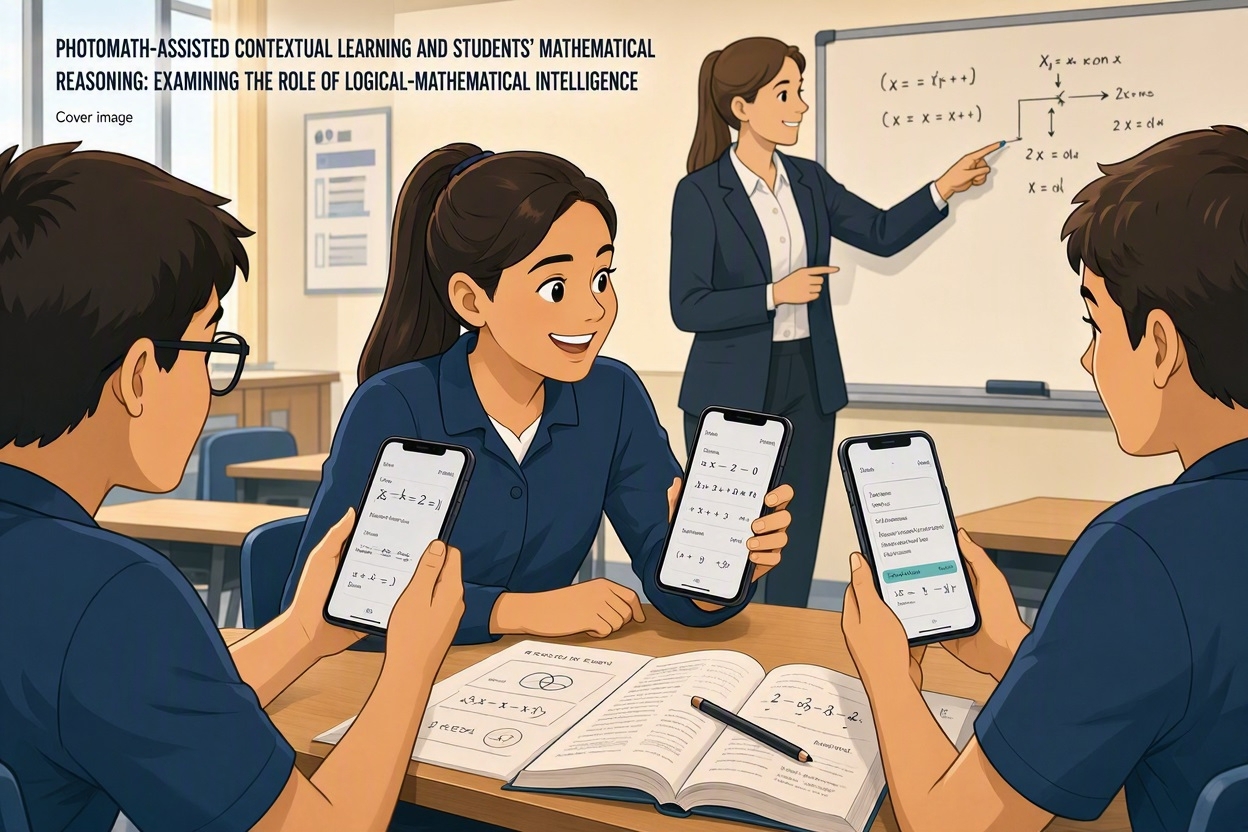
Photomath-assisted contextual learning and students’ mathematical reasoning: Examining the role of logical-mathematical intelligence
DOI:
https://doi.org/10.33474/jpm.v12i2.25881Keywords:
Contextual Learning, Photomath, Logical-Mathematical Intelligence, Student Reasoning, ModeratorAbstract
This study aims to examine the effect of Photomath-assisted contextual learning on students’ mathematical reasoning and to investigate the moderating role of logical-mathematical intelligence in the relationships between learning and mathematical reasoning at Islamic Junior High School Madrasah Tsanawiyah (MTs) Al Washliyah Tanjung Morawa. This study employs a quantitative approach with a quasi-experimental pretest-posttest control group design. The study population consisted of 129 eighth-grade students. Using purposive sampling, two classes were selected: 31 students in the experimental class and 32 students in the control class. The research instruments consisted of a mathematical reasoning test and a logical-mathematical intelligence questionnaire. The data were analyzed using an independent-samples t-test and two-way ANOVA (2×2). The data were analyzed using an independent-samples t-test, which showed no statistically significant difference in logical-mathematical intelligence scores between the experimental and control groups, t(61) = 1.662, p=0.102 . The two-way ANOVA revealed a statistically significant main effect of the learning class on students’ mathematical reasoning, F(1,59) = 83.551, p < 0.001. In contrast, the main effect of logical-mathematical intelligence was not statistically significant, F(1,59) = 0.215, p = 0.644. The interaction between learning style and logical-mathematical intelligence was also not statistically significant, F (1,59) = 0.456, p = 0.502. Thus, logical-mathematical intelligence did not have a statistically significant moderating effect on the relationships between learning style and students’ mathematical reasoning.
References
Asmal, M. (2020). Pengaruh kecerdasan logis matematis terhadap kemampuan pemecahan masalah siswa kelas vii smpn 30 makassar. [The effect of logical-mathematical intelligence on the problem-solving skills of seventh-grade students at SMPN 30 Makassar]. In ELIPS: Jurnal Pendidikan Matematika 1(1). https://doi.org/10.47650/elips.v1i1.122
Asoraya, M. S., & Ruli, R. M. (2023). Analisis kemampuan penalaran matematis siswa smp pada materi relasi dan fungsi. [Analysis of junior high school students’ mathematical reasoning skills in the topic of relations and functions]. Jurnal Cendekia : Jurnal Pendidikan Matematika, 7(3), 3053–3066. https://doi.org/10.31004/cendekia.v7i3.2412
Astriani, N., & Al Dhana, M. B. (2024). Kemampuan penalaran matematis siswa melalui pendekatan contextual teaching and learning [Students’ mathematical reasoning skills through contextual teaching and learning]. Jurnal Theorems (The Original Research Of Mathematics), 8(2), 263-271. https://doi.org/10.31949/th.v8i2.7404
Babullah, R. (2022). Teori perkembangan kognitif jean piaget dan penerapannya dalam pembelajaran. [Jean Piaget’s theory of cognitive development and its application in learning]. EPISTEMIC: Jurnal Ilmiah Pendidikan, 1(2), 131-152. https://doi.org/10.70287/epistemic.v1i2.10
Baharuddin, B. & Wahyuni, E. N. (2015). Teori belajar dan pembelajaran. [Theories of learning and instruction]. Ar-Ruzz Media.
Erlina, E., & Hakim, D. L. (2019). Kecerdasan logis matematis siswa smp pada scaffolding [Mathematical-logical intelligence of junior high school students in scaffolding]. Prosiding Sesiomedika, 2(1e). https://journal.unsika.ac.id/index.php/sesiomadika/article/view/2941
Fathinatusholihah, W., Sari, A. P., & Susilo, S. P. (2024). Studi literatur: peningkatan kemampuan penalaran matematika dengan pendekatan konstruktivisme pada model problem based learning [Improving mathematical reasoning skills through a constructivist approach in a problem-based learning model]. PRISMA, Prosiding Seminar Nasional Matematika, 7, 829–833. https://proceeding.unnes.ac.id/prisma/article/view/3036
Hana, Z., & Sucilestari, R. (2020). Memahami dan mengukur kecerdasan logis matematis: Sebuah telaah pustaka. [Understanding and measuring logical-mathematical intelligence: A literature review]. Jurnal Ilmu Pendidikan Dasar 3(2), 197, https://doi.org/10.31100/dikdas.v3i2.742
Handayani, S. D., & Solihah, A. (2022). Pemanfaatan aplikasi Photomath dan aplikasi yHomework pada pembelajaran matematika. [A collection of articles on community service projects utilizing the photomath and yhomework apps in mathematics education]. Kapas: Kumpulan Artikel Pengabdian Masyarakat 1(1), 1-7. https://doi.org/10.30998/kapas.v1i1.1208
Hidayatulloh, D. A., Hidayanto, E., & Irawati, S. (2024). Kecerdasan logis matematis siswa dalam menyelesaikan masalah kontekstual [Student’s logical-mathematical intelligence in solving contextual problems]. AKSIOMA:Jurnal Program Studi Pendidikan Matematika, 13(4), 1126–1140. https://doi.org/10.24127/ajpm.v13i4.9058
• Imaniyah, M., Natasya, A., Putri, Q. D. A., & Hernaeny, U. (2025). Peran aplikasi photomath terhadap kemampuan pemecahan masalah matematika [The role of the photomath app in mathematical problem-solving skills]. Nusantara Journal of Education and Social Science, 2(2), 72–78. https://doi.org/10.69959/nujess.v2i2.103
Indaswari, N., Azmi, S., Novitasari, D., & Sarjana, K. (2021). Pengaruh kecerdasan logis matematis dan kecerdasan linguistik siswa terhadap kemampuan menyelesaikan soal cerita. [The effect of students’ logical-mathematical and linguistic intelligence on their ability to solve word problems]. Jurnal Ilmiah Profesi Pendidikan, 6(4), 722–730. https://doi.org/10.29303/jipp.v6i4.329
Isrok’atun, & Rosmala, A. (2018). Model-model pembelajaran matematika. [Mathematics instructional models] (B. S. Fatmawati, Ed.). PT Bumi Aksara
Mulia, C. T., & Meiliasari. (2023). The advantages of aptitude treatment interaction model in mathematics learning. PRIMA: (Jurnal Pendidikan Matematika, 7(2), 119–130. https://doi.org/10.31000/prima.v7i2.8202
Nuraini, N., Firmansyah, F., & Mawengkang, H. (2020). Pengembangan perangkat pembelajaran matematika realistik untuk meningkatkan kemampuan komunikasi matematis [Development of realistic mathematics learning materials to improve mathematical communication skills]. Journal for Lesson and Learning Studies, 3(1), 58-65. https://ejournal.undiksha.ac.id/index.php/JLLS/article/view/23361
Nurdin, E., Saputri, I. Y., & Kurniati, A. (2020). Development of comic mathematics learning media based on contextual approaches. JIPM (Jurnal Ilmiah Pendidikan Matematika), 8(2), 85-97. https://doi.org/10.25273/jipm.v8i2.5145
Nurfadhillah, S. (2021). Media pembelajaran: pengertian media pembelajaran, landasan, fungsi, manfaat, jenis-jenis media pembelajaran, dan cara penggunaan kedudukan media pembelajaran [Learning materials: Defination of instructional media, its foundations, functions, benefits, types of instructional media, and how to use instructional media] (R. Awahita, Ed.). CV Jejak.
Nurlinda, E., Azis, Z., & Nasution, D. M. (2024). Students’ mathematical reasoning ability and self-efficacy viewed from the application of problem based learning and contextual teaching and learning models assisted. JMEA : Journal of Mathematics Education and Application, 3, No 2, 54-61. https://doi.org/10.30596/jmea.v3i2.20329
Prastika, V. Y. A., Riyadi, R., & Siswanto, S. (2021). Mathematical reasoning ability of junior high school viewed from logical mathematical intelligence. Journal of Physics: Conference Series, 1918(4). https://doi.org/10.1088/1742-6596/1918/4/042067
Rahman, L., Fitraini, D., & Fitri, I. (2019). Pengaruh penerapan model discovery leraning terhadap kemampuan penalaran matematis ditinjau dari pengetahuan awal siswa smp negeri 3 tambang kabupaten kampar. [The effect of implementing discovery learning on mathematical reasoning skills, as viewed through the prerequisite knowledge of students at state junior high school 3 Tambang], Kampar Regency. Journal for Research in Mathematics Learning, 12(1). https://doi.org/10.24014/juring.v2i1.7467
Rahmawati, L. (2021). The effect of the aptitude treatment ınteraction learning model on the mathematical communication skill of elementary school students. Social, Humanities, and Educational Studies (SHEs): Conference Series 4(6), 446-452. https://jurnal.uns.ac.id/SHES/article/view/68481
Relawati, R. (2021). Pengaruh kecerdasan logis matematis terhadap kemampuan penalaran matematis siswa SMP Negeri 23 Muaro Jambi. [The effect of logical-mathematical intelligence on the mathematical reasoning ability of students at Muaro Jambi Public junior high school 23]. Jurnal Math-Umb.Edu 8(2). https://doi.org/10.36085/math-umb.edu.v8i2.1637
Rifa’i, M., & Yahfizam. (2024). Penggunaan aplikasi photomath pada pembelajaran matematika: systematic literature review. [The use of the photomath app in mathematics education: systematic literature review]. LANCAH, Jurnal Inovasi dan Tren, 2(2), 587–590. https://doi.org/10.35870/ljit.v2i2.2798
Saleh, M., Jamilah, S., & Said, Z. (2023). Memetakan kecerdasan peserta didik melalui multiple intelligensi.[Assessing students’ intelligence through multiple intelligence]. Ruang Karya Bersama.
Simamora, R. N., Salayan, M., Karnasih, I., & Wisada Dachi, S. (2020). Pengembangan perangkat pembelajaran berbasis CTL berbantuan ICT untuk meningkatkan kemampuan komunikasi matematis dan rasa percaya diri terhadap siswa SMK Swasta Smart School IT. [Development of ICT-supported CTL-based learning materials to improve mathematical communication skills and self-confidence among private SMK students at Smart School IT, a private vocational high school]. Jurnal Curere, 4(2), 66. https://portaluniversitasquality.ac.id:5388/ojssystem%20/index.php/CURERE/article/view/431
Thrash, T. M., & Elliot, A. J. (2003). Inspiration as a psychological construct. Journal of Personality and Social Psychology, 84(4), 871–889. https://doi.org/10.1037/0022-3514.84.4.871
Wahab, G., & Rosnawati. (2021). Teori-teori belajar pembelajaran. [Learning theories] (H. Azmi & N. Musyafak, Eds). CV. Adanu Abimata.
Wardani, I. R., Immama, M., Zuani, P., Kholis, N., Ali, U., & Tulungagung, R. (2023). Teori belajar perkembangan kognitif lev vygotsky dan implikasinya dalam pembelajaran. [Lev Vygotsky’s theory of cognitive development and its implications for learning]. Jurnal Pendidikan Islam, 14(2). https://doi.org/10.58577/dimar.v4i2.92
Zahra, F., & Yahfizham, Y. (2024). Systematic Literature Review : Memanfaatkan aplikasi photomath sebagai media belajar untuk meningkatkan kemampuan komputasi siswa. [Using the photomath app as a learning tool to improve students’ computational skills]. Bilangan : Jurnal Ilmiah Matematika, Kebumian dan Angkasa, 2(3), 35-58. https://doi.org/10.62383/bilangan.v2i3.46
Downloads
Published
How to Cite
Issue
Section
License
Copyright (c) 2026 Ela Maya Firanti, Darmina Eka Sari Rangkuti

This work is licensed under a Creative Commons Attribution 4.0 International License.

_-_Copy.jpg)
.jpg)
.jpg)
.jpg)