
An analysis of grade 6 English first additional language reading comprehension questions in CAPS-aligned examinations
DOI:
https://doi.org/10.33474/j-reall.v6i2.23338Keywords:
Barrett’s taxonomy, CAPS, English first additional language, reading comprehension questionAbstract
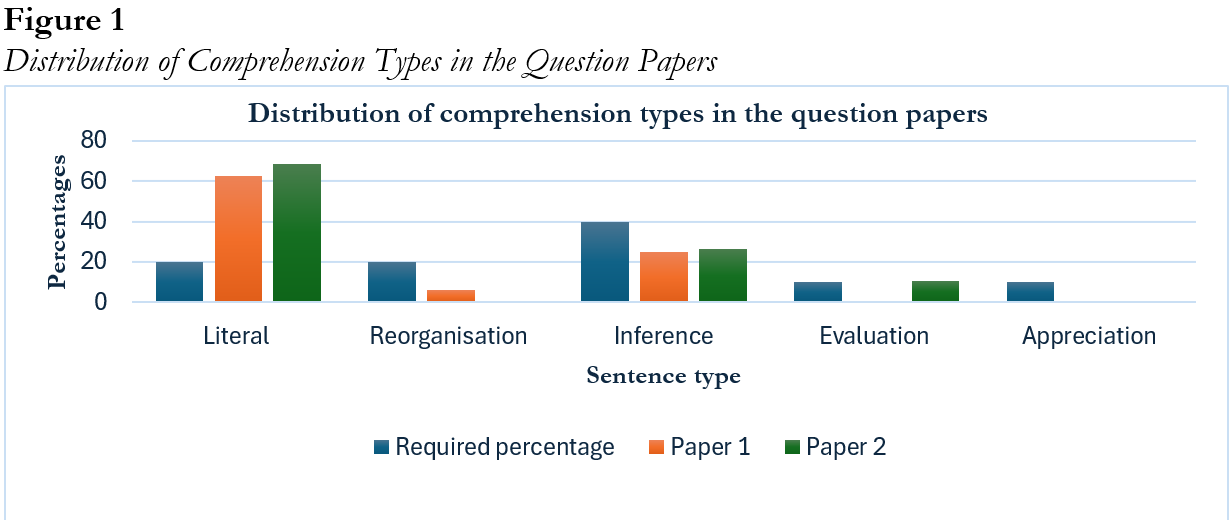
Reading comprehension, a crucial skill for successful text interaction, remains a significant challenge for many South African learners, as evidenced by their persistent difficulties in answering comprehension questions. This struggle underscores the importance of examining how comprehension assessments are designed and implemented. The South African curriculum assessment policy statement (CAPS) mandates a variety of cognitive levels in reading tests, using Barrett's taxonomy for question design. However, there is a lack of research examining whether the reading comprehension questions in grade 6 English first additional language (EFAL) exams align with the cognitive levels. The purpose of this study is to examine the alignment of grade 6 EFA reading comprehension questions with the cognitive levels. The study employs Barrett’s taxonomy framework to categorize and evaluate reading comprehension questions in grade 6 EFAL exams. The results show a striking imbalance between actual question distributions and CAPS benchmarks: lower-order questions dominated at 68.75% (Paper 1) and 63.16% (Paper 2), far exceeding the CAPS target of 40%, inferential questions reached only 25.00% (Paper 1) and 26.32% (Paper 2), falling short of the 40% requirement, higher-order questions were critically underrepresented at 0.00% (Paper 1) and 10.53% (Paper 2), versus the 20% benchmark. The study recommends a substantive rebalancing of examination questions to achieve the CAPS-mandated distribution of cognitive levels (40% lower-order, 40% inferential, 20% higher-order).
References
Aqeel, M. Y., & Farrah, M. (2019). Eighth grade textbook reading comprehension questions and Barrett’s taxonomy: Teachers’ perspective at Hebron District, Palestine. Hebron University Research Journal (B), 14(1), 229-260.
http://dspace.hebron.edu:80/xmlui/handle/123456789/310
Bobkina, J., & Stefanova, S. (2016). Literature and critical literacy pedagogy in the EFL classroom: Towards a model of teaching critical thinking skills. Studies in Second Language Learning and Teaching, 6(4), 677–696. https://doi.org/10.14746/ssllt.2016.6.4.6
Candra, I. (2014). The classification of reading comprehension questions in senior high school textbook entitled “English” using Barrett’s Taxonomy [Unpublished thesis]. English Faculty of Teacher Training and Education, Widya Mandala Catholic University.
Department of Basic Education (DBE). (2011). Curriculum and assessment policy statement: English first additional language, intermediate phase grades 4–6. Government Printing Works.
Elleman, A. M., & Oslund, E. L. (2019). Reading comprehension research: Implications for practice and policy. Policy Insights from the Behavioral and Brain Sciences, 6(1), 3–11.
https://doi.org/10.1177/2372732218816339
Göçer, A. (2014). The assessment of Turkish written examination questions based on the text in accordance with Barrett’s taxonomy. International Journal of Languages’ Education and Teaching, 3, 1–16. https://eric.ed.gov/?id=ED557158
Isman, A. (2011). Instructional design in education: New model. TOJET: The Turkish Online Journal of Educational Technology, 10(1), 136-142. Retrieved from https://www.tojet.net/articles/v24i2/2421.pdf
Javed, M., Eng, L. S., Mohamed, A. R., & Ismail, S. A. M. (2016). Identifying reading strategies to teach literal, reorganisation, and inferential comprehension questions to ESL students. The Journal of Asia TEFL, 13(3), 204–220. https://doi.org/10.18823/asiatefl.2016.13.3.3.204
Khasawneh, M. A. S. (2021). The use of reading speed strategy in promoting reading comprehension among EFL students with learning disabilities. Al-Lisan, 6, 225–235.
https://doi.org/10.30603/al.v7i2.2135
Malda, M., Nel, C., & Van de Vijver, F. J. R. (2014). The road to reading for South African learners: The role of orthographic depth. Learning and Individual Differences, 28, 181–191.
https://doi.org/10.1016/j.lindif.2013.11.008
Muhassin, M., Annisa, J., & Hidayati, D. A. (2021). The impact of fix-up strategy on Indonesian EFL learners’ reading comprehension. International Journal of Instruction, 14(2), 253–270.
https://doi.org/10.29333/iji.2021.14215a
Mullis, I. V. S., von Davier, M., Foy, P., Fishbein, B., Reynolds, K. A., & Wry, E. (2023). PIRLS 2021 international results in reading. Boston College, TIMSS & PIRLS International Study Center. https://doi.org/10.6017/lse.tpisc.tr2103.kb5342
Nehari, H., Bouhassoun, A., & Kantaoui, M. (2024). An analysis of the reading comprehension questions in the elementary Arabic language textbook in Algeria in light of Barrett’s taxonomy. International Journal of Arabic Language Education, 61(4), 277–241. Retrieved from https://www.psychologyandeducation.net/pae/index.php/pae/issue/view/31
Novytasari, D. A. (2017). Analysis of reading comprehension questions in the English textbook for eleventh graders based on Barrett’s taxonomy [Unpublished thesis]. Universitas Negeri Malang. http://repository.um.ac.id/id/eprint/10826
Rahmadani, N., & Zainil, Y. (2023). An analysis of reading comprehension questions in English textbooks “Work in Progress” and “Pathway to English” based on Barrett’s taxonomy. Journal of English Language Teaching, 12(3), 976–987.
Rahmah, D. A., & Mistar, J. (2023). Assessing the level of the student’s reading comprehension abilities and their difficulties. Premise: Journal of English Education and Applied Linguistics, 12(1), 46–57. https://doi.org/10.24127/pj.v12i1.4895
Reeves, C. (2012). Developing a framework for assessing and comparing the cognitive challenge of home language examinations. University of Pretoria.
Richards, K. A. R., & Hemphill, M. A. (2018). A practical guide to collaborative qualitative data analysis. Journal of Teaching in Physical Education, 37(2), 225–231.
https://doi.org/10.1123/jtpe.2017-0084
Seman, S. C., Yusoff, W. M. W., & Embong, R. (2017). Teachers’ challenges in teaching and learning for higher order thinking skills (HOTS) in primary school. International Journal of Asian Social Science, 7(7), 534–545. https://doi.org/10.18488/journal.1.2017.77.534.545
Shabalala, J. (2005). The SACMEQ II Project in Swaziland: A study of the conditions of schooling and the quality of education. Southern and Eastern Africa Consortium for Monitoring Educational Quality. http://www.sacmeq.org/education-swaziland.htm
Spaull, N. (2017). A preliminary analysis of SACMEQ III South Africa (Stellenbosch Economic Working Papers No. 11/11). Department of Economics and the Bureau for Economic Research, Stellenbosch University.
Surtantini, R. (2019). Reading comprehension question levels in grade X English students’ book in light of the issues of curriculum policy in Indonesia. PAROLE: Journal of Linguistics and Education, 9(1), 44–52. https://doi.org/10.14710/parole.v9i1.44-52
Yousefi, S., & Mohammadi, M. (2016). Critical thinking and reading comprehension among postgraduate students: The case of gender and language proficiency level. Journal of Language Teaching and Research, 7(4), 802–807. https://doi.org/10.17507/jltr.0704.23
Yurko, N., & Protsenko, U. (2022). Reading comprehension: The significance, features, and strategies. In Proceedings of the 1st International Conference on Modern Research in Education (pp. 106–114). https://doi.org/10.36074/rodmmrfssn.ed-1
Downloads
Published
How to Cite
Issue
Section
License
Copyright (c) 2025 Lucy Sibanda

This work is licensed under a Creative Commons Attribution 4.0 International License.
Authors who publish this journal agree to the following terms:
- Authors retain copyright and grant the journal right of first publication with the work simultaneously licensed under a Creative Commons Attribution License that allows others to share the work with an acknowledgement of the work's authorship and initial publication in this journal.
- Authors can separately make additional contractual arrangements for non-exclusive distribution published by the journal (e.g., publish it in a book), with an acknowledgement of its initial publication in this journal.
- Authors are allowed and encouraged to send their work via online (e.g., in the institutional repositories or their website) after published by the journal.