Flex, adapt, and engage: A new framework for EFL teaching success
DOI:
https://doi.org/10.33474/j-reall.v6i2.23694Keywords:
EFL teaching, independent curriculum, learning methods, narrative inquiry, student engagementAbstract
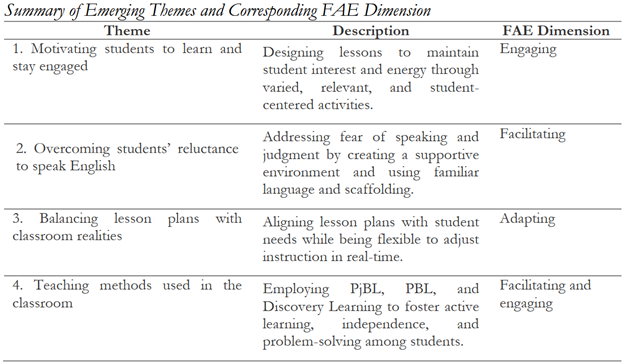
Although the Independent Curriculum of Indonesia promotes self-directed learning and encourages the active involvement of learners, minimal student participation continues to be a persistent challenge. Prior research has reductively viewed student engagement as simply attendance, and few have looked at how teachers fill this gap within the flexible structure of the curriculum. This qualitative case study tries to fill this gap by looking at one East Java English teacher's experiences through narrative interviews. Findings illuminate her multifaceted strategies such as energizing students and encouraging the use of English, adapting lessons in real-time, and implementing a multitude of methods. Persistent challenges included high rates of absenteeism and a general reluctance to converse in English. These indicate a greater need for tailored approaches and ongoing, differentiated instructional support from teachers to meet the aims of the curriculum. Due to the analysis consisting of only one single participant, the findings may not be generalizable; however, the results provide direct insight for educators regarding changes to instructional strategies as well as for policy makers in developing policies grounded on research. Subsequent inquiries should increase participant numbers and integrate other forms of documentation to build evidentiary strength. Such efforts can inform responsive approaches to foster language acquisition in Indonesia and comparable settings.
References
Balalle, H. (2024). Exploring student engagement in technology-based education in relation to gamification, online/distance learning, and other factors: A systematic literature review. Social Sciences and Humanities Open, 9. https://doi.org/10.1016/j.ssaho.2024.100870
Bernhardt, E. B., & Krashen, S. D. (1989). Second language acquisition and second language learning. The Modern Language Journal, 73(4). https://doi.org/10.2307/326882
Blase, J., & Blase, J. (2004). The dark side of school leadership: Implications for administrator preparation. Leadership and Policy in Schools, 3(4), 245–273.
https://doi.org/10.1080/15700760490503733
Bramley, R. J., Little, S., & Bishop, J. (2025). ‘One person can’t deliver it’: Exploring teachers’ agency and stance in relation to integrating an interdisciplinary subject in UK primary and secondary schools. Cogent Education, 12(1). https://doi.org/10.1080/2331186X.2025.2466302
Chusni, M. M., Saputro, S., Rahardjo, S. B., & Suranto. (2020). Student’s critical thinking skills through discovery learning model using e-learning on environmental change subject matter. European Journal of Educational Research, 10(3), 1123–1135. https://doi.org/10.12973/EU-JER.10.3.1123
Clandinin, D. J. (2006). Narrative inquiry: A methodology for studying lived experience. Research Studies in Music Education, 27(1), 44–54. https://doi.org/10.1177/1321103X060270010301
Creswell, J. W. (2006). Qualitative inquiry & research design. Sage Publications.
Erizar, E., Hidayati, T., & Diana, S. (2021). The implementation of K13 curriculum in Madrasah Aliyah in the south west region of Aceh (English teachers’ perspectives). International Journal of Islamic Studies and Social Sciences, 3(2), 177–219. https://doi.org/10.56613/islam-universalia.v3i2.202
Fikri, N. M. Al, & Prasetya, W. (2024). Indonesian English teachers’ narratives on adapting to curriculum change. IJECA (International Journal of Education and Curriculum Application), 7(3), 304. https://doi.org/10.31764/ijeca.v7i3.26251
Firdausih, F., & Aslan, A. (2024). Literature review: The effect of project-based learning on student motivation and achievement in science. Indonesian Journal of Education (INJOE), 4(3), 1011–1022.
Retrieved from https://injoe.org/index.php/INJOE/article/view/176
Forman, J., & Damschroder, L. (2008). Qualitative Content Analysis. Empirical methods for bioethics: A primer, 11, 39–62. JAI Press. https://doi.org/10.1016/S1479-3709(07)11003-7
Haq, H., & Wakidi, W. (2024). Evaluation of the implementation of the Merdeka Belajar Curriculum in secondary schools in the digital era. International Journal of Post Axial, 2(4), 215–228.
https://doi.org/10.59944/postaxial.v2i4.391
Hattie, J., & Timperley, H. (2007). The power of feedback. Review of Educational Research, 77(1), 81–122.
Hoang, V. Q. (2024). Fostering willingness to communicate in online educational environments: Opportunities and challenges. Proceedings of the 2nd International Conference Resilience by Technology and Design, 272–286. https://doi.org/10.2991/978-94-6463-583-6_13
Ilmi, K. A., & Dewi, D. N. (2022). The integration of multimodality in EFL classes: Students’ perception. Jo-ELT (Journal of English Language Teaching) Fakultas Pendidikan Bahasa & Seni Prodi Pendidikan Bahasa Inggris IKIP, 9(2), 150. https://doi.org/10.33394/jo-elt.v9i2.6343
Kamii, C., & Ewing, J. K. (2012). Basing teaching on Piaget’s constructivism. Childhood Education, 72(5), 260–264. https://doi.org/10.1080/00094056.1996.10521862
Kearsley, G., & Shneiderman, B. (1998). Engagement theory: A framework for technology-based teaching and learning. Educational Technology, 38(5), 20–23.
http://www.jstor.org/stable/44428478
Keith, E., & Ramadani, M. M. (2024). The impact of the 2013 Curriculum on the development of 21st century attitudes in elementary school students. International Journal of Post Axial, 2(4), 229–244.
https://doi.org/10.59944/postaxial.v2i4.392
Larsen-Freeman, D. (2023). Complex dynamic systems theory: A webinar with Diane Larsen-Freeman. Language Teaching, 56(3), 402–419. https://doi.org/10.1017/S0261444822000362
Le, H. V. (2021). An investigation into factors affecting concentration of university students. Journal of English Language Teaching and Applied Linguistics, 3(6), 07–12.
https://doi.org/10.32996/jeltal.2021.3.6.2
Ningsih, W. (2023). The analyst of interactive lecturing approach to enhance the students’ learning motivation in higher education institutions. Al-Hijr: Journal of Adulearn World, 3(1), 172–187. https://doi.org/10.55849/alhijr.v2i4.563
Peiris, C. L., O’donoghue, G., Rippon, L., Meyers, D., Hahne, A., De Noronha, M., Lynch, J., & Hanson, L. C. (2021). Classroom movement breaks reduce sedentary behavior and increase concentration, alertness and enjoyment during university classes: A mixed-methods feasibility study. International Journal of Environmental Research and Public Health, 18(11). 5589.
https://doi.org/10.3390/ijerph18115589
Poulton, P. (2025). Preservice teachers as curriculum deliverers or curriculum-makers? Exploring curriculum-making conceptions and opportunities in professional experiences. Australian Educational Researcher. 52, 2201–2227. https://doi.org/10.1007/s13384-025-00808-6
Puspitasari, P., & Maisarah, I. (2025). Independence Curriculum implementation challenges: A case study in secondary school of Bengkulu Tengah. Journal of English for Specific Purposes in Indonesia, 4(1), 6–10. https://doi.org/10.33369/espindonesia.v4i1.34707
Romadhon, M. G. E. (2020). The implementation of Robinson’s strategy (SQ3R) to enhance the reading ability in English class. UHAMKA International Conference on ELT and CALL, 17–18. Retrieved from https://journal.uhamka.ac.id/uicell/article/view/6275
Saarsar, P. (2018). Exploring the constructivist approach in education: Theory, practice, and implications. International Journal of Research and Analytical Reviews (IJRAR), 5(2), 716-725. Retrieved from IJRAR19D5140.pdf
Silma, N., Maulida, I., Primi Wulan, A., Merawati, J., Kamrul Hasan, M., Ilmu Tarbiyah dan Keguruan, F., & Maulana Malik Ibrahim Malang, U. (2024). A comprehensive review of project-based learning (PBL): Unravelling its aims, methodologies, and implications. Journal of Education, Social, and Communication Studies, 1(1). https://ojs.ptmjb.com/index.php/JESCS
Sliogerjene, J., Darginaviciene, I., Suchanova, J., & Gulbinskiene, D. (2025). Problem-based learning in developing students’ communicative skills and creativity in teaching English for specific purposes. Creativity Studies, 18(1), 30–42. https://doi.org/10.3846/cs.2025.22343
Suhartoyo, E. (2017). The importance of critical thinking competence: An investigation of students’ writing experiences. Proceedings International Seminar on Language, Education, and Culture (ISoLEC), 34–42. Retrieved from https://sastra.um.ac.id/wp-content/uploads/2017/11/34-42-Eko-Suhartoyo_Edited_LAYOUTED.pdf
Tang, K. H. D. (2023). Student-centered approach in teaching and learning: What does it really mean? Acta Pedagogia Asiana, 2(2), 72–83. https://doi.org/10.53623/apga.v2i2.218
Teravainen-Goff, A. (2022). Why motivated learners might not engage in language learning: An exploratory interview study of language learners and teachers. Language Teaching Research, 29(6), 2500-2520. https://doi.org/10.1177/13621688221135399
Tiwari, H. P. (2024). Perspectives of ELT teachers in enhancing writing skills through immediate feedback. BMC Research Journal, 3(1), 45–60. https://doi.org/10.3126/bmcrj.v3i1.69272
Tomlinson, B. (2014). Developing materials for language teaching: Chapters from the first edition. Bloomsbury Publishing.
Tomlinson, C. A., & Imbeau, M. B. (2023). Leading and managing: A differentiated classroom. ASCD.
Ventista, O. M., & Brown, C. (2023). Teachers’ professional learning and its impact on students’ learning outcomes: Findings from a systematic review. Social Sciences and Humanities Open, 8(1). https://doi.org/10.1016/j.ssaho.2023.100565
Wang, M., Wang, H., & Shi, Y. (2022). The role of English as a foreign language learners’ grit and foreign language anxiety in their willingness to communicate: Theoretical perspectives. Frontiers in Psychology, 13. https://doi.org/10.3389/fpsyg.2022.1002562
Wulantari, N. P., Rachman, A., Sari, M. N., Uktolseja, L. J., & Rofi’i, A. (2023). The role of gamification in English language teaching: A literature review. Journal on Education, 6(1), 2847–2856. https://doi.org/10.31004/joe.v6i1.3328
Yunus, M., & Ubaidillah, M. F. (2021). EFL teacher educators’ experiences in teaching critical reading: evidence from Indonesia. Journal on English as a Foreign Language, 11(2), 422–441.
https://doi.org/10.23971/jefl.v11i2.3133
Zein, S., Sukyadi, D., Hamied, F. A., & Lengkanawati, N. S. (2020). English language education in Indonesia: A review of research (2011-2019). Language Teaching, 53(4), 491–523.
https://doi.org/10.1017/S0261444820000208
Zondag, A. (2021). Student teachers’ experience with improvisation activities for spontaneous speech practice in English. Language Teaching Research, 28(6), 2190-2213.
https://doi.org/10.1177/13621688211044725
Downloads
Published
How to Cite
Issue
Section
License
Copyright (c) 2025 Muhammad Yunus, Riesty Kartika Anggraini, M Galuh Elga Romadhon

This work is licensed under a Creative Commons Attribution 4.0 International License.
Authors who publish this journal agree to the following terms:
- Authors retain copyright and grant the journal right of first publication with the work simultaneously licensed under a Creative Commons Attribution License that allows others to share the work with an acknowledgement of the work's authorship and initial publication in this journal.
- Authors can separately make additional contractual arrangements for non-exclusive distribution published by the journal (e.g., publish it in a book), with an acknowledgement of its initial publication in this journal.
- Authors are allowed and encouraged to send their work via online (e.g., in the institutional repositories or their website) after published by the journal.