A systematic literature review of artificial intelligence in academic writing: Challenges and opportunities
DOI:
https://doi.org/10.33474/j-reall.v6i2.23821Keywords:
academic writing, artificial intelligence, challenges, opportunities, SLRAbstract
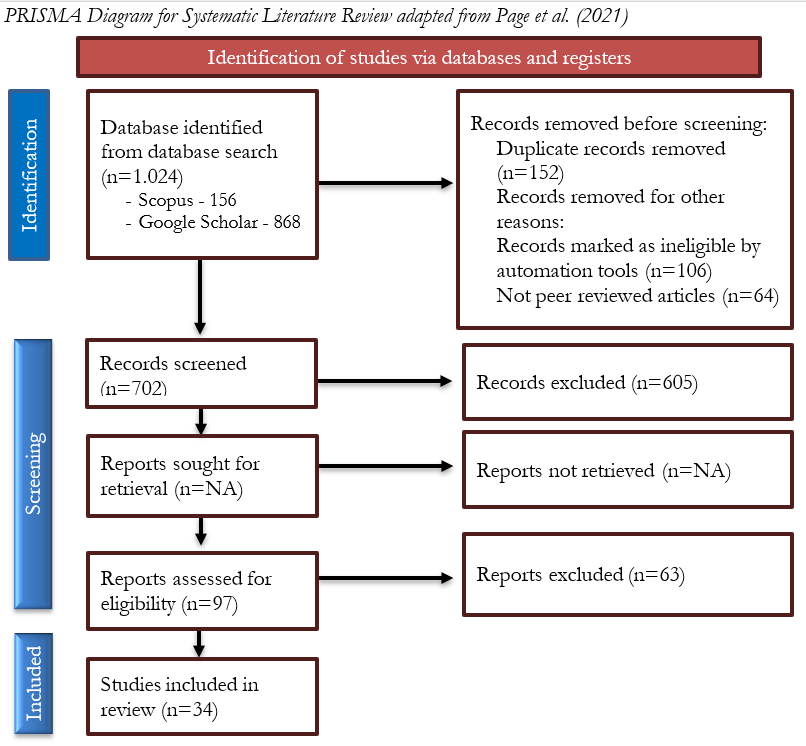
Artificial intelligence (AI) is reshaping academic writing by offering both challenges and opportunities. Numerous studies have discussed this topic and are worth compiling and synthesising. Based on the topic, several existing studies published from January 2023 to March 2025 were reviewed systematically using the PRISMA (Preferred Reporting Items for Systematic Reviews and Meta-Analysis) framework. After searches in Scopus and Google Scholar yielded 1,024 records, 34 titles were selected based on defined inclusion and exclusion criteria. The findings highlight the two sides of AI in academic writing: 1) presenting ethical issues, training needs, Critical thinking degradation, AI misinformation, AI addiction, weak AI detectors, AI’s rhetorical patterns, users’ negative perceptions, and other challenges, 2) facilitating several opportunities, such as writing quality improvement (accuracy, organization, and style), writing productivity and efficiency, idea development, AI awareness, research support, new insights, writing engagement, and usability. This study contributed to developing guidelines to address ethical, effective, and prudent use of AI in academic writing. It is a foundation for upcoming researchers who delve into AI in academic writing and other related skills in the EFL teaching context. Moreover, investigations across disciplines and educational levels are worth exploring.
References
Al-Bukhrani, M. A., Alrefaee, Y. M. H., & Tawfik, M. (2025). Adoption of AI writing tools among academic researchers: A theory of reasoned action approach. PLoS ONE, 20(1 January), 1–25. https://doi.org/10.1371/journal.pone.0313837
Aljuaid, H. (2024). The impact of artificial intelligence tools on academic writing instruction in higher education: A systematic review. Arab World English Journal, 1(1), 26–55.
https://doi.org/10.24093/awej/chatgpt.2
Alkamel, M. A. A., & Alwagieh, N. A. S. (2024). Utilizing an adaptable artificial intelligence writing tool (ChatGPT) to enhance academic writing skills among Yemeni university EFL students. Social Sciences and Humanities Open, 10(July), 101095.
https://doi.org/10.1016/j.ssaho.2024.101095
AlSamhori, A. F., & Alnaimat, F. (2024). Artificial intelligence in writing and research: Ethical implications and best practices. Central Asian Journal of Medical Hypotheses and Ethics, 5(4), 259–268. https://doi.org/10.47316/cajmhe.2024.5.4.02
Anani, G. E., Nyamekye, E., & Bafour-Koduah, D. (2025). Using artificial intelligence for academic writing in higher education: The perspectives of university students in Ghana. Discover Education, 4(1). https://doi.org/10.1007/s44217-025-00434-5
Balalle, H., & Pannilage, S. (2025). Reassessing academic integrity in the age of AI: A systematic literature review on AI and academic integrity. Social Sciences and Humanities Open, 11(June 2024), 101299. https://doi.org/10.1016/j.ssaho.2025.101299
Barrett, A., & Pack, A. (2023). Not quite eye to A.I.: Student and teacher perspectives on the use of generative artificial intelligence in the writing process. International Journal of Educational Technology in Higher Education, 20(1). https://doi.org/10.1186/s41239-023-00427-0
Carobene, A., Padoan, A., Cabitza, F., Banfi, G., & Plebani, M. (2024). Rising adoption of artificial intelligence in scientific publishing: Evaluating the role, risks, and ethical implications in paper drafting and review process. Clinical Chemistry and Laboratory Medicine, 62(5), 835–843. https://doi.org/10.1515/cclm-2023-1136
Cheng, A., Calhoun, A., & Reedy, G. (2025). Artificial intelligence-assisted academic writing: Recommendations for ethical use. Advances in Simulation, 10(1), 1–9.
https://doi.org/10.1186/s41077-025-00350-6
Cohen, J. F., & Moher, D. (2025). Generative artificial intelligence and academic writing: Friend or foe? Journal of Clinical Epidemiology, 179, 2024–2026.
https://doi.org/10.1016/j.jclinepi.2024.111646
Cui, Y. (2025). What influences college students using AI for academic writing? - A quantitative analysis based on HISAM and TRI theory. Computers and Education: Artificial Intelligence, 8(February), 100391. https://doi.org/10.1016/j.caeai.2025.100391
Dakakni, D., & Safa, N. (2023). Artificial intelligence in the L2 classroom: Implications and challenges on ethics and equity in higher education: A 21st century pandora’s box. Computers and Education: Artificial Intelligence, 5, 100179. https://doi.org/10.1016/j.caeai.2023.100179
Dergaa, I., Chamari, K., Zmijewski, P., & Saad, H. Ben. (2023). From human writing to artificial intelligence generated text: Examining the prospects and potential threats of ChatGPT in academic writing. Biology of Sport, 40(2), 615–622.
https://doi.org/10.5114/BIOLSPORT.2023.125623
Dja’far, V. H., & Hamidah, F. N. (2024). The effectiveness of AI technology in improving academic English writing skills in higher education. Journal of Language and Literature Studies, 4(3), 579–593. https://doi.org/10.36312/jolls.v4i3.2031
Dorta-González, P., López-Puig, A. J., Dorta-González, M. I., & González-Betancor, S. M. (2024). Generative artificial intelligence usage by researchers at work: Effects of gender, career stage, type of workplace, and perceived barriers. Telematics and Informatics, 94(September), 1–12. https://doi.org/10.1016/j.tele.2024.102187
Garg, S., Ahmad, A., & Madsen, D. Ø. (2024). Academic writing in the age of AI: Comparing the reliability of ChatGPT and Bard with Scopus and Web of Science. Journal of Innovation and Knowledge, 9(4). https://doi.org/10.1016/j.jik.2024.100563
Giglio, A. Del, & da Costa, M. U. P. (2023). The use of artificial intelligence to improve the scientific writing of non-native English speakers. Revista Da Associacao Medica Brasileira, 69(9), 1–5. https://doi.org/10.1590/1806-9282.20230560
Godwin-Jones, R. (2021). Evolving technologies for language learning. Language Learning & Technology ISSN, 25(3), 6–26. http://hdl.handle.net/10125/73443
Golan, R., Reddy, R., Muthigi, A., & Ramasamy, R. (2023). Artificial intelligence in academic writing: A paradigm-shifting technological advance. Nature Reviews Urology, 20(6), 327–328. https://doi.org/10.1038/s41585-023-00746-x
Hakam, H. T., Prill, R., Korte, L., Lovreković, B., Ostojić, M., Ramadanov, N., & Muehlensiepen, F. (2024). Human-written vs AI-generated texts in orthopedic academic literature: Comparative qualitative analysis. JMIR Formative Research, 8, e52164. https://doi.org/10.2196/52164
Hosseini, M., Resnik, D. B., & Holmes, K. (2023). The ethics of disclosing the use of artificial intelligence tools in writing scholarly manuscripts. Research Ethics, 19(4), 449–465. https://doi.org/10.1177/17470161231180449
Huang, J., & Tan, M. (2023). The role of ChatGPT in scientific communication: Writing better scientific review articles. American Journal of Cancer Research, 13(4), 1148–1154. Retrieved from https://pubmed.ncbi.nlm.nih.gov/37168339/
Hysaj, A., Dean, B. A., & Freeman, M. (2025). Exploring the purposes and uses of generative artificial intelligence tools in academic writing for multicultural students. Higher Education Research and Development, 1–15. https://doi.org/10.1080/07294360.2025.2488862
Jain, R., & Jain, A. (2024). Generative AI in writing research papers: A new type of algorithmic bias and uncertainty in scholarly work. Lecture Notes in Networks and Systems, 1065 LNNS, 656–669. https://doi.org/10.1007/978-3-031-66329-1_42
Jeyaraman, M., Ramasubramanian, S., Balaji, S., Jeyaraman, N., Nallakumarasamy, A., & Sharma, S. (2023). ChatGPT in action: Harnessing artificial intelligence potential and addressing ethical challenges in medicine, education, and scientific research. World Journal of Methodology, 13(4), 170–178. https://doi.org/10.5662/wjm.v13.i4.170
Jin, F., Sun, L., Pan, Y., & Lin, C. H. (2025). High heels, compass, Spider-man, or drug? Metaphor analysis of generative artificial intelligence in academic writing. Computers and Education, 228(July 2024), 105248. https://doi.org/10.1016/j.compedu.2025.105248
Khalifa, M., & Albadawy, M. (2024). Using artificial intelligence in academic writing and research: An essential productivity tool. Computer Methods and Programs in Biomedicine Update, 5, 100145. https://doi.org/10.1016/j.cmpbup.2024.100145
Khlaif, Z. N., Mousa, A., Hattab, M. K., Itmazi, J., Hassan, A. A., Sanmugam, M., & Ayyoub, A. (2023). The potential and concerns of using AI in scientific research: ChatGPT performance evaluation. JMIR Medical Education, 9, e47049. https://doi.org/10.2196/47049
Kildė, L. (2024). The integration of generative AI in foreign language teacher education: A systematic literature review. Pedagogika, 154(2), 5–26. https://doi.org/10.15823/p.2024.154.1
Kim, J., Yu, S., Detrick, R., & Li, N. (2024). Exploring students’ perspectives on generative AI-assisted academic writing. Education and Information Technologies. https://doi.org/10.1007/s10639-024-12878-7
Levin, G., Piedimonte, S., & Zand, B. (2024). Navigating the complexities of artificial intelligence in scientific writing: A dual perspective. International Journal of Gynecologic Cancer, 34(10), ijgc-2024-005691. https://doi.org/10.1136/ijgc-2024-005691
Li, H. (2025). Teaching academic English in higher education: Strategies and challenges. Frontiers in Education, 10, 1–6. https://doi.org/10.3389/feduc.2025.1559307
Li, J., Zong, H., Wu, E., Wu, R., Peng, Z., Zhao, J., Yang, L., Xie, H., & Shen, B. (2024). Exploring the potential of artificial intelligence to enhance the writing of English academic papers by non-native English-speaking medical students - The educational application of ChatGPT. BMC Medical Education, 24(1), 1–8. https://doi.org/10.1186/s12909-024-05738-y
Li, M., Enkhtur, A., Cheng, F., & Yamamoto, B. A. (2024). Ethical implications of ChatGPT in higher education: A scoping review. Journal of Interdisciplinary Studies in Education, 13(1), 55–68. https://doi.org/10.32674/jise.v13i1.6072
Liu, J. Q. J., Hui, K. T. K., Al Zoubi, F., Zhou, Z. Z. X., Samartzis, D., Yu, C. C. H., Chang, J. R., & Wong, A. Y. L. (2024). The great detectives: Humans versus AI detectors in catching large language model-generated medical writing. International Journal for Educational Integrity, 20(1), 1–14. https://doi.org/10.1007/s40979-024-00155-6
Livberber, T., & Ayvaz, S. (2023). The impact of artificial intelligence in academia: Views of Turkish academics on ChatGPT. Heliyon, 9(9), e19688. https://doi.org/10.1016/j.heliyon.2023.e19688
Madanchian, M., & Taherdoost, H. (2025). Results in engineering the impact of artificial intelligence on research efficiency. Results in Engineering, 26(February), 104743.
https://doi.org/10.1016/j.rineng.2025.104743
Mahapatra, S. (2024). Impact of ChatGPT on ESL students’ academic writing skills: A mixed methods intervention study. Smart Learning Environments, 11(1). https://doi.org/10.1186/s40561-024-00295-9
Malik, A. R., Pratiwi, Y., Andajani, K., Numertayasa, I. W., Suharti, S., Darwis, A., & Marzuki. (2023). Exploring artificial intelligence in academic essay: Higher education student’s perspective. International Journal of Educational Research Open, 5(October), 100296.
https://doi.org/10.1016/j.ijedro.2023.100296
Marzuki, Widiati, U., Rusdin, D., Darwin, & Indrawati, I. (2023). The impact of AI writing tools on the content and organization of students’ writing: EFL teachers’ perspective. Cogent Education, 10(2). https://doi.org/10.1080/2331186X.2023.2236469
Meyer, J. G., Urbanowicz, R. J., Martin, P. C. N., O’Connor, K., Li, R., Peng, P. C., Bright, T. J., Tatonetti, N., Won, K. J., Gonzalez-Hernandez, G., & Moore, J. H. (2023). ChatGPT and large language models in academia: Opportunities and challenges. BioData Mining, 16(1), 1–11. https://doi.org/10.1186/s13040-023-00339-9
Michel-Villarreal, R., Vilalta-Perdomo, E., Salinas-Navarro, D. E., Thierry-Aguilera, R., & Gerardou, F. S. (2023). Challenges and opportunities of generative AI for higher education as explained by ChatGPT. Education Sciences, 13(9), 856. https://doi.org/10.3390/educsci13090856
Mo, Z., & Crosthwaite, P. (2025). Exploring the affordances of generative AI large language models for stance and engagement in academic writing. Journal of English for Academic Purposes, 75(November 2024), 101499. https://doi.org/10.1016/j.jeap.2025.101499
Moher, D., Shamseer, L., Clarke, M., Ghersi, D., Liberati, A., Petticrew, M., Shekelle, P., & Stewart, L. A. (2015). Preferred Reporting Items for Systematic Review and Meta-Analysis Protocols (PRISMA-P). Systematic Reviews, 4(1), 1. https://doi.org/10.1186/2046-4053-4-1
Nguyen, A., Hong, Y., Dang, B., & Huang, X. (2024). Human-AI collaboration patterns in AI-assisted academic writing. Studies in Higher Education, 49(5), 847–864.
https://doi.org/10.1080/03075079.2024.2323593
Nurchurifiani, E., Maximilian, A., Ajeng, G. D., Wiratno, P., Hastomo, T., & Wicaksono, A. (2025). Leveraging AI-powered tools in academic writing and research: Insights from English faculty members in Indonesia. International Journal of Information and Education Technology, 15(2), 312–322. https://doi.org/10.18178/ijiet.2025.15.2.2244
Obura, E. A., & Emoit, P. I. (2025). Artificial intelligence in academic writing and research skills in Kenyan Universities: Opportunities and challenges. Africa Education Review, 20(6), 58–80. https://doi.org/10.1080/18146627.2024.2440351
Odri, G. A., & Ji Yun Yооn, D. (2023). Detecting generative artificial intelligence in scientific articles: Evasion techniques and implications for scientific integrity. Orthopaedics and Traumatology: Surgery and Research, 109(8), 103706. https://doi.org/10.1016/j.otsr.2023.103706
Ou, A. W., Khuder, B., Franzetti, S., & Negretti, R. (2024). Conceptualising and cultivating critical GAI literacy in doctoral academic writing. Journal of Second Language Writing, 66, 101156. https://doi.org/10.1016/j.jslw.2024.101156
Page, M. J., McKenzie, J. E., Bossuyt, P. M., Boutron, I., Hoffmann, T. C., Mulrow, C. D., Shamseer, L., Tetzlaff, J. M., Akl, E. A., Brennan, S. E., Chou, R., Glanville, J., Grimshaw, J. M., Hróbjartsson, A., Lalu, M. M., Li, T., Loder, E. W., Mayo-Wilson, E., McDonald, S., … Moher, D. (2021). The PRISMA 2020 statement: An updated guideline for reporting systematic reviews. BMJ, 71. https://doi.org/10.1136/bmj.n71
Polyportis, A. (2024). A longitudinal study on artificial intelligence adoption: Understanding the drivers of ChatGPT usage behavior change in higher education. Frontiers in Artificial Intelligence, 6. https://doi.org/10.3389/frai.2023.1324398
Qadhi, S. M., Alduais, A., Chaaban, Y., & Khraisheh, M. (2024). Generative AI, research ethics, and higher education research: Insights from a scientometric analysis. Information, 15(6), 325. https://doi.org/10.3390/info15060325
Revell, T., Yeadon, W., Cahilly-Bretzin, G., Clarke, I., Manning, G., Jones, J., Mulley, C., Pascual, R., Bradley, N., Thomas, D., & Leneghan, F. (2023). ChatGPT versus human essayists: An exploration of the impact of artificial intelligence for authorship and academic integrity in the humanities. Research Square, 8. https://doi.org/10.1007/s40979-024-00161-8
Safrai, M., & Orwig, K. E. (2024). Utilizing Artificial Intelligence in academic writing: An in-depth evaluation of a scientific review on fertility preservation written by ChatGPT-4. Journal of Assisted Reproduction and Genetics, 41(7), 1871–1880. https://doi.org/10.1007/s10815-024-03089-7
Salimi, A., & Saheb, H. (2023). Large language models in ophthalmology scientific writing: Ethical considerations blurred lines or not at all? American Journal of Ophthalmology, 254, 177–181. https://doi.org/10.1016/j.ajo.2023.06.004
Semrl, N., Feigl, S., Taumberger, N., Bracic, T., Fluhr, H., Blockeel, C., & Kollmann, M. (2023). AI language models in human reproduction research: Exploring ChatGPT’s potential to assist academic writing. Human Reproduction, 38(12), 2281–2288.
https://doi.org/10.1093/humrep/dead207
Stanford, J. (2025). How disruptive is AI in students’ academic writing in higher education? Studies in Technology Enhanced Learning, 4(1), 1-23. https://doi.org/10.21428/8c225f6e.b1d05ed3
Subaveerapandiyan, A., Kalbande, D., & Ahmad, N. (2025). Perceptions of effectiveness and ethical use of AI tools in academic writing: a study among PhD scholars in India. Information Development. https://doi.org/10.1177/02666669251314840
Tang, A., Li, K. K., Kwok, K. O., Cao, L., Luong, S., & Tam, W. (2024). The importance of transparency: Declaring the use of generative artificial intelligence (AI) in academic writing. Journal of Nursing Scholarship, 56(2), 314–318. https://doi.org/10.1111/jnu.12938
Teng, M. F., & Wang, C. (2023). Assessing academic writing self‐efficacy belief and writing performance in a foreign language context. Foreign Language Annals, 56(1), 144–169. https://doi.org/10.1111/flan.12638
Tran, H. N., Tran, V. B. U., & Le, T. T. N. (2025). AI tools in learning academic writing: Benefits and challenges for MA students in the English language studies at the Industrial University of Ho Chi Minh City. International Journal of AI in Language Education, 2(1), 74–91. https://doi.org/10.54855/ijaile.25215
Vall, R. R. F. de la, & Araya, F. G. (2023). Exploring the benefits and challenges of AI-language learning tools. International Journal of Social Sciences and Humanities Invention, 10(01), 7569–7576. https://doi.org/10.18535/ijsshi/v10i01.02
Werdiningsih, I., Marzuki, & Rusdin, D. (2024). Balancing AI and authenticity: EFL students’ experiences with ChatGPT in academic writing. Cogent Arts and Humanities, 11(1). https://doi.org/10.1080/23311983.2024.2392388
Winberg, C., Engel-hills, P., & Winberg, S. L. (2024). “Am I in control of my own writing?” Training postgraduate candidates in the responsible use of generative artificial intelligence in academic writing. African Journal of Inter/Multidisciplinary Studies, 6(1), 1–12. https://doi.org/10.51415/ajims.v6i1.1512
Wise, B., Emerson, L., Van Luyn, A., Dyson, B., Bjork, C., & Thomas, S. E. (2024). A scholarly dialogue: Writing scholarship, authorship, academic integrity and the challenges of AI. Higher Education Research and Development, 43(3), 578–590.
https://doi.org/10.1080/07294360.2023.2280195
Wu, L., & Halim, H. B. A. (2024). Task complexity and foreign language writing emotions as predictors of EFL writing performance. Frontiers in Education, 9.
https://doi.org/10.3389/feduc.2024.1323843
Yao, Y., Sun, Y., Zhu, S., & Zhu, X. (2024). A qualitative inquiry into metacognitive strategies of postgraduate students in employing ChatGPT for English academic writing. European Journal of Education. https://doi.org/10.1111/ejed.12824
Zhai, C., Wibowo, S., & Li, L. D. (2024). The effects of over-reliance on AI dialogue systems on students’ cognitive abilities: a systematic review. Smart Learning Environments, 11(1), 28. https://doi.org/10.1186/s40561-024-00316-7
Švab, I., Klemenc-Ketiš, Z., & Zupanič, S. (2023). New challenges in scientific publications: Referencing, artificial intelligence and ChatGPT. Slovenian Journal of Public Health, 62(3), 109–112. https://doi.org/10.2478/sjph-2023-0015
Downloads
Published
How to Cite
Issue
Section
License
Copyright (c) 2025 M. Hilmy Hidayatullah, Nunung Suryati, Bambang Yudi Cahyono, Nadrotin Mawaddah

This work is licensed under a Creative Commons Attribution 4.0 International License.
Authors who publish this journal agree to the following terms:
- Authors retain copyright and grant the journal right of first publication with the work simultaneously licensed under a Creative Commons Attribution License that allows others to share the work with an acknowledgement of the work's authorship and initial publication in this journal.
- Authors can separately make additional contractual arrangements for non-exclusive distribution published by the journal (e.g., publish it in a book), with an acknowledgement of its initial publication in this journal.
- Authors are allowed and encouraged to send their work via online (e.g., in the institutional repositories or their website) after published by the journal.