The impact of AI chatbots on English language learners’ speaking proficiency: A systematic review
DOI:
https://doi.org/10.33474/j-reall.v6i2.23866Keywords:
artificial intelligence (AI), chatbots, English language teaching, speaking proficiencyAbstract
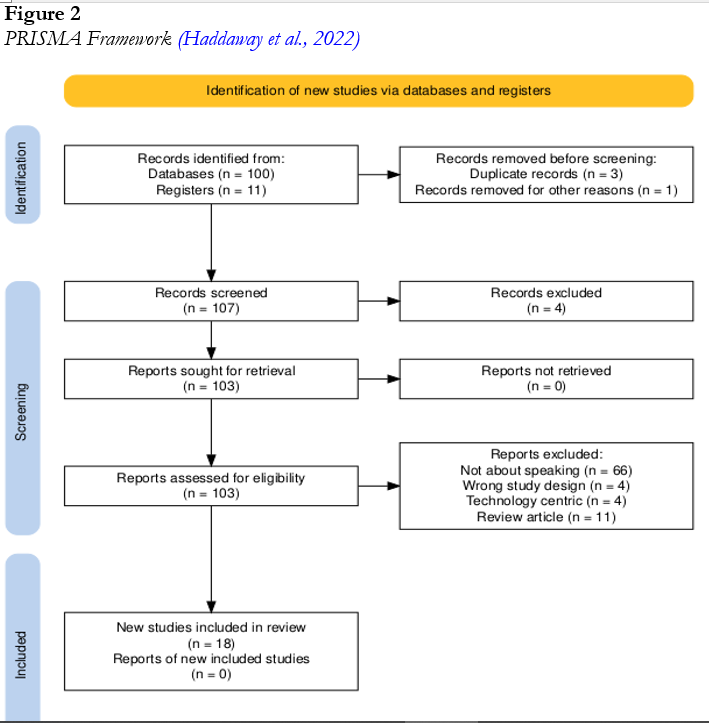
Artificial intelligence (AI) chatbots have become a significant phenomenon not only in the information technology field but also in education, where they are transforming how students learn English. Numerous studies have explored the use of AI chatbots in English language teaching (ELT), especially their potential to support speaking practice. However, the existing research is fragmented and lacks a systematic synthesis, making the findings inconclusive about how chatbots contribute to speaking proficiency and how learners perceive their use. This limitation creates uncertainty for educators, policymakers, and researchers in assessing the educational value of chatbots in ELT. To address this gap, this study aims to critically analyze how AI chatbots enhance students' English-speaking skills and the implications for developing speaking proficiency, as well as investigate students' perceptions of their effectiveness. This systematic literature review examines findings from various studies related to AI chatbot applications in English-speaking educational settings, published between 2018 and 2025. Using the PRISMA guidelines, an initial search across Google Scholar and Science Direct yielded 111 papers; the findings reveal both benefits, such as increased learner engagement and opportunities to practice, and challenges, including the lack of accuracy. By synthesizing prior research, this study offers a clearer understanding of the role of chatbots in increasing speaking proficiency and contributes to ongoing debates about AI in ELT.
References
https://doi.org/10.14569/ijacsa.2015.060712
Adamopoulou, E., & Moussiades, L. (2020). Chatbots: History, technology, and applications. Machine Learning with Applications, 2, 100006. https://doi.org/10.1016/j.mlwa.2020.100006
Al-khresheh, M. H. (2024). Bridging technology and pedagogy from a global lens: Teachers’ perspectives on integrating ChatGPT in English language teaching. Computers and Education: Artificial Intelligence, 6. https://doi.org/10.1016/j.caeai.2024.100218
Almawadeh, N. S., Almaharma, H., Qatawneh, S., & bin Tareef, M. (2024). Enhancing the ability of Jordanian secondary-school students to speak English through employing AI chatbot instruction educational administration: Theory and practice. Educational Administration, 30(5), 3188–3196. https://doi.org/10.53555/kuey.v30i5.3408
Azizimajd, H. (2023). Investigating the impacts of voice-based student-chatbot interactions in the classroom on EFL learners’ oral fluency and foreign language speaking anxiety. Technology Assisted Language Education, 1(2), 61-83. https://tale.razi.ac.ir/article_2732.html
Braun, V., & Clarke, V. (2022). Thematic analysis: A practical guide. SAGE Publications Ltd. https://books.google.com/books/about/Thematic_Analysis.html?hl=id&id=mToqEAAAQBAJ
Dewi, D. F., Nur’Aini, S., & Suwarti, T. S. (2024). Students’ perception on the use of chatbot from memrise site and their willingness to communicate in English. Linguistics and Education Journal, 2(1), 11-21. https://doi.org/10.26877/lej.v2i1.18092
Du, J., & Daniel, B. K. (2024). Transforming language education: A systematic review of AI-powered chatbots for English as a foreign language speaking practice. Computers and Education: Artificial Intelligence, 6. https://doi.org/10.1016/j.caeai.2024.100230
Duong, T., & Suppasetseree, S. (2024). The effects of an artificial intelligence voice chatbot on improving Vietnamese undergraduate students’ English speaking skills. International Journal of Learning, Teaching and Educational Research, 23(3), 293–321.
https://doi.org/10.26803/ijlter.23.3.15
Fathi, J., Rahimi, M., & Derakhshan, A. (2024). Improving EFL learners’ speaking skills and willingness to communicate via artificial intelligence-mediated interactions. System, 121. https://doi.org/10.1016/j.system.2024.103254
Gumusel, E. (2024). A literature review of user privacy concerns in conversational chatbots: A social informatics approach: An annual review of information science and technology (ARIST) paper. Journal of the Association for Information Science and Technology, 76(1), 121-154.
https://doi.org/10.1002/asi.24898
Gunnam, G. R., Inupakutika, D., Mundlamuri, R., Kaghyan, S., Akopian, D., Chalela, P., & Ramirez, A. G. (2023). Performance evaluation of keyword detection for the chatbot model. Electronic Imaging, 35(3), 359-1-359-5. https://doi.org/10.2352/ei.2023.35.3.mobmu-359
Haddaway, N. R., Page, M. J., Pritchard, C. C., & McGuinness, L. A. (2022). PRISMA2020: An R package and Shiny app for producing PRISMA 2020-compliant flow diagrams, with interactivity for optimised digital transparency and Open Synthesis. Campbell Systematic Reviews, 18(2), e1230. https://doi.org/https://doi.org/10.1002/cl2.1230
Han, D. E. (2020). The effects of voice-based AI chatbots on Korean EFL middle school students’ speaking competence and affective domains. Asia-Pacific Journal of Convergent Research Interchange, 6(7), 71–80. https://doi.org/10.47116/apjcri.2020.07.07
Huang, Y. (2023). Research on the development of voice assistants in the era of artificial intelligence. 2nd International Conference on Social Development and Media Communication (SDMC 2022), 155(03019), 1-4. https://doi.org/10.1051/shsconf/202315503019
Khasawneh, M. A. S. (2023). Integrating AI-based virtual conversation partners in enhancing speaking skills in foreign languages: Insights from university students. Journal of Southwest Jiaotong University, 58(5), 575-587. https://doi.org/10.35741/ISSN.0258-2724.58.5.43
Kim, H. S., Cha, Y., & Kim, N. Y. (2021a). Effects of AI chatbots on EFL students’ communication skills. Korean Journal of English Language and Linguistics, 21, 712-724.
http://journal.kasell.or.kr/xml/30253/30253.pdf
Kim, H. S., Kim, N. Y., & Cha, Y. (2021b). Is it beneficial to use AI chatbots to improve learners’ speaking performance? Journal of Asia TEFL, 18(1), 161–178.
https://doi.org/10.18823/asiatefl.2021.18.1.10.161
Koç, F. Ş. (2024). The development of listening and speaking skills in EFL via an artificially intelligent chatbot application: A quasi-experimental design study [Ph.D. - Doctoral Program]. Middle East Technical University.
Lee, K. A., Lim, S. B., & Nagarajan, N. (2023). A study of the effectiveness of English speaking of teachable agent using ai chatbot. International Conference on Agents and Artificial Intelligence, 1, 308–314. https://doi.org/10.5220/0011730300003393
Mahmoud, R. H. (2022). Implementing AI-based conversational chatbots in EFL speaking classes: An evolutionary perspective. Research Square. https://doi.org/10.21203/rs.3.rs-1911791/v1
Mathew, A. N. M., V. R., & Paulose, J. (2021). NLP-based personal learning assistant for school education. International Journal of Electrical and Computer Engineering, 11(5), 4522-4530.
https://doi.org/10.11591/ijece.v11i5.pp4522-4530
Page, M. J., McKenzie, J. E., Bossuyt, P. M., Boutron, I., Hoffmann, T. C., Mulrow, C. D., Shamseer, L., Tetzlaff, J. M., Akl, E. A., Brennan, S. E., Chou, R., Glanville, J., Grimshaw, J. M., Hróbjartsson, A., Lalu, M. M., Li, T., Loder, E. W., Mayo-Wilson, E., McDonald, S., McGuinness, L. A., … Moher, D. (2021). The PRISMA 2020 statement: An updated guideline for reporting systematic reviews. BMJ (Clinical research ed.), 372, n71. https://doi.org/10.1136/bmj.n71
Priya, K., & Rao, K. (2023). Design and development of InfoRef using Dialogflow: A 24/7 online reference service platform. SRELS Journal of Information Management, 60(3), 185–190. https://doi.org/10.17821/srels/2023/v60i3/171042
Rajaei, K. (2023). Teaching in the age of AI/ChatGPT in mental-health-related fields. The Family Journal, 32(1), 6-10. https://doi.org/10.1177/10664807231209721
Rof, A., Bikfalvi, A., & Marques, P. (2022). Pandemic-accelerated digital transformation of a born digital higher education institution: Towards a customized multimode learning strategy. Educational Technology & Society, 25(1), 124-141. Retrieved from
https://drive.google.com/file/d/1KIy34Jf__2gTeiBoFbZNFW7JA1PN0Ky2/view
Selwyn, N. (2022). The future of AI and education: Some cautionary notes. European Journal of Education, 57(4), 531-691. https://doi.org/10.1111/ejed.12532
Swain, M. (2005). The output hypothesis: Theory and research. Handbook of Research in Second Language Teaching and Learning, 471–483. https://doi.org/10.4324/9781410612700-38
Szmurlo, D., & Akhtar, H. (2024). Digital sentinels and antagonists: The dual nature of chatbots in cybersecurity. Information. https://doi.org/10.3390/info15080443
Tai, T. Y., & Chen, H. H. J. (2024). Improving elementary EFL speaking skills with generative AI chatbots: Exploring individual and paired interactions. Computers & Education, 220, 1-14. https://doi.org/10.1016/j.compedu.2024.105112
Wang, C., Zou, B., Du, Y., & Wang, Z. (2024). The impact of different conversational generative AI chatbots on EFL learners: An analysis of willingness to communicate, foreign language speaking anxiety, and self-perceived communicative competence. System. 127.
https://doi.org/10.1016/j.system.2024.103533
Winkler, R., & Soellner, M. (2018). Unleashing the potential of Chatbots in education: A state-of-the-art analysis. Academy of Management Proceedings.
https://doi.org/10.5465/ambpp.2018.15903abstract
Yang, H., Kim, H., Lee, J. H., & Shin, D. (2022). Implementation of an AI chatbot as an English conversation partner in EFL speaking classes. ReCALL, 34(3), 327–343. https://doi.org/10.1017/S0958344022000039
Zhao, X.-J., Hwang, W.-Y., Hoang, A., & Su, Y.-C. (2023). Investigation of facilitating English speaking of elementary school students in authentic contexts with English. Human-Centric Intelligent Systems, 3(3), 244–262. https://doi.org/10.1007/s44230-023-00031-5
Zou, B., Du, Y., Wang, Z., Chen, J., & Zhang, W. (2023). An investigation into artificial intelligence speech evaluation programs with automatic feedback for developing EFL learners’ speaking skills. SAGE Open, 13(3). https://doi.org/10.1177/21582440231193818
Çakmak, F. (2022). Chatbot-human interaction and its effects on EFL students’ L2 speaking performance and anxiety. Novitas-ROYAL (Research on Youth and Language), 16(2), 113-131. https://www.researchgate.net/publication/364933879
Çelik, D., & Hüseyinli, T., & Can, M. (2022). What are the drivers of using chatbots in online shopping: A cross-country analysis. Journal of Business Research – Turk, 14(3), 2201-2222. https://doi.org/10.20491/isarder.2022.1497
Downloads
Published
How to Cite
Issue
Section
License
Copyright (c) 2025 Ersa Izmi Safitri, Sari Hidayati, Dyah Setyowati Ciptaningrum

This work is licensed under a Creative Commons Attribution 4.0 International License.
Authors who publish this journal agree to the following terms:
- Authors retain copyright and grant the journal right of first publication with the work simultaneously licensed under a Creative Commons Attribution License that allows others to share the work with an acknowledgement of the work's authorship and initial publication in this journal.
- Authors can separately make additional contractual arrangements for non-exclusive distribution published by the journal (e.g., publish it in a book), with an acknowledgement of its initial publication in this journal.
- Authors are allowed and encouraged to send their work via online (e.g., in the institutional repositories or their website) after published by the journal.