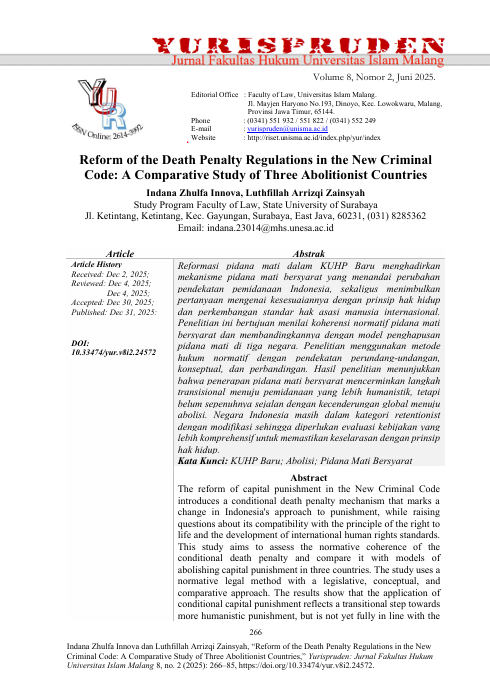
Reform of the Death Penalty Regulations in the New Criminal Code: A Comparative Study of Three Abolitionist Countries
DOI:
https://doi.org/10.33474/yur.v8i2.24572Keywords:
Conditional Death Penalty, New Criminal Code, Custody, Abolition, The Right to LifeAbstract
Changes to the Criminal Code regarding the death penalty introduce new procedural requirements, which naturally raise questions about their compatibility with the right to life in light of evolving international human rights standards. This study aims to assess the normative coherence of the conditional death penalty and compare it with models of abolishing capital punishment in three countries. The study uses a normative legal method with a legislative, conceptual, and comparative approach. The results show that the application of conditional capital punishment reflects a transitional step towards more humanistic punishment, but is not yet fully in line with the global trend towards abolition. Indonesia is still in the retentionist category with modifications, so a more comprehensive policy evaluation is needed to ensure alignment with the principle of the right to life. The novelty of this study lies in the formulation of a joint custody model centered on the best interests of the child, rather than merely the division of rights between the father and mother. This model prioritizes the child’s psychological well-being as the primary basis for determining the custody arrangement. The contribution of this study is to advance the study of Islamic family law in Indonesia by integrating the concepts of parental alienation, the best interests of the child, and joint custody into a single analytical framework.
References
Amnesty International. Death Sentences and Executions 2022. London: Amnesty International, 2023.
Angelina, Anita, and Subekti Subekti. “Hukuman Mati Dalam Perspektif Hak Asasi Manusia Di Indonesia.” Jurnal Ilmiah Wahana Pendidikan 10, no. 21 (2024): 84–91. https://doi.org/10.5281/zenodo.14287289.
Anugrah, Roby, and Raja Desril. “Kebijakan Formulasi Pidana Mati Dalam Pembaharuan Hukum Pidana Indonesia.” Jurnal Pembangunan Hukum Indonesia 3, no. 1 (2021): 80–95. https://doi.org/10.14710/jphi.v3i1.80-95.
Baiti, Aqmarina Khusnul. “Pidana Mati Dalam Perspektif Undang-Undang Nomor 1 Tahun 2023: Tinjauan Yuridis Terhadap Model Pemidanaan Alternatif.” Jurnal Hukum In Concreto 3, no. 1 (2024): 114–29. https://ejournal.uhb.ac.id/index.php/inconcreto/article/view/1849/982.
Burhan, Abdul As’ad Al. “Reformulasi Kebijakan Pidana Mati Terhadap Koruptor Dalam Perspektif Hukum Positif Dan Hak Asasi Manusia.” Jurnal Hukum In Concreto 3, no. 1 (2024): 130–48. https://ejournal.uhb.ac.id/index.php/inconcreto/article/view/1856.
Darajati, Muhammad Rafi, and Muhammad Syafei. “Politik Hukum Pembentukan Dua Kovenan HAM Internasional Tentang Hak Sipil Politik dan Hak Ekonomi Sosial Budaya.” Syiah Kuala Law Journal 4, no. 2 (2020): 106–22. https://doi.org/10.24815/sklj.v4i2.16999.
Death Penalty Information Center. “Equatorial Guinea Becomes 25th African Country to Abolish Death Penalty.” Accessed December 25, 2025. https://deathpenaltyinfo.org/equatorial-guinea-becomes-25th-african-country-to-abolish-death-penalty.
“Death Sentences and Executions 2022.” Amnesty International, May 16, 2023. https://www.amnesty.org/en/documents/act50/6548/2023/en/.
Gunawan, Bertrand Jerison, and Go Lisanawati. “Masa Percobaan Pidana Mati Pada KUHP Nasional Ditinjau dari Aliran Utilitarianisme Hukum.” Jurnal Hukum Lex Generalis 5, no. 12 (2024): 1–23. https://doi.org/10.56370/jhlg.v5i12.857.
Harmain, Irfan, Dian Mustika Intan, Ilhamda Fattah Kaloko, Herry Wahyudi, and Irman. “Diskrepansi Praktik Hukuman Mati Di Indonesia Terhadap Standar Ham Internasional: Analisis Reformasi Kuhp 2023 Dan Implikasinya Bagi Kebijakan Pidana Nasional.” Jurnal Hukum Samudra Keadilan 20, no. 1 (2025): 1–16. https://doi.org/10.33059/jhsk.v20i1.11360.
Harmain, Irfan, Dian Mustika Intan, Ilhamda Fattah Kaloko, Herry Wahyudi, and Irman. “Diskrepansi Praktik Hukuman Mati Di Indonesia Terhadap Standar HAM Internasional: Analisis Reformasi KUHP 2023 Dan Implikasinya Bagi Kebijakan Pidana Nasional.” Jurnal Hukum Samudra Keadilan 20, no. 1 (2025): 1–16. https://doi.org/10.33059/jhsk.v20i1.11360.
Hendriana, Rani, Dwiki Oktobrian, and Muhammad Isa Abdillah. “Proyeksi Ke Depan Pelaksanaan Pidana Mati Di Indonesia Dalam Rancangan Kitab Undang-Undang Hukum Pidana.” Jurnal Ius Constituendum 7, no. 1 (2022): 68–86. https://doi.org/10.26623/jic.v7i1.4906.
Huang, Gui. “The Death Penalty and Its Reforms in China and Other Countries.” In On the Alternative Punishment to the Death Penalty in China, edited by Gui Huang. Springer Nature, 2024. https://doi.org/10.1007/978-981-97-1627-2_3.
Jayanti, Feren Nur. “Kebijakan Pemerintah Dalam Pelaksanaan Hukuman Mati Terhadap Kasus Pembunuhan Berencana Berdasarkan Perspektif Hak Asasi Manusia.” WEDANA: Jurnal Kajian Pemerintahan, Politik Dan Birokrasi 10, no. 2 (2024): 50–59. https://doi.org/10.25299/wedana.2024.18132.
Kazakhstan Became the 90th State to Ratify the Second Optional Protocol to the International Covenant on Civil and Political Rights. March 30, 2022. https://icomdp.org/kazakhstan-became-the-90th-state-to-ratify-the-second-optional-protocol-to-the-international-covenant-on-civil-and-political-rights/.
“Laporan Amnesty International tentang Hukuman Mati 2023/2024 • Amnesty International Indonesia.” Amnesty International Indonesia, May 28, 2024. https://www.amnesty.id/kabar-terbaru/siaran-pers/laporan-amnesty-international-tentang-hukuman-mati-2023-2024/05/2024/.
Mubarok, Kiagus Zaenal, Dina Yulianti, and Otong Sulaeman. “Dilema Hukuman Mati: Komparasi Antara Konvenan International Terkait Hak Asasi Manusia Dan Pandangan Nahdlatul Ulama.” Jurnal Keislaman 6, no. 1 (2023): 190–209. https://doi.org/10.54298/jk.v6i1.3709.
Ningsih, Putu Ayu Veguita Putri, and Irsyaf Marsal. “Politik Hukum Pembentukan Rancangan Kitab Undang-Undang Hukum Acara Pidana: Peluang dan Hambatannya Dalam Penegakan Hukum Di Indonesia.” Al-Zayn: Jurnal Ilmu Sosial & Hukum 3, no. 5 (2025): 7373–91. https://ejournal.yayasanpendidikandzurriyatulquran.id/index.php/AlZayn/article/view/2375/1450.
Nugraha, Roby Satya, Edi Rohaedi, Nandang Kusnadi, and Abid Abid. “The Transformation of Indonesia’s Criminal Law System: Comprehensive Comparison between the Old and New Penal Codes.” Reformasi Hukum 29, no. 1 (2025): 1–21. https://doi.org/10.46257/jrh.v29i1.1169.
Puro, Djuhandhani Rahadjo, Kukuh Sudarmanto, and Zaenal Arifin. “Optimalisasi Pelaksanaan Pidana Mati Dalam Mewujudkan Efek Jera Pada Tindak Pidana Pembunuhan Berencana.” Jurnal USM Law Review 6, no. 3 (2023): 1181–92. https://doi.org/10.26623/julr.v6i3.7945.
Putra, Aista Wisnu, and Rahmi Dwi Sutanti. “Kebijakan Formulasi Pidana Mati Bersyarat dalam Perspektif Pembaharuan Hukum Pidana Indonesia.” Jurnal Pembangunan Hukum Indonesia 2, no. 3 (2020): 319–30. https://doi.org/10.14710/jphi.v2i3.319-330.
Putri, Dita Melati. “Hukuman Pidana Mati Dalam KUHP Baru Dan Perspektif Abolisionalis Serta Retensionis.” Eksekusi : Jurnal Ilmu Hukum Dan Administrasi Negara 2, no. 4 (2024): 01–13. https://doi.org/10.55606/eksekusi.v2i4.1451.
Rasina Padeni Nasution, Rizki Akbar Muluk Siregar, Ratu Frisya Ritonga, Amany Zuhaira Ritonga, and Reza Ananda Siregar. “Penghapusan Hukuman Mati Pada Sistem Peradilan Pidana Di Indonesia Atas Lahirnya UU No 1 Tahun 2023 Tentang KUHP.” Jurnal Hukum, Politik dan Ilmu Sosial 3, no. 1 (2023): 225–32. https://doi.org/10.55606/jhpis.v3i1.3249.
“Republik Afrika Tengah Hapus Hukuman Mati.” Accessed December 25, 2025. https://komunio.id/2022/05/30/berita-terkini-internasional-republik-afrika-tengah-hapus-hukuman-mati/.
swissinfo.ch, S. W. I. “Guinea Ecuatorial abole la pena de muerte en el nuevo Código Penal.” SWI swissinfo.ch, September 19, 2022. https://www.swissinfo.ch/spa/guinea-ecuatorial-abole-la-pena-de-muerte-en-el-nuevo-código-penal/47912656.
Tarmizi, Puan Zhinta Azzahra. “Perbandingan Penerapan Hukuman Mati Dalam Sistem Hukum Pidana Di Indonesia dan Negara-Negara Eropa: Tinjauan Terhadap Aspek Moral dan Efektivitasnya.” Jurnal Kajian Hukum dan Kebijakan Publik 2, no. 2 (2025): 833–40. https://jurnal.kopusindo.com/index.php/jkhkp/article/view/635.
Theofany, Shekinah, and Wahyu Wijiati. “Pandangan Etika Kristen Tentang Hukuman Mati: Dilematis Antara Keadilan Atau Kekejaman.” Jurnal Ilmu Sosial dan Humaniora 1, no. 4 (2025): 1653–61. https://indojurnal.com/index.php/jisoh/article/view/1365.
Tim Institute for Criminal Jutice Reform (ICJR). Politik Kebijakan Hukuman Mati Dari Masa Ke Masa. Institute for Criminal Justice Reform, 2017.
“Upaya Mencegah Overkriminalisasi Tindak Pidana Kesusilaan Di Indonesia -.” Accessed December 25, 2025. https://icjr.or.id/upaya-mencegah-overkriminalisasi-tindak-pidana-kesusilaan-di-indonesia/.
Wahyudi, Ade Arga, Wami Irma Suryani, and Zul Fahmi. “Hukuman Mati dan Hak untuk Hidup di Indonesia: Tinjauan HAM terhadap Undang-undang Nomor 1 Tahun 2023.” Jurnal Ilmu Sosial dan Humaniora 4, no. 3 (2025): 880–89. https://journal.literasisains.id/index.php/sosmaniora/article/view/5924.
Downloads
Additional Files
Published
How to Cite
Issue
Section
License
Copyright (c) 2025 Indana Zhulfa Innova, Luthfillah Arrizqi Zainsyah

This work is licensed under a Creative Commons Attribution 4.0 International License.
The publication and dissemination of the article is subject to an attribution license (CC BY) under the Creative Commons Attribution License, so that others free also to copy, and redistribute the material in any medium or format, remix, transform and build upon material for any purpose, even commercially, as long as they give credit to the author for the authentic work.