Exploring EFL students’ perceptions of using ChatGPT-supported Quizlet for vocabulary learning
DOI:
https://doi.org/10.33474/j-reall.v7i2.25157Keywords:
artificial intelligence, ChatGPT, Quizlet, vocabulary learningAbstract
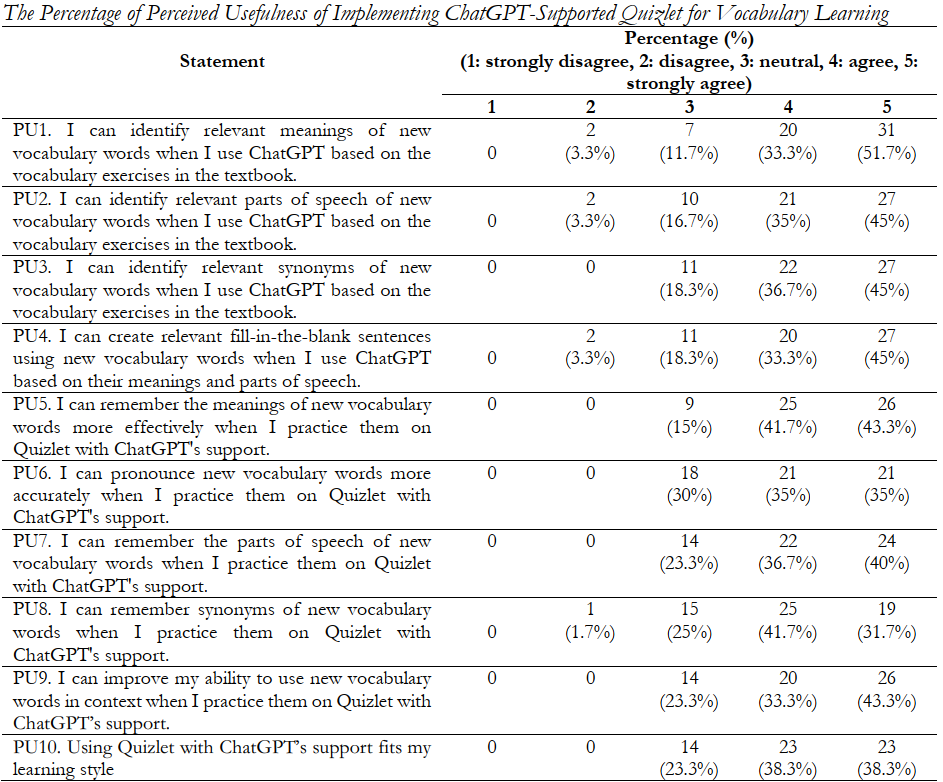
The role of vocabulary in facilitating reading and listening comprehension in a foreign language is widely acknowledged. Despite its importance, many university students in Vietnam still struggle to expand their vocabulary effectively. With the rapid development of digital technologies and artificial intelligence (AI), new opportunities for vocabulary learning have emerged. However, despite the growing use of digital tools, many studies examine them separately rather than exploring their combined use to maximize the benefits for vocabulary learning. This study aims to explore English-majored students’ perceptions of the usefulness of ChatGPT-supported Quizlet (free version) for vocabulary learning in a university listening course in Vietnam. A mixed-methods approach was employed, using a 5-point Likert-scale questionnaire focusing on perceived usefulness and semi-structured interviews. Data were collected from 60 participants after 14 weeks of implementing the tools. The quantitative results indicate that students generally perceive the implementation of ChatGPT-supported Quizlet as useful for improving vocabulary learning, particularly in meaning retention, pronunciation, parts of speech, and contextual use. The qualitative findings further reveal that these tools help learners better understand words, identify parts of speech, and increase their exposure to vocabulary through accurate, instant, context-specific, and personalized examples from ChatGPT, a variety of interactive practice features from Quizlet, and by fostering learner autonomy. The findings highlight the importance of integrating AI-assisted tools into vocabulary instruction in Vietnamese EFL higher education contexts, with appropriate training in prompt writing and Quizlet use. Future research may further investigate the long-term effects of AI-assisted vocabulary learning on learners’ vocabulary retention.
References
Abdelhalim, S. M., & Alsehibany, R. A. (2025). Integrating ChatGPT for vocabulary learning and retention: A classroom-based study of Saudi EFL learners. Language Learning & Technology, 29(1), 1-24. https://doi.org/10.64152/10125/73635
Aldowsari, B. I., & Aljebreen, S. G. (2024). The impact of using a ChatGPT-based application to enhance Saudi students’ EFL vocabulary learning. International Journal of Language and Literary Studies, 6(4), 380-397. https://doi.org/10.36892/ijlls.v6i4.1955
Alqahtani, M. (2015). The importance of vocabulary in language learning and how to be taught. International Journal of Teaching and Education, 3(3), 21-34. https://doi.org/10.20472/TE.2015.3.3.002
Ariani, S., Rachmawaty, N., & Amalia, P. A. (2026). Students’ voices on ChatGPT: A pilot study on academic writing enhancement. Journal of Research on English and Language Learning (J-REaLL), 7(1), 165–184. https://doi.org/10.33474/j-reall.v7i1.24665
Brown, M. E., & Hocutt, D. L. (2015). Learning to use, useful for learning: A usability study of Google apps for education. Journal of Usability Studies, 10(4), 160-181. https://dl.acm.org/doi/10.5555/2817322.2817327
Bueno-Alastuey, M. C., & Nemeth, K. (2022). Quizlet and podcasts: Effects on vocabulary acquisition. Computer Assisted Language Learning, 35(7), 1407–1436. https://doi.org/10.1080/09588221.2020.1802601
Chaikovska, O., & Zbaravska, L. (2020). The efficiency of Quizlet-based EFL vocabulary learning in preparing undergraduates for State English exam. Advanced Education, 7(14), 84-90. https://doi.org/10.20535/2410-8286.197808
Chaokongjakra, W. (2023). Is it “important,” “significant,” or “crucial”? A corpus-based study of English synonyms. LEARN Journal: Language Education and Acquisition Research Network, 16(2), 512–532. Retrieved from https://so04.tci-thaijo.org/index.php/LEARN/article/view/266969
Cohen, L., Manion, L., & Morrison, K. (2018). Research methods in education (8th ed.). Routledge.
Creswell, J. W., & Clark, V. L. P. (2017). Designing and conducting mixed methods research (3rd ed.). SAGE Publications.
Creswell, J. W., & Creswell, J. D. (2022). Research design: qualitative, quantitative, and mixed methods approaches (6th ed.). SAGE Publications.
Dang, T. B. D., Le, V. L., Nguyen, M., Vo, V. S., & Hua, N. N. (2021). An investigation into difficulties in English listening of freshmen majoring in English at a university in the Mekong Delta, Vietnam. European Journal of English Language Teaching, 6(6), 38-62. https://doi.org/10.46827/ejel.v6i6.3925
Egamova, J. K. K. , & Sharofova, N. R. K. (2022). The importance of vocabulary in learning language. Central Asian Research Journal For Interdisciplinary Studies (CARJIS), 2(11), 187-190. Retrieved from https://cyberleninka.ru/article/n/the-importance-of-vocabulary-in-learning-english-language
Elhami, A., & Khoshnevisan, B. (2022). Conducting an interview in qualitative research: The Modus Operandi. Mextesol Journal, 46(1). Retrieved from https://www.mextesol.net/journal/public/files/e2310aaf328014506afd393a7ca413a4.pdf
Eljack, N. S., Altahir, N. A., Mohammed, N. I., & Osman, S. A. (2025). ChatGPT as an AI assistant tool to enhance university students’ teaching, assessment and academic achievements: A case study of an EAP lecturer. Journal of Language Teaching and Research, 16(6), 1813–1823. https://doi.org/10.17507/jltr.1606.03
Enamorado M., Á. J. (2025). Development of linguistic competence in English for specific purposes through ChatGPT: A Case Study. Journal of Language and Education, 11(1), 85-100. https://doi.org/10.17323/jle.2025.23745
Fetters, M. D., Curry, L. A., & Creswell, J. W. (2013). Achieving integration in mixed methods designs—principles and practices. Health Services Research, 48(6, Pt. 2), 2134-2156. https://doi.org/10.1111/1475-6773.12117
Freire, R., & Jones, T. (2019). Q: Skills for success: Level 4: Listening and speaking (3rd ed.). Oxford University Press.
Herlinawati, H., Marwa, M., Ismail, N., Liza, L. O., & Situmorang, D. D. B. (2024). The integration of 21st century skills in the curriculum of education. Heliyon, 10(15), e35148. https://doi.org/10.1016/j.heliyon.2024.e35148
Hiebert, E. H., & Kamil, M. L. (2005). Teaching and learning vocabulary bringing research to practice. Routledge. https://doi.org/10.4324/9781410612922
Ho, T. T. H. , & Kawaguchi, S. (2021). The effectiveness of Quizlet in improving EFL learners’ receptive vocabulary acquisition. Asiatic: IIUM Journal of English Language and Literature, 15(1), 115–159. https://doi.org/10.31436/asiatic.v15i1.2314
Hsu, H. T., & Chao, W. N. (2024). Acceptance of mobile-assisted engineering vocabulary learning by military students. Education and Information Technologies, 29(2), 2413–2435. https://doi.org/10.1007/s10639-023-11932-0
Ifadloh, N. (2025). Using Quizlet and ChatGPT to create fun and easy English vocabulary learning. In N. H. Fajaria (Ed.), Powerful Vocabulary and Grammar Classroom Activities (pp. 203-214). Rizquna.
Juwita, N. J., & Hendra, D. (2025). Optimization of ChatGPT use for efficient German vocabulary compilation on the Quizlet application. Allemania Jurnal Bahasa dan Sastra Jerman, 15(1), 17-26. Retrieved from https://ejournal.upi.edu/index.php/allemania/article/view/82930
Kholis, M. N., & Nadhif, M. F. (2023). The effectiveness of Quizlet.com in Arabic vocabulary learning: Students’ perception and acceptance of technology. Journal of Arabic Education and Literature, 7(1), 1-13. https://doi.org/10.18326/lisania.v7i1.1-13
Khudayberdievna, K. Z. (2025). Theoretical foundations for developing receptive skills in second language acquisition. AMERICAN Journal of Language, Literacy and Learning in STEM Education, 3(3), 372-374. Retrieved from https://grnjournal.us/index.php/STEM/article/view/7262
Khurma, O. A., Albahti, F., Ali, N., & Bustanji, A. (2024). AI ChatGPT and student engagement: Unraveling dimensions through PRISMA analysis for enhanced learning experiences. Contemporary Educational Technology, 16(2). https://doi.org/10.30935/cedtech/14334
Le, T. N. U., & Bui, D. B. H. (2026). Combination of using ChatGPT and Quizlet to learn vocabulary: A study of learners' perceptions. Journal of English and Applied Linguistics, 5(1), 1–19. https://doi.org/10.59588/2961-3094.1242
Lichtman, M. (2014). Qualitative research for the social sciences. SAGE Publications. https://doi.org/10.4135/9781544307756
Lutfiyah, N., Nuraeningsih, N., & Rusiana, R. (2022). The obstacles in learning vocabulary of EFL students. Prominent: Journal of English Studies, 5(2), 114-125. https://doi.org/10.24176/pro.v5i2.8257
Luu, D. K. C, & Bui, D. B. H. (2025). The Utilization of Chat-GPT 3.5 for vocabulary learning: A study on students’ perceptions. AsiaCALL Online Journal, 16(1), 226-252. https://doi.org/10.54855/acoj.2516111
Manda, S., Talib, A., & Aeni, N. (2022). Improving students’ vocabulary by using show and tell (S&T) method at the first grade students of SMA Negeri 6 Toraja Utara. Journal of Excellence in English Language Education, 1(4), 310-316. Retrieved from https://ojs.unm.ac.id/JoEELE/article/view/37945/17648
McLean, S., Stewart, J., & Batty, A. O. (2020). Predicting L2 reading proficiency with modalities of vocabulary knowledge: A bootstrapping approach. Language Testing, 37(3), 147–177. https://doi.org/10.1177/0265532219898380
Mirvositovna, M. D., & Dilafruz, S. (2023). The importance of synonyms in enhancing reading and writing. Technical Science Research in Uzbekistan, 1(5), 201-204. Retrieved from https://universalpublishings.com/index.php/tsru/article/view/3328/6376
Mugableh, A. I. (2024). The impact of ChatGPT on the development of vocabulary knowledge of Saudi EFL students. Arab World English Journal (AWEJ) Special Issue on ChatGPT, 265-281. https://doi.org/10.24093/awej/ChatGPT.18
Nation, I. S. P. (2013). Learning vocabulary in another language (2nd ed.). Cambridge University. https://doi.org/10.1017/CBO9781139858656
Nguyen, H. T. V., & Javosky, K. (2025). Beyond memorization: Transforming Vocabulary teaching and learning for equity in Vietnamese EFL classrooms. In T. Q. Tran, & T. M. Duong, Differentiated Instruction, Equity, and Inclusion in Language Education (pp. 1-40). IGI Global Scientific Publishing. https://doi.org/10.4018/979-8-3693-6497-0.ch001
Nguyen, L. Q., & Le, H. V. (2022). Quizlet as a learning tool for enhancing L2 learners’ lexical retention: Should it be used in class or at home? Human Behavior and Emerging Technologies, 2022(1). https://doi.org/10.1155/2022/8683671
Nguyen, L. Q., & Le, H. V. (2023). The role of Quizlet learning tool in learners’ lexical retention: A quasi-experimental study. International Journal of Emerging Technologies in Learning, 18(3), 38-50. https://doi.org/10.3991/ijet.v18i03.34919
Nguyen, T. T., Nguyen, D. T., Nguyen, D. L. Q. K., Mai, H. H., & Le, T. X. (2022). Quizlet as a tool for enhancing autonomous learning of English vocabulary. AsiaCALL Online Journal, 13(1), 150-165. https://doi.org/10.54855/acoj221319
Pan, Q., & Xu, R. (2011). Vocabulary teaching in English language teaching. Theory and Practice in Language Studies, 1(11), 1586-1589. https://doi.org/10.4304/tpls.1.11.1586-1589
Pan, S. C., Zung, I., Imundo, M. N., Zhang, X., & Qiu, Y. (2023). User-generated digital flashcards yield better learning than premade flashcards. Journal of Applied Research in Memory and Cognition, 12(4), 574–588. https://doi.org/10.1037/mac0000083
Qu, K., & Wu, X. (2024). ChatGPT as a CALL tool in language education: A study of hedonic motivation adoption models in English learning environments. Education and Information Technologies, 29(25), 19471–19503. https://doi.org/10.1007/s10639-024-12598-y
Rahman, S. F. A., Yunus, M. M., & Hashim, H. (2022). A review on adapted models in technology acceptance. International Journal of Academic Research in Business and Social Sciences, 12(3), 708-722. https://doi.org/10.6007/IJARBSS/v12-i3/12346
Ratnawati, P. D., Yulianti, A., & Desi, E. (2021). English learning innovation using flash card media to improve students' understanding of vocabulary and pronounciation. The 14th University Research Colloqium, 27-35.
Retrieved from https://repository.urecol.org/index.php/proceeding/article/view/1726
Richards, J. C., & Renandya, W. A. (Eds.) (2010). Methodology in language teaching: An anthology of current practice. Cambridge University Press. https://doi.org/10.1017/CBO9780511667190
Rutakumwa, R., Mugisha, J. O., Bernays, S., Kabunga, E., Tumwekwase, G., Mbonye, M., & Seeley, J. (2019). Conducting in-depth interviews with and without voice recorders: A comparative analysis. Qualitative Research, 20(5), 565-581. https://doi.org/10.1177/1468794119884806
Safitri, E. I., Hidayati, S., & Ciptaningrum, D. S. (2025). The impact of AI chatbots on English language learners’ speaking proficiency: A systematic review. Journal of Research on English and Language Learning (J-REaLL), 6(1), 313–329. https://doi.org/10.33474/j-reall.v6i2.23866
Sazonova, N., Ivanova, S., & Lavrova, A. (2018). Advantages, disadvantages and limitations of using Google Forms for online tests: A case study of a Russian university. The 13th International Conference on Virtual Learning, 142-148. https://pdfcoffee.com/qdownload/advantages-disadvantages-and-limitations-of-using-google-pdf-free.html
Shaengchart, Y. (2023). A conceptual review of TAM and ChatGPT usage intentions among higher education students. Advance Knowledge for Executives, 2(3), 1-7. Available at SSRN: https://ssrn.com/abstract=4581231
Shcherbakova, O., & Baranenko, T. (2024). The usage of web applications in English language learning. Scientific Journal of Polonia University, 64(3), 104-109. https://doi.org/10.23856/6412
Shukhratovna, M. D., & O'mirbaevna, E. G. (2025). Language learning through mobile applications: A comparative analyses of Duolingo, Memrise, and ChatGPT. KONFERENSIYA, 1(2), 963–967. https://journalss.org/index.php/conf/article/view/15224
Tanjung, N. F., & Rafida, T. (2025). Quizlet interactive learning: Junior high school students' perspective to enrich English vocabulary. Curricula: Journal of Curriculum Development, 4(1), 733–748. Retrieved from https://ejournal.upi.edu/index.php/CURRICULA/article/view/84843
Tran, K. Q. (2024). The effects of integrating artificial intelligence into learning academic vocabulary among masters in English studies students. International Journal of AI in Language Education, 1(1), 1-19. https://doi.org/10.54855/ijaile.24111
Tran, T. Q., & Nguyen, V. L. T. (2023). Insights into Vietnamese bilingual students' Quizlet-based English vocabulary learning. Journal of Language Teaching and Research, 14(3), 682-688. https://doi.org/10.17507/jltr.1403.15
Tran, N. T., Nguyen, T. T., & Pham, H. H. (2024). Exploring the challenges of L1 negative transfer among Vietnamese English language learners: A qualitative study. rEFLections, 31(2), 837-857. https://doi.org/10.61508/refl.v31i2.275268
Ur, P. (2024). A course in English language teaching (3rd ed.). Cambridge University Press & Assessment.
Vo, A., & Nguyen, H. (2024). Generative artificial intelligence and ChatGPT in language learning: EFL Students' perceptions of technology acceptance. Journal of University Teaching and Learning Practice, 21(6), 199-218. https://doi.org/10.53761/fr1rkj58
Yen, D. T. N. (2020). Vietnamese non-English major EFL university students' receptive knowledge of the most frequent English words. VNU Journal of Foreign Studies, 36(3), 1-11. https://doi.org/10.25073/2525-2445/vnufs.4553
Yu, M. (2026). Optimizing EFL vocabulary acquisition: A randomized controlled mixed-methods investigation of artificial intelligence-driven incidental, contextual, and multimodal strategies. Education and Information Technologies, 31(1), 53–97. https://doi.org/10.1007/s10639-025-13803-2
Downloads
Published
How to Cite
Issue
Section
License
Copyright (c) 2026 Tran Nhu Uyen Le, Diem Bich Huyen Bui

This work is licensed under a Creative Commons Attribution 4.0 International License.
Authors who publish this journal agree to the following terms:
- Authors retain copyright and grant the journal right of first publication with the work simultaneously licensed under a Creative Commons Attribution License that allows others to share the work with an acknowledgement of the work's authorship and initial publication in this journal.
- Authors can separately make additional contractual arrangements for non-exclusive distribution published by the journal (e.g., publish it in a book), with an acknowledgement of its initial publication in this journal.
- Authors are allowed and encouraged to send their work via online (e.g., in the institutional repositories or their website) after published by the journal.