
Spaced repetition for vocabulary retention in EFL and ESL learning: A systematic literature review
DOI:
https://doi.org/10.33474/j-reall.v7i2.25562Keywords:
EFL and ESL learners, English vocabulary, spaced repetition, systematic literature review, vocabulary retentionAbstract
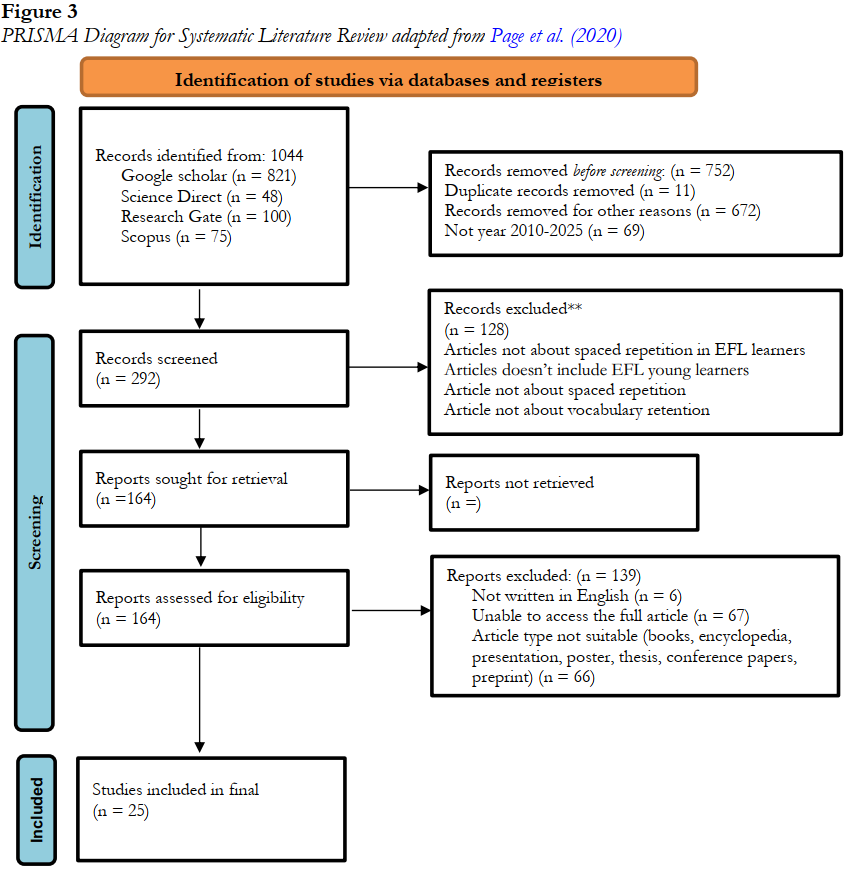
Vocabulary retention remains a persistent challenge among EFL and ESL learners because newly learned words are often forgotten without systematic, repeated exposure. Although spaced repetition (SR) is widely recognized as an effective strategy for long-term memory, there is still limited understanding of how SR can be optimally implemented across diverse EFL and ESL learners' contexts, particularly regarding spacing schedules, instructional design, and technology integration. As a result, evidence on SR implementation in EFL and ESL learners' vocabulary learning remains fragmented. EFL and ESL learners’ systematic literature review aims to synthesize the opportunities and challenges associated with the use of SR for vocabulary learning among EFL and ESL learners. Following the PRISMA guidelines, 25 studies published between 2010 and 2025 were selected from Scopus, Google Scholar, ScienceDirect, and ResearchGate based on predetermined inclusion and exclusion criteria. The reviewed studies examined various SR approaches, including digital flashcards, retrieval-based activities, mobile-assisted language learning applications, cumulative testing, and multimodal learning tools. The findings indicate that SR provides substantial opportunities, particularly for improving vocabulary retention and enhancing long-term memory, while also increasing learner motivation, learner autonomy, retrieval practice, and technology-enhanced language learning. However, several challenges were identified, including instructional design issues, uncertainty regarding optimal spacing schedules, technology and digital literacy constraints, learner-related differences, and limited empirical evidence across diverse educational settings. Overall, the reviewed evidence consistently points to the positive potential of SR as a cognitively efficient approach for supporting vocabulary development, particularly when implemented through well-designed instructional practices.
References
Alqahtani, M. (2015). The importance of vocabulary in language learning and how to be taught. International Journal of Teaching and Education, III(3), 21–34. https://doi.org/10.20472/te.2015.3.3.002
Ameen, F. (2026). Challenges in vocabulary learning among Kuwaiti EFL learners: A narrative review. Discover Education, 5(1). https://doi.org/10.1007/s44217-026-01267-6
Annisah, Z., Putri, G. N. A., & Tarihoran, N. (2025). Leveraging flashcard for ELT: A Systematic Review. International Journal of Society Reviews (INJOSER), 3(5), 682–710. https://injoqast.net/index.php/INJOSER/article/view/175
Bayliss, D. M., & Jarrold, C. (2015). How quickly they forget: The relationship between forgetting and working memory performance. Journal of Experimental Psychology: Learning Memory and Cognition, 41(1), 163–177. https://doi.org/10.1037/a0037429
Cepeda, N. J., Pashler, H., Vul, E., Wixted, J. T., & Rohrer, D. (2006). Distributed practice in verbal recall tasks: A review and quantitative synthesis. Psychological Bulletin, 132(3), 354–380. https://doi.org/10.1037/0033-2909.132.3.354
Clark, J. M., & Paivio, A. (1991). Dual coding theory and education. Educational Psychology Review, 3(3), 149–210. https://doi.org/10.1007/BF01320076
Darsana, K. I. P. D. (2025). The use of bilingual flashcards as learning media to teach English vocabulary for young learners. The Art of Teaching English as a Foreign Language (TATEFL), 6(1), 70–82. https://doi.org/10.36663/tatefl.v6i1.954
Dhiya, J. S., Shafya, U. F, Pramesty, A., & Nurhasanah, A. (2025). The effect of using online platform on students’ vocabulary: A systematic literature review. Retrieved from Research Gate, 1(April), 1–24. https://www.researchgate.net/publication/391238544
Ebbinghaus, H. (1913). Memory: A contribution to experimental psychology (H.A. Ruger & C. E Bussenius, Trans.). Teacher College, Columbia University. (Original work published 1885)
Farvardin, M. T. (2019). Effects of spacing techniques on EFL learners’ recognition and production of lexical collocations. Indonesian Journal of Applied Linguistics, 9(2), 395–403. https://doi.org/10.17509/ijal.v9i2.20237
Hanson, A. S., & Brown, C. (2020). Enhancing L2 learning through a mobile assisted spaced-repetition tool: An effective but bitter pill? Computer Assisted Language Learning, 33(1-2), 133-155, https://doi.org/10.1080/09588221.2018.1552975
Hirschel, R., & Fritz, E. (2013). CALL program versus vocabulary notebook. System, 41(3), 639–653. https://doi.org/10.1016/j.system.2013.07.016
Hu, T. C., Sung, Y. T., Liang, H. H., Chang, T. J., & Chou, Y. T. (2022). Relative Roles of grammar knowledge and vocabulary in the reading comprehension of EFL elementary-school learners: Direct, mediating, and form/meaning-distinct effects. Frontiers in Psychology, 13(June). https://doi.org/10.3389/fpsyg.2022.827007
Janebi, M., Asadi, N., & Arabmofrad, A. (2025). Effects of two mobile-assisted language learning apps on L2 receptive and productive vocabulary knowledge: A mixed-methods study. System, 133(2024), 103763. https://doi.org/10.1016/j.system.2025.103763
Kang, S. H. K. (2016). Spaced repetition promotes efficient and effective learning: Policy implications for instruction. Policy Insights from the Behavioral and Brain Sciences, 3(1), 12–19. https://doi.org/10.1177/2372732215624708
Karpicke, J. D., & Roediger, H. L. (2008). The critical importance of retrieval for learning. Science, 319(5865), 966–968. https://doi.org/10.1126/science.1152408
Kiliç, M. (2019). Vocabulary knowledge as a predictor of performance in writing and speaking: A case of Turkish EFL learners. Pasaa, 57, 133–164. https://doi.org/10.58837/chula.pasaa.57.1.6
Kim, A. S. N., Wong-Kee-You, A. M. B., Wiseheart, M., & Rosenbaum, R. S. (2019). The spacing effect stands up to big data. Behavior Research Methods, 51(4), 1485–1497. https://doi.org/10.3758/s13428-018-1184-7
Kim, S. K., & Webb, S. (2022). The effects of spaced practice on second language learning: A meta-analysis. Language Learning, 72(1), 269–319. https://doi.org/10.1111/lang.12479
Lexi, P., Tawarik, O., & Giovani, W. (2025). The implementation of flashcard in English teaching at SDS Bina Setia Meradak. Journal of Educational Learning and Innovation (ELIa), 5(2), 12–22. https://doi.org/10.46229/elia.V5i2
Lo, S. (2024). Vocabulary learning through viewing dual-subtitled videos: Immediate repetition versus spaced repetition as an enhancement strategy. ReCALL, 36(2), 152–167. https://doi.org/10.1017/S0958344024000053
Lotfolahi, A. R., & Salehi, H. (2016). Learners’ perceptions of the effectiveness of spaced learning schedule in L2 vocabulary learning. SAGE Open, 6(2), 1–9. https://doi.org/10.1177/2158244016646148
Lotfolahi, A. R., & Salehi, H. (2017). Spacing effects in vocabulary learning: Young EFL learners in focus. Cogent Education, 4(1), 1–10. https://doi.org/10.1080/2331186X.2017.1287391
Mettler, E., Massey, C. M., Kellman, P. J., (2016). A comparison of adaptive and fixed schedules of practice. Journal of Experimental Psychology: General 145(7), 897-917, https://doi.org/10.1037/xge0000170
Miftah, M. Z., Basthomi, Y., & Syahid, A. (2022). Preservice teachers’ reflections on English teaching practicum for professional development: A bibliometric analysis. Pedagogika, 147(3), 198–226. https://doi.org/10.15823/p.2022.147.10
Mijan, N. N., & Hashim, H. (2023). The usage of MALL for vocabulary acquisition: A systematic review (2019–2023). International Journal of Academic Research in Business and Social Sciences, 13(12), 96–112. https://doi.org/10.6007/ijarbss/v13-i12/19725
Miles, S. W. (2014). Spaced vs massed distribution instruction for L2 grammar learning. System, 42, 412–428. https://doi.org/10.1016/j.system.2014.01.014
Murphy, A. P. D. (2024). The impact of spaced learning strategies on vocabulary retention in primary English classrooms. Journal of Artificial Intelligence General Science (JAIGS), 4(1), 142–154. https://doi.org/10.60087/jaigs.vol4.issue1.p142
Nakata, T. (2015). Effects of expanding and equal spacing on second language vocabulary learning: Does gradually increasing spacing increase vocabulary learning. Studies in Second Language Acquisition, 37(4), 677–711. https://doi.org/10.1017/S0272263114000825
Nakata, T. (2017). Does repeated practice make perfect? The effects of within-session repeated retrieval on second language vocabulary learning. Studies in Second Language Acquisition, 39(4), 653–679. https://doi.org/10.1017/S0272263116000280
Nakata, T., Tada, S., McLean, S., & Kim, Y. A. (2021). Effects of distributed retrieval practice over a semester: Cumulative tests as a way to facilitate second language vocabulary learning. TESOL Quarterly, 55(1), 248–270. https://doi.org/10.1002/tesq.596
Namaziandost, E., Sawalmeh, M. H. M., & Soltanabadi, M. I. (2020). The effects of spaced versus massed distribution instruction on EFL learners’ vocabulary recall and retention. Cogent Education, 7(1), 1–13. https://doi.org/10.1080/2331186X.2020.1792261
Page, M. J., McKenzie, J. E., Bossuyt, P. M., Boutron, I., Hoffmann, T. C., Mulrow, C. D., Shamseer, L., Tetzlaff, J. M., Akl, E. A., Brennan, S. E., Chou, R., Glanville, J., Grimshaw, J. M., Hróbjartsson, A., Lalu, M. M., Li, T., Loder, E. W., Mayo-Wilson, E., McDonald, S., … Moher, D. (2021). The PRISMA 2020 statement: An updated guideline for reporting systematic reviews. BMJ, 372, n71. https://doi.org/10.1136/bmj.n71
Pek, L. S, Mee, R. W. M., Nallisamy, V., Yob, F. S. C., Miftah, M. Z., & Elfi, E. (2025). The role of home literacy environment in mitigating educational disruptions: A bibliometric analysis. European Journal of Educational Research, 14(3), 773–788. https://doi.org/10.12973/eu-jer.14.3.773
Permatasari, H. A., Nurulia, A., Putri, C., Rohayati, D., & Tugiawati, L. (2025). Enhancing EFL learners’ vocabulary mastery through Quizlet: A classroom action research study. AJARCDE (Asian Journal of Applied Research for Community Development and Empowerment), 9(2), 47–52. https://doi.org/10.29165/ajarcde.v9i2.649
Peterson, M., Brandes, D., Kunkel, A., Wilson, J., Rahn, N. L., Egan, A., & McComas, J. (2014). Teaching letter sounds to kindergarten English language learners using incremental rehearsal. Journal of School Psychology, 52(1), 97–107. https://doi.org/10.1016/j.jsp.2013.11.001
Roediger, H. L., & Karpicke, J. D. (2006). The power of testing memory: Basic research and implications for educational practice. Perspectives on Psychological Science, 1(3), 181–210. https://doi.org/10.1111/j.1745-6916.2006.00012.x
Seibert Hanson, A. E., & Brown, C. M. (2020). Enhancing L2 learning through a mobile assisted spaced-repetition tool: An effective but bitter pill? Computer Assisted Language Learning, 33(1–2), 133–155. https://doi.org/10.1080/09588221.2018.1552975
Smith, C. D., & Scarf, D. (2017). Spacing repetitions over long timescales: A review and a reconsolidation explanation. Frontiers in Psychology, 8(6), 1–17. https://doi.org/10.3389/fpsyg.2017.00962
Tabibian, B., Upadhyay, U., De, A., Zarezade, A., Schölkopf, B., & Gomez-Rodriguez, M. (2019). Enhancing human learning via spaced repetition optimization. Proceedings of the National Academy of Sciences of the United States of America, 116(10), 3988–3993. https://doi.org/10.1073/pnas.1815156116
Uchihara, T., Webb, S., & Yanagisawa, A. (2019). The effects of repetition on incidental vocabulary learning: A meta-analysis of correlational studies. Language Learning, 69(3), 559–599. https://doi.org/10.1111/lang.12343
Zarrati, Z., Zohrabi, M., Abedini, H., & Xodabande, I. (2024). Social sciences & humanities open learning academic vocabulary with digital flashcards: Comparing the outcomes from computers and smartphones. Social Sciences & Humanities Open, 9(11), 100900. https://doi.org/10.1016/j.ssaho.2024.100900
Zawadzka, K., Baloro, S., Wells, J., Wilding, E. L., & Hanczakowski, M. (2021). On the memory benefits of repeated study with variable tasks. Journal of Experimental Psychology: Learning Memory and Cognition, 47(7), 1067–1082. https://doi.org/10.1037/xlm0001013
Zhang, R., Zou, D., & Xie, H. (2022). Spaced repetition for authentic mobile-assisted word learning: Nature, learner perceptions, and factors leading to positive perceptions. Computer Assisted Language Learning, 35(9), 2593–2626. https://doi.org/10.1080/09588221.2021.1888752
Çakmak, F., Namaziandost, E., & Kumar, T. (2021). CALL-enhanced L2 vocabulary learning: Using spaced exposure through CALL to enhance L2 vocabulary retention. Education Research International, 2021(1), 1–8. https://doi.org/10.1155/2021/5848525
Downloads
Published
How to Cite
Issue
Section
License
Copyright (c) 2026 Hasbuna Nikmah Shalehah, Luqman Baehaqi, M. Zaini Miftah

This work is licensed under a Creative Commons Attribution 4.0 International License.
Authors who publish this journal agree to the following terms:
- Authors retain copyright and grant the journal right of first publication with the work simultaneously licensed under a Creative Commons Attribution License that allows others to share the work with an acknowledgement of the work's authorship and initial publication in this journal.
- Authors can separately make additional contractual arrangements for non-exclusive distribution published by the journal (e.g., publish it in a book), with an acknowledgement of its initial publication in this journal.
- Authors are allowed and encouraged to send their work via online (e.g., in the institutional repositories or their website) after published by the journal.