Who programs the teacher? Rethinking bias and inclusion in AI-powered Indonesian classrooms
DOI:
https://doi.org/10.33474/j-reall.v6i2.23880Keywords:
AI in education, algorithmic bias, inclusivity, teacher agencyAbstract
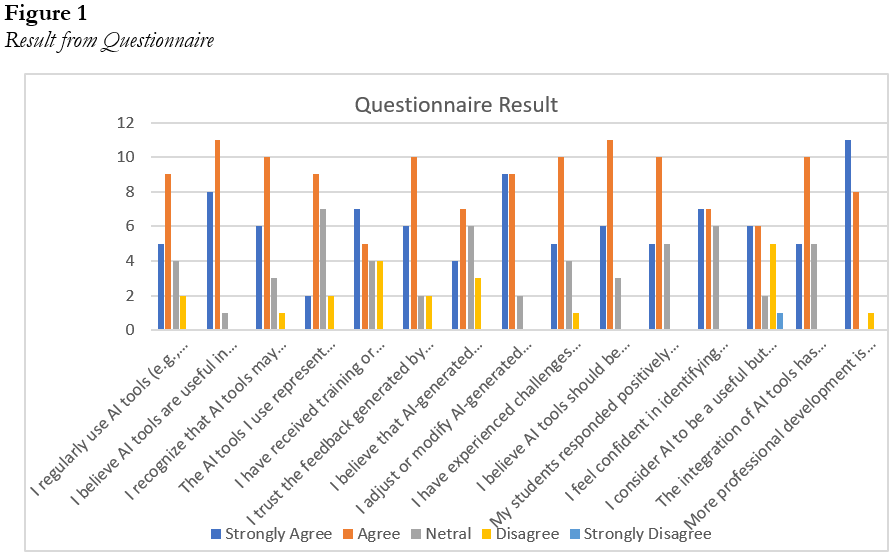
Despite the growing use of artificial intelligence (AI) in education, research often emphasizes its efficiency while overlooking its ethical implications, particularly with respect to algorithmic bias and teacher agency. This study aims at examining how junior high school teachers in Lumajang Regency, East Java, Indonesia perceive the bias and inclusivity of AI systems, and their pedagogical agencies when using AI tools in Indonesian EFL classroom settings. A qualitative approach was employed, involving questionnaire responses from 20 teachers and semi-structured interviews with 12 selected participants. The data revealed that while teachers appreciate AI for streamlining lesson planning and content generation, they are also aware of the limitations in its cultural and linguistic representation in AI-generated content. Many participants actively modify AI-generated materials to reflect their students’ local contexts better. However, only a small proportion reported receiving AI training in educational settings, highlighting a significant gap in institutional support. This study is limited by its localized sample and the reliance on self-reported data, which may affect generalizability. Nonetheless, the findings underscore the need for targeted professional development that includes not only technical training but also ethical and cultural competencies. Practically, this research informs policy on teacher preparation for AI integration. Socially, it contributes to more equitable digital education practices by centering the teacher’s role in mediating AI use. Future studies should expand geographically and include student perspectives to develop a more comprehensive understanding of AI’s impact on education.
References
Arora, P. (2024). Creative data justice: A decolonial and indigenous framework to assess creativity and artificial intelligence. Information, Communication & Society, 1–17. https://doi.org/10.1080/1369118X.2024.2420041
Arumugam, D., Dong, S., & Van Roy, B. (2023). Inclusive artificial intelligence. arXiv. https://doi.org/10.48550/arXiv.2212.12633
Baker, R. S., & Hawn, A. (2022). Algorithmic bias in education. International Journal of Artificial Intelligence in Education, 32, 1052–1092. https://doi.org/10.1007/s40593-021-00285-9
Balahur, A., Jenet, A., Hupont, I. T., Charisi, V., Ganesh, A., Griesinger, C. B., Maurer, P., Mian, L., Salvi, M., & Scalzo, S. (2022). Data quality requirements for inclusive, non-biased and trustworthy AI: Putting science into standards. Publications Office of the European Union. https://data.europa.eu/doi/10.2760/365479
Braun, V., & Clarke, V. (2006). Using thematic analysis in psychology. Qualitative Research in Psychology, 3(2), 77–101. https://doi.org/10.1191/1478088706qp063oa
Cau, R., Pisu, F., Suri, J. S., & Saba, L. (2024). Addressing hidden risks: Systematic review of artificial intelligence biases across racial and ethnic groups in cardiovascular diseases. European journal of radiology, 183, 111867. https://doi.org/10.1016/j.ejrad.2024.111867
Chaka, C. (2022). Digital marginalization, data marginalization, and algorithmic exclusions: A critical southern decolonial approach to datafication, algorithms, and digital citizenship from the Souths. Journal of E-Learning and Knowledge Society, 18(3), 83–95. https://doi.org/10.20368/1971-8829/1135678
Chen, L., Chen, P., & Lin, Z. (2020). Artificial intelligence in education: A review. IEEE Access, 8, 75264–75278. https://doi.org/10.1109/ACCESS.2020.2988510
Cheuk, T. (2021). Can AI be racist? Color‐evasiveness in the application of machine learning to science assessments. Science Education, 105(5), 825–836. https://doi.org/10.1002/sce.21671
Dakakni, D., & Safa, N. (2023). Artificial intelligence in the L2 classroom: Implications and challenges on ethics and equity in higher education: A 21st century pandora’s box. Computers and Education: Artificial Intelligence, 5, 100179. https://doi.org/10.1016/j.caeai.2023.100179
Delcker, J., Heil, J., & Ifenthaler, D. (2025). Evidence-based development of an instrument for the assessment of teachers’ self-perceptions of their artificial intelligence competence. Educational Technology Research and Development, 73(1), 115–133. https://doi.org/10.1007/s11423-024-10418-1
Fauziddin, M., Adha, T. R., Arifiyanti, N., Indriyani, F., Rizki, L. M., Wulandary, V., & Reddy, V. S. V. (2025). The impact of AI on the future of education in Indonesia. Educative: Jurnal Ilmiah Pendidikan, 3(1), 11–16. https://doi.org/10.70437/educative.v3i1.828
Fischer, C., Pardos, Z. A., Baker, R. S., Williams, J. J., Smyth, P., Yu, R., Slater, S., Baker, R., & Warschauer, M. (2020). Mining big data in education: Affordances and challenges. Review of Research in Education, 44(1), 130–160. https://doi.org/10.3102/0091732X20903304
Franco D’Souza, R., Mathew, M., Mishra, V., & Surapaneni, K. M. (2024). Twelve tips for addressing ethical concerns in the implementation of artificial intelligence in medical education. Medical Education Online, 29(1). https://doi.org/10.1080/10872981.2024.2330250
Guilherme, A. (2019). AI and education: The importance of teacher and student relations. AI & Society, 34, 47–54. https://doi.org/10.1007/s00146-017-0693-8
Holmes IV, O., Jiang, K., Avery, D. R., McKay, P. F., Oh, I.-S., & Tillman, C. J. (2021). A meta-analysis integrating 25 years of diversity climate research. Journal of Management, 47(6), 1357–1382. https://doi.org/10.1177/0149206320934547
Holstein, K., & Doroudi, S. (2022). Equity and artificial intelligence in education. In W. Holmes, & K. P-Pomsta (Eds.), The ethics of artificial intelligence in education (pp. 151–173). Routledge.
Iyer, S. S. (2025). Key drivers of artificial intelligence on learner engagement and experience. Next-Generation AI Methodologies in Education, 57–92. DOI: 10.4018/979-8-3693-7220-3.ch004
Kamali, J., Alpat, M. F., & Bozkurt, A. (2024). AI ethics as a complex and multifaceted challenge: Decoding educators’ AI ethics alignment through the lens of activity theory. International Journal of Educational Technology in Higher Education, 21(1), 62. https://doi.org/10.1186/s41239-024-00496-9
Kim, N., & Kim, M. (2022). Teacher’s perceptions of using an artificial intelligence–based educational tool. Frontiers in Education, 7, Article 755914. https://doi.org/10.3389/feduc.2022.755914
Kordzadeh, N., & Ghasemaghaei, M. (2022). Algorithmic bias: Review, synthesis, and future research directions. European Journal of Information Systems, 31(3), 388–409. https://doi.org/10.1080/0960085X.2021.1927212
Lee, C.-H. (2022). Analysis of the educational needs of elementary school teachers’ teaching competency for artificial intelligence education. The Institute for Education and Research Gyeongin National University of Education, 42(2), 131–148. https://doi.org/10.25020/je.2022.42.2.131
Lim, W. M. (2024). What is qualitative research? An overview and guidelines. Australasian Marketing Journal, 33(2), 199-229. https://doi.org/10.1177/14413582241264619 (Original work published 2025)
Liu, C., Hou, J., Tu, Y.-F., Wang, Y., & Hwang, G.-J. (2023). Incorporating a reflective thinking promoting mechanism into artificial intelligence-supported English writing environments. Interactive Learning Environments, 31(9), 5614–5632. https://doi.org/10.1080/10494820.2021.2012812
Liu, Y., Chen, L., & Yao, Z. (2022). The application of artificial intelligence assistant to deep learning in teachers’ teaching and students’ learning processes. Frontiers in Psychology, 13, 929175. https://doi.org/10.3389/fpsyg.2022.929175
Mabuan, R. A. (2024). ChatGPT and ELT: Exploring teachers’ voices. International Journal of Technology in Education, 7(1), 128–153. https://doi.org/10.46328/ijte.523
Madaio, M., Blodgett, S. L., Mayfield, E., & Dixon-Román, E. (2022). Beyond “fairness”: Structural (in) justice lenses on AI for education. In W. Holmes, & K. P-Pomsta (Eds.), The ethics of artificial intelligence in education (pp. 203–239). Routledge.
Mhlanga, D. (2022). The role of artificial intelligence and machine learning amid the COVID-19 pandemic: What lessons are we learning on 4IR and the sustainable development goals. International Journal of Environmental Research and Public Health, 19(3), 1879. https://doi.org/10.3390/ijerph19031879
Miftah, Z. (2022). Digitalisasi dan disparitas dalam pendidikan: Studi kasus di SDN Ngayung Lamongan [Digitalization and disparity in education: A case study at SDN Ngayung Lamongan]. Al-Aufa: Jurnal Pendidikan dan Kajian Keislaman, 4(2), 62–76. https://doi.org/10.32665/alaufa.v4i2.1572
Miragoli, M. (2024). Conformism, ignorance & injustice: AI as a tool of epistemic oppression. Episteme, 22(2), 522–540. doi:10.1017/epi.2024.11
Nguyen, A., Ngo, H. N., Hong, Y., Dang, B., & Nguyen, B.-P. T. (2023). Ethical principles for artificial intelligence in education. Education and Information Technologies, 28(4), 4221–4241. https://doi.org/10.1007/s10639-022-11316-w
Nurhayati, S., Taufikin, T., Judijanto, L., & Musa, S. (2025). Towards effective artificial intelligence-driven learning in Indonesian child education: Understanding parental readiness, challenges, and policy implications. Educational Process: International Journal (EDUPIJ), 15. Retrieved from https://www.edupij.com/files/1/articles/article_526/EDUPIJ_526_article_67fef1b1ab6ee.pdf
Ofosu-Asare, Y. (2024). Cognitive imperialism in artificial intelligence: Counteracting bias with indigenous epistemologies. AI & Society, 40, 3045–3061. https://doi.org/10.1007/s00146-024-02065-0
Ouyang, F., Dinh, T. A., & Xu, W. (2023). A systematic review of AI-driven educational assessment in STEM education. Journal for STEM Education Research, 6(3), 408–426. https://doi.org/10.1007/s41979-023-00112-x
Rahardja, U. (2022). Masalah etis dalam penerapan sistem kecerdasan buatan [Ethical issues in the application of artificial intelligence systems]. Technomedia Journal, 7(2), 181–188. https://doi.org/10.33050/tmj.v7i2.1895
Sahebi, S., & Formosa, P. (2025). The AI-mediated communication dilemma: Epistemic trust, social media, and the challenge of generative artificial intelligence. Synthese, 205(3), 128. https://doi.org/10.1007/s11229-025-04963-2
Schiff, D. (2022). Education for AI, not AI for education: The role of education and ethics in national AI policy strategies. International Journal of Artificial Intelligence in Education, 32(3), 527–563. https://doi.org/10.1007/s40593-021-00270-2
Shah, S. S. (2024). Gender bias in artificial intelligence: Empowering women through digital literacy. Premier Journal of Artificial Intelligence, 1-13. https://doi.org/10.70389/PJAI.1000088
Shams, R. A., Zowghi, D., & Bano, M. (2023). AI and the quest for diversity and inclusion: A systematic literature review. AI and Ethics, 411–438. https://doi.org/10.1007/s43681-023-00362-w
Shankar, S. K., Pothancheri, G., Sasi, D., & Mishra, S. (2025). Bringing teachers in the loop: Exploring perspectives on integrating generative AI in technology-enhanced learning. International Journal of Artificial Intelligence in Education, 35(1), 155–180. https://doi.org/10.1007/s40593-024-00428-8
Subiyantoro, S. (2024). Transformative online learning post-pandemic: Challenges, opportunities, and future trends. Jurnal Pekommas, 9(1), 29–39. https://orcid.org/0000-0002-1601-6635
Vygotsky, L. S. (1978). Mind in society: The development of higher psychological processes. Cambridge, MA: Harvard University Press. ISBN 978-0-674-57629-2, L. S. (1978). Mind in society: The development of higher psychological processes. Cambridge, MA: Harvard University Press. ISBN 978-0-674-57629-2
Wang, S., Wang, F., Zhu, Z., Wang, J., Tran, T., & Du, Z. (2024). Artificial intelligence in education: A systematic literature review. Expert Systems with Applications, 252, 124167. https://doi.org/10.1016/j.eswa.2024.124167
Zaman, M. N. (2019). Id<>En translator vs Google Terjemahan: Bias gender dalam alat bantu elektronik penerjemahan dalam jaringan [Id<>En translator vs Google Translate: Gender bias in online translation tools]. RETORIKA: Jurnal Bahasa, Sastra, Dan Pengajarannya, 12(1), 36. https://doi.org/10.26858/retorika.v12i1.7386
Downloads
Published
How to Cite
Issue
Section
License
Copyright (c) 2025 Uswatun Hasanah, Rizal Wahid Permana Putra, Dzulfikri Dzulfikri, Junaidi Mistar

This work is licensed under a Creative Commons Attribution 4.0 International License.
Authors who publish this journal agree to the following terms:
- Authors retain copyright and grant the journal right of first publication with the work simultaneously licensed under a Creative Commons Attribution License that allows others to share the work with an acknowledgement of the work's authorship and initial publication in this journal.
- Authors can separately make additional contractual arrangements for non-exclusive distribution published by the journal (e.g., publish it in a book), with an acknowledgement of its initial publication in this journal.
- Authors are allowed and encouraged to send their work via online (e.g., in the institutional repositories or their website) after published by the journal.