Digital storytelling in English language teaching: A critical literature review of empirical trends and pedagogical gaps
DOI:
https://doi.org/10.33474/j-reall.v7i2.25396Keywords:
critical pedagogy teaching, critical review, digital storytelling, English language teaching (ELT)Abstract
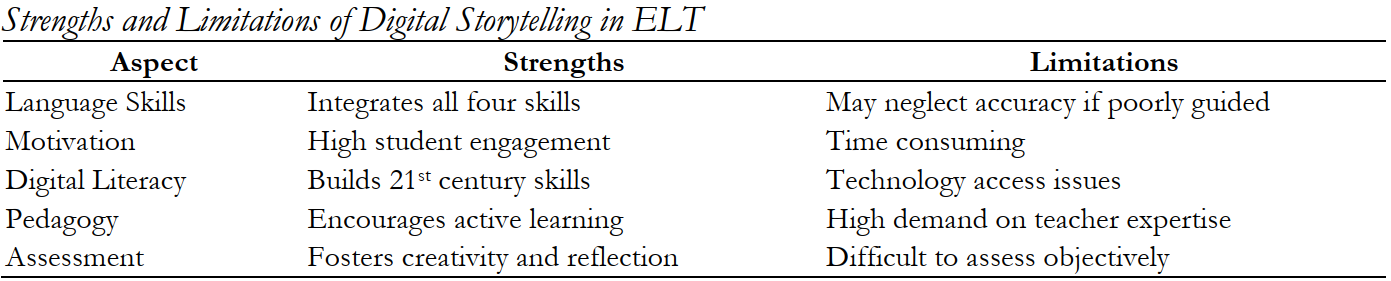
Research on digital storytelling (DST) in English language teaching (ELT) has grown rapidly. However, existing reviews often adopt an overly celebratory tone, creating a pedagogical gap by obscuring empirical weaknesses and digital inequities. To address this issue, this critical review evaluates a curated corpus of peer-reviewed articles published between 2012 and 2025. It interrogates the methodological robustness and theoretical grounding of current scholarship. Synthesizing the corpus reveals three key contributions: enhanced language proficiency, learner autonomy, and digital literacy. Nevertheless, these outcomes are frequently overstated due to short-term interventions and small convenience samples. The main limitation of this review stems from restricted data boundaries that exclude grey literature, affecting qualitative generalizability. Practically, these findings imply that educators must integrate DST into structured curricula with multimodal rubrics to solve real-world engagement issues. Socially, this review promotes equity by demonstrating how minimizing the digital divide prevents DST from reinforcing inequalities among marginalized students. Ultimately, this study guides future research toward longitudinal designs in under-resourced settings.
References
Al Khateeb, A. A. (2019). Socially orientated digital storytelling among Saudi EFL learners. Interactive Technology and Smart Education, 16(2), 130–142. https://doi.org/10.1108/ITSE-11-2018-0098
Alghamdi, A. K. H., & Malekan, M. (2020). Saudi science teachers’ perceptions of the cultural factors influencing elementary students’ science learning. Cultural Studies of Science Education, 15(4), 1143–1167. https://doi.org/10.1007/s11422-019-09960-9
Aris, M., Ludecke, M., & Crawford, R. (2025). Exploring the use of theatre methods within simulation-based teacher education: A scoping review. Teachers and Teaching, 1–25. https://doi.org/10.1080/13540602.2025.2518402
Arthi, M. P., & Gandhimathi, S. N. S. (2025). Heliyon research trends and network approach of critical thinking skills in English language teaching – A bibliometric analysis implementing R studio. Heliyon, 11(2). https://doi.org/10.1016/j.heliyon.2025.e42080
Bacon, C. K. (2017). Multilanguage, multipurpose: A literature review, synthesis, and framework for critical literacies in English language teaching. Journal of Literacy Research. 49(3). https://doi.org/10.1177/1086296X17718324
Barkhoda, J., Azizi, A., & Abdulrahman, B. S. (2025). Bridging worlds: Enhancing English teaching through a culture-based approach in Iranian Kurdistan. Cogent Education, 12(1). https://doi.org/10.1080/2331186X.2025.2464308
Beazidou, E., Zygouris, N., Botsoglou, K., Kougioumtzidou, E., & Samantzis, C. (2024). Teachers’ perceptions about digital storytelling and its pedagogical usage. The improvement of minority children’s classroom engagement. International Journal of Primary, Elementary and Early Years Education, 3(13), 1–14. https://doi.org/10.1080/03004279.2024.2367556
Chinpakdee, M. (2024). EFL teachers’ expectations and students’ reading-related difficulties at the university level. LEARN Journal: Language Education and Acquisition Research Network, 17(2), 48–68. https://doi.org/10.70730/YTVV7549
Christiansen, M. S., & Koelzer, M.-L. (2016). Digital storytelling: Using different technologies for EFL. MEXTESOL Journal, 40(1), 1–14. Retrieved from https://mextesol.net/journal/index.php?page=journal&id_article=1338
Cope, B., Kalantzis, M. (2015). The things you do to know: An introduction to the pedagogy of multiliteracies. In: Cope, B., Kalantzis, M. (eds.) A pedagogy of multiliteracies (pp. 1–30). Palgrave Macmillan, London. https://doi.org/10.1057/9781137539724_1
Dooly, M., & Sadler, R. (2016). Becoming little scientists: Technologically-enhanced project-based language learning. Language Learning and Technology, 20(1), 54–78. https://doi.org/10.64152/10125/44446
Dragonas, T., Gergen, K. J., McNamee, S., & Tseliou, E. (2015). Education as social construction: Contributions to theory, research and practice. Taos Institute. https://works.swarthmore.edu/fac-psychology/837
Ellis, R. (2003). Task-based language teaching. Oxford University Press.
Evans, N. S., Burke, R., Vitiello, V., Zumbrunn, S., & Jirout, J. J. (2023). Curiosity in classrooms: An examination of curiosity promotion and suppression in preschool math and science classrooms. Thinking Skills and Creativity, 49, 101333. https://doi.org/10.1016/J.TSC.2023.101333
Fitzgerald, A., Avirmed, T., & Battulga, N. (2024). Exploring the factors informing educational inequality in higher education: A systematic literature review. Perspectives: Policy and Practice in Higher Education, 29(4), 199-209. https://doi.org/10.1080/13603108.2024.2381121
Ghimire, N. B. (2023). Five facets for effective English language teaching. Journal of NELTA Gandaki, 2(1), 65-73. https://doi.org/10.3126/jong.v2i0.26604
Gosavi, C. S., & Arora, S. (2022). Active learning strategies for engaging students in higher education. Journal of Engineering Education Transformations, 36(1), 1–7. https://doi.org/10.16920/jeet/2022/v36is1/22167
Guo, P., Saab, N., Post, L. S., & Admiraal, W. (2020). A review of project-based learning in higher education: Student outcomes and measures. International Journal of Educational Research, 102, 101586. https://doi.org/10.1016/j.ijer.2020.101586
Jain, S. (2019). Role of artificial intelligence in higher education- an empirical investigation. IJRAR- International Journal of Research and Analytical Reviews, 6(2), 144–150. https://ijrar.com/upload_issue/ijrar_issue_20544069.pdf
Jawarneh, M., Alshar’E, M., Dewi, D. A., Al Nasar, M., Almajed, R., & Ibrahim, A. (2023). The impact of virtual reality technology on Jordan’s learning environment and medical informatics among physicians. International Journal of Computer Games Technology, 2023(1), 9. https://doi.org/10.1155/2023/1678226
Karimah, S. A., Lustyantie, N., & Chaeruman, U. A. (2025). Metacognitive listening strategies and MALL: Effects of learning styles and self- efficacy. Indonesian EFL Journal, 11(2), 299–308. https://doi.org/10.25134/ieflj.v11i2.11660
Lustyantie, N., & Aprilia, F. (2020). Reading interest and achievement motivation: A study in an EFL context. TESOL International Journal, 15(4), 147–166. https://files.eric.ed.gov/fulltext/EJ1329504.pdf
Meletiadou, E. (2022). Using educational digital storytelling to enhance multilingual students’ writing skills in higher education. IAFOR Journal of Education, 10(2), 111–130. Retrieved from https://files.eric.ed.gov/fulltext/EJ1359937.pdf
Meyers, E. M., Erickson, I., & Small, R. V. (2013). Digital literacy and informal learning environments: An introduction. Learning, Media and Technology, 38(4), 355–367. https://doi.org/10.1080/17439884.2013.783597
Moradi, H., & Chen, H. (2019). Behavioral sciences digital storytelling in language education. Behavioral Sciences, 9(12), 1–9. Retrieved from https://www.researchgate.net/publication/337850757_Digital_Storytelling_in_Language_Education
Mouboua, P., Atobatele, F., & Akintayo. (2024). Language as a tool for intercultural understanding: Multilingual approaches in global citizenship education. Magna Scientia Advanced Research and Reviews, 11(1), 019–030. https://doi.org/10.30574/msarr.2024.11.1.0071
Nation, I. S. P. (2008). Teaching ESL/EFL reading and writing. Routledge. https://doi.org/10.4324/9780203891643
Neokleous, G. (2022). Fostering digital literacies in primary English language education. In D. Valente & D. Xerri (Eds.), Innovative Practices in Early English Language Education (pp. 129–146). Springer International Publishing. https://doi.org/10.1007/978-3-031-12922-3_7
Ong, C., & Arydoust, V. (2023). A review of digital storytelling in language learning in children: Methods, design and reliability. Research and Practice in Technology Enhanced Learning, 18,011. https://doi.org/10.58459/rptel.2023.18011
Padmadewi, N. N., & Artini, P. (2020). Applying content and language integrated learning (CLIL): Teachers' perceptions and challenges. International Journal of Innovation, Creativity and Change. 14(3), 78–94. https://www.ijicc.net/images/Vol_14/Iss_3/14306_Budiarta_E_2020_R.pdf
Page, M. J., McKenzie, J. E., Bossuyt, P., Boutron, I., Hoffmann, T. C., Mulrow, C. D., Shamseer, L., Tetzlaff, J. M., Akl, E., Brennan, S. E., Chou, R., Glanville, J., Grimshaw, J. M., Hróbjartsson, A., Lalu, M. M., Li, T., Loder, E. W., Mayo-Wilson, E., McDonald, S., … Moher, D. (2021). The PRISMA 2020 statement: An updated guideline for reporting systematic reviews. Medicina Fluminensis, 57(4), 444–465. https://doi.org/10.21860/medflum2021_264903
Pangrazio, L., Godhe, A. L., & Ledesma, A. G. L. (2020). What is digital literacy? A comparative review of publications across three language contexts. E-learning and Digital Media, 17(6), 442-459. https://doi.org/10.1177/2042753020946291
Prakash, C. S. (2023). Constructivism in Education: Exploring the contributions of Piaget, Vygotsky, and Bruner. International Journal of Science and Research (IJSR), 12(7), 274–278. https://doi.org/10.21275/sr23630021800
Prasetya, E. P., Usman, H., & Lustyantie, N. (2024). Creative writing lessons in junior high school: An ethnographic study. Zhongguo Kuangye Daxue Xuebao, 211(3), 211–217. https://zkdx.ch/journal/zkdx/article/view/58
Rahman, N. F. N. A., & Bakar, R. A. (2020). Digital storytelling: A systematic review. Journal of English Language Teaching Innovations and Materials, 2(2), 97–108. https://doi.org/10.26418/jeltim.v2i2.42199
Reinders, H., & Benson, P. (2017). Research agenda: Language learning beyond the classroom. Language Teaching, 50(4), 561–578. https://doi.org/10.1017/S0261444817000192
Ribeiro, S. (2015). Digital storytelling: An integrated approach to language learning for the 21st century student. Teaching English with Technology, 15(2), 39–53. https://files.eric.ed.gov/fulltext/EJ1140588.pdf
Robin, B. R. (2008). Digital storytelling: A powerful technology tool for the 21st-century classroom. Theory into Practice, 47(3), 220–228. https://doi.org/10.1080/00405840802153916
Sapan, N. S. (2024). Exploring the impact of digital storytelling on reading and critical thinking: A preliminary study. International Journal of Modern Education, 6(23), 50-63. https://doi.org/10.35631/IJMOE.623005
Sari, T. I., Surono, S., & Arroyo, E. (2022). Teachers’ Adaptation in the use of instructional media in teaching English as a foreign language at junior high school in Sungai Penuh. Devotion: Journal of Research and Community Service, 3(12), 2024–2039. https://doi.org/10.36418/dev.v3i12.249
Selwyn, N. (2016). Education and technology: Key issues and debates. Bloomsbury.
Setyono, B., & Widodo, H. P. (2019). The representation of multicultural values in the Indonesian ministry of education and culture-endorsed EFL textbook: A critical discourse analysis. Intercultural Education, 30(4), 383–397. https://doi.org/10.1080/14675986.2019.1548102
Snyder, H. (2019). Literature review as a research methodology: An overview and guidelines. Journal of Business Research, 104, 333–339. https://doi.org/10.1016/j.jbusres.2019.07.039
Van Horn, K. R. (2024). ChatGPT in English language learning: Exploring perceptions and promoting autonomy in a university EFL context. Teaching English as a Second Language (TESL-EJ), 28(1), 1–26. https://doi.org/10.55593/ej.28109a8
Venditti, J. A., Murrugarra, E., McLean, C. R., & Goldstein, M. H. (2023). Curiosity constructs communicative competence through social feedback loops. Advances in Child Development and Behavior, 65, 99–134. https://doi.org/10.1016/bs.acdb.2023.05.007
Vygotsky, L. S. (1978). Mind in society: The development of higher psychological processes. Harvard University Press.
Wu, J., & Chen, D.-T. V. (2020). A systematic review of educational digital storytelling. Computers & Education, 147, Article 103786. https://doi.org/10.1016/j.compedu.2019.103786
Yang, Y. T. C., & Wu, W. C. I. (2012). Digital storytelling for enhancing student academic achievement, critical thinking, learning motivation: A year-long experimental study. Computers and Education, 59(2), 339–352. https://doi.org/10.1016/j.compedu.2011.12.012
Yu, B., & Wang, W. (2025). Using digital storytelling to promote language learning, digital skills and digital collaboration among English pre-service teachers. System, 129, 103577. https://doi.org/10.1016/j.system.2024.103577
Zheng, H., Chen, H., & Tao, J. (2024). Connecting collaborative practicums to beliefs: The development of nonnative student teachers’ self-efficacy in native-nonnative trainee collaboration. System, 123, 103326. https://doi.org/10.1016/j.system.2024.103326
Zhou, X. (2023). How can the Hayes and Flower’s (1980) model of composition be applied to second language writers based on an analysis of the characteristics of the model. Open Journal of Modern Linguistics, 13(03), 406–422. https://doi.org/10.4236/ojml.2023.133025
Downloads
Published
How to Cite
Issue
Section
License
Copyright (c) 2026 Aminulloh Aminulloh, Moch. Imam Machfudi, Dewa Putu Ramendra, Moh. Arif Mahbub, Wildana M. Giffari

This work is licensed under a Creative Commons Attribution 4.0 International License.
Authors who publish this journal agree to the following terms:
- Authors retain copyright and grant the journal right of first publication with the work simultaneously licensed under a Creative Commons Attribution License that allows others to share the work with an acknowledgement of the work's authorship and initial publication in this journal.
- Authors can separately make additional contractual arrangements for non-exclusive distribution published by the journal (e.g., publish it in a book), with an acknowledgement of its initial publication in this journal.
- Authors are allowed and encouraged to send their work via online (e.g., in the institutional repositories or their website) after published by the journal.