From everyday objects to Islamic adab: Teacher-guided semiotic mapping in a young-learner EFL classroom
DOI:
https://doi.org/10.33474/j-reall.v7i2.25703Keywords:
everyday realia, Islamic adab, material meaning making, semiotic mapping, teacher scaffoldingAbstract
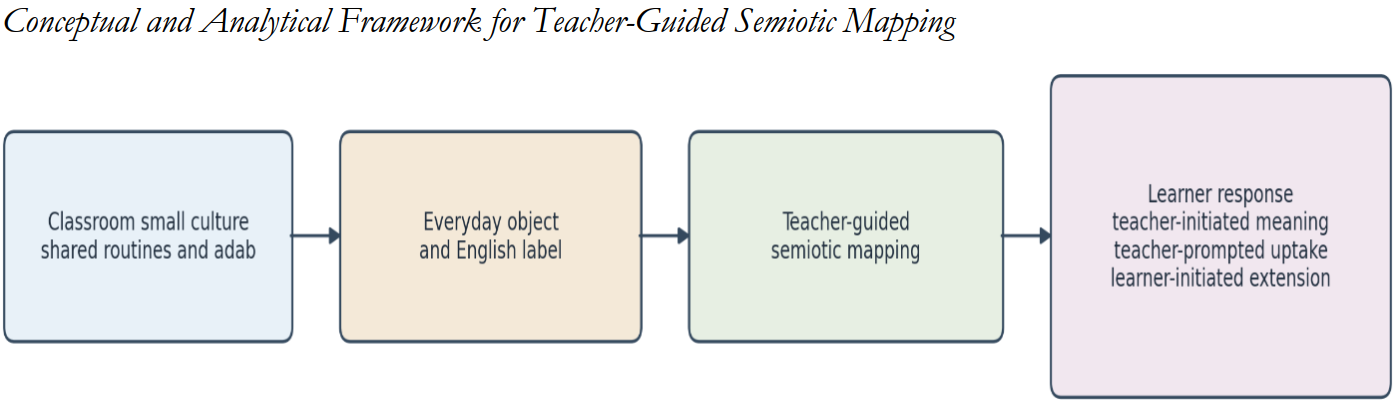
Ordinary classroom objects are often used to make English words concrete, but less is known about how teachers connect those objects with locally meaningful moral practices. This qualitative single case study investigated teacher-guided semiotic mapping in a third-grade EFL classroom at an Islamic elementary school in Sidoarjo, Indonesia. The case involved one teacher and twenty-five students observed across six lessons; five focal students and the teacher also participated in short interviews. Thematic analysis traced how objects, English labels, familiar actions, and Islamic adab were linked and classified students’ responses according to who introduced or extended the meaning. The findings show a recurring three-move process: establishing an object-word relation, grounding the word in an everyday action, and framing that action through adab-related teacher discourse. Students named objects and described familiar functions, but the moral interpretations were usually teacher-initiated or teacher-prompted. Some students produced short bilingual extensions within the teacher’s frame, whereas no clear episode demonstrated a fully independent learner-generated object-adab connection. The study contributes a process-based explanation of how ordinary realia becomes culturally and religiously situated through classroom interaction. Pedagogically, it suggests that values integration should begin with plausible object functions and gradually move from teacher explanation toward open prompts that give young learners greater interpretive space. The findings concern meaning-making processes rather than measured vocabulary gain or independent moral development.
References
Ahmadova, K. (2025). Learning through the lens of realia: Expanding language skills with real-world contexts. Acta Globalis Humanitatis et Linguarum, 2(5), 78–88. https://doi.org/10.69760/aghel.0250050007
Alfian, A., Yusuf, M., & Nafiah, U. (2022). Integrating Islamic values in teaching English: Lessons learned from an integrated Islamic school. Elsya: Journal of English Language Studies, 4(1), 1–11. https://doi.org/10.31849/elsya.v4i1.7322
Alonso, Y. P. B. (2019). Making connections through realia and storytelling for vocabulary learning with EFL [Master’s thesis, Universidad de La Sabana]. https://intellectum.unisabana.edu.co/entities/publication/3acfd214-bc72-4b21-9862-e5307a6ae949
Astuti, R., Mustofa, M. L., & Nisak, N. M. (2024). Integration of Islamic values in English language teaching in the digital era: Challenges and prospectives. Halaqa: Islamic Education, 8(1), 26–34. https://doi.org/10.21070/halaqa.v8i1.1680
Astutik, Y., Megawati, F., & Agustina, S. (2026). Pembelajaran bahasa Inggris sekolah dasar dengan realia dan project-based learning [Teaching elementary English through realia and project-based learning]. Umsida Press. https://press.umsida.ac.id/index.php/umsidapress/article/view/1544
Bakker, A., Smit, J., &, & Wegerif, R. (2015). Scaffolding and dialogic teaching in mathematics education : introduction and review. ZDM–Mathematics Education, 47(7), 1047–1065. https://doi.org/10.1007/s11858-015-0738-8
Bara, F., & Kaminski, G. (2019). Holding a real object during encoding helps the learning of foreign vocabulary. Acta Psychologica, 196, 26–32. https://doi.org/10.1016/j.actpsy.2019.03.008
Barsalou, L. W. (2008). Grounded cognition. Annual Review of Psychology, 59, 617–645. https://doi.org/10.1146/annurev.psych.59.103006.093639
Berwald, J.-P. (1987). Teaching foreign languages with realia and other authentic materials. ERIC Clearinghouse on Languages and Linguistics. https://eric.ed.gov/?id=ED289367
Braun, V., & Clarke, V. (2006). Using thematic analysis in psychology. Qualitative Research in Psychology, 3(2), 77–101. https://doi.org/10.1191/1478088706qp063oa
Gobert, M. (2018). Flash cards, realia, and objects. In J. I. Liontas (Ed.), The TESOL encyclopedia of English language teaching (pp. 1–6). Wiley. https://doi.org/10.1002/9781118784235.eelt0188
Handayani, E. S., & Subakti, H. (2021). Analisis penggunaan media realia melalui pembelajaran online di sekolah dasar [Analysis of the use of realia media through online learning in elementary schools]. Jurnal Basicedu, 5(2), 772–783. https://doi.org/10.31004/basicedu.v5i2.810
Holliday, A. (1999). Small cultures. Applied Linguistics, 20(2), 237–264. https://doi.org/10.1093/applin/20.2.237
Irawan, Y. (2020). Situating Islamic values in English language teaching: Documenting the best practices in Indonesia. Jurnal Islamika: Jurnal Ilmu-Ilmu Keislaman, 20(01), 95–103. https://doi.org/10.32939/islamika.v20i01.617
Khaidir, N. A., & Harahap, Y. S. (2024). The effect of realia (real object) media on students’ vocabulary skill at MIS Hikmatul Salridho. Journal of Educational Research and Humaniora (JERH), 2(3), 10–15. https://doi.org/10.51178/jerh.v2i3.2216
Kress, G. (2010). Multimodality: A social semiotic approach to contemporary communication. Routledge.
Li, W., & Zou, W. (2021). Exploring primary-school EFL teacher expertise in scaffolding: A comparative study. Sage Open, 11(4). https://doi.org/10.1177/21582440211061574
Milal, A. D., Rohmah, Z., Kusumajanti, W., Basthomi, Y., Sholihah, D. N., & Susilowati, M. (2020). Integrating character education in the English teaching at Islamic junior high schools in Indonesia. Teflin Journal, 31(2), 88–107. https://doi.org/10.15639/teflinjournal.v31i1/88-107
Mokalu, P. (2022). The use of realia to improve young learners’ vocabulary. Journal of English Language Teaching, Literature and Culture, 1(1), 46–53. https://doi.org/10.53682/jeltec.v1i1.3724
Rahmayani, F. A. (2022). Vocabulary acquisition on young learners through the use of realia media. Journal of Research on English and Language Learning (J-REaLL), 3(2), 89–97. https://doi.org/10.33474/j-reall.v3i2.15998
Riaz, N., Bhatti, M. S., Ahmad, H., & Asif, N. (2024). Using realia to enhance vocabulary skills in young learners : An investigation. Migration Letters, 2(S2), 1739–1746. https://migrationletters.com/index.php/ml/article/view/12079
Tang, K.-S. (2024). Exploring the materiality of science learning: Analytical frameworks for examining interactions with material objects in science meaning-making. Research in Science & Technological Education, 42(1), 32–53. https://doi.org/10.1080/02635143.2023.2232307
Tang, K.-S., Jeppsson, F., Danielsson, K., & Bergh Nestlog, E. (2022). Affordances of physical objects as a material mode of representation: A social semiotics perspective of hands-on meaning-making. International Journal of Science Education, 44(2), 179–200. https://doi.org/10.1080/09500693.2021.2021313
Tisdell, E. J., Merriam, S. B., & Stuckey-Peyrot, H. L. (2025). Qualitative research: A guide to design and implementation (5th ed.). Jossey-Bass.
van Leeuwen, T. (2005). Introducing social semiotics. Routledge.
Yusuf, Q., Asyik, A. G., Yusuf, Y. Q., & Rusdi, L. (2017). Language teaching research “Listen, do, repeat, understand and remember”: Teaching English to very young children in Aceh. Iranian Journal of Language Teaching Research, 5(2), 113–132. https://doi.org/10.30466/ijltr.2017.20333
Downloads
Published
How to Cite
Issue
Section
License
Copyright (c) 2026 Yuli Astutik, Rahmania Sri Untari, Fitria Wulandari, Abdurrosyid Abdurrosyid

This work is licensed under a Creative Commons Attribution 4.0 International License.
Authors who publish this journal agree to the following terms:
- Authors retain copyright and grant the journal right of first publication with the work simultaneously licensed under a Creative Commons Attribution License that allows others to share the work with an acknowledgement of the work's authorship and initial publication in this journal.
- Authors can separately make additional contractual arrangements for non-exclusive distribution published by the journal (e.g., publish it in a book), with an acknowledgement of its initial publication in this journal.
- Authors are allowed and encouraged to send their work via online (e.g., in the institutional repositories or their website) after published by the journal.