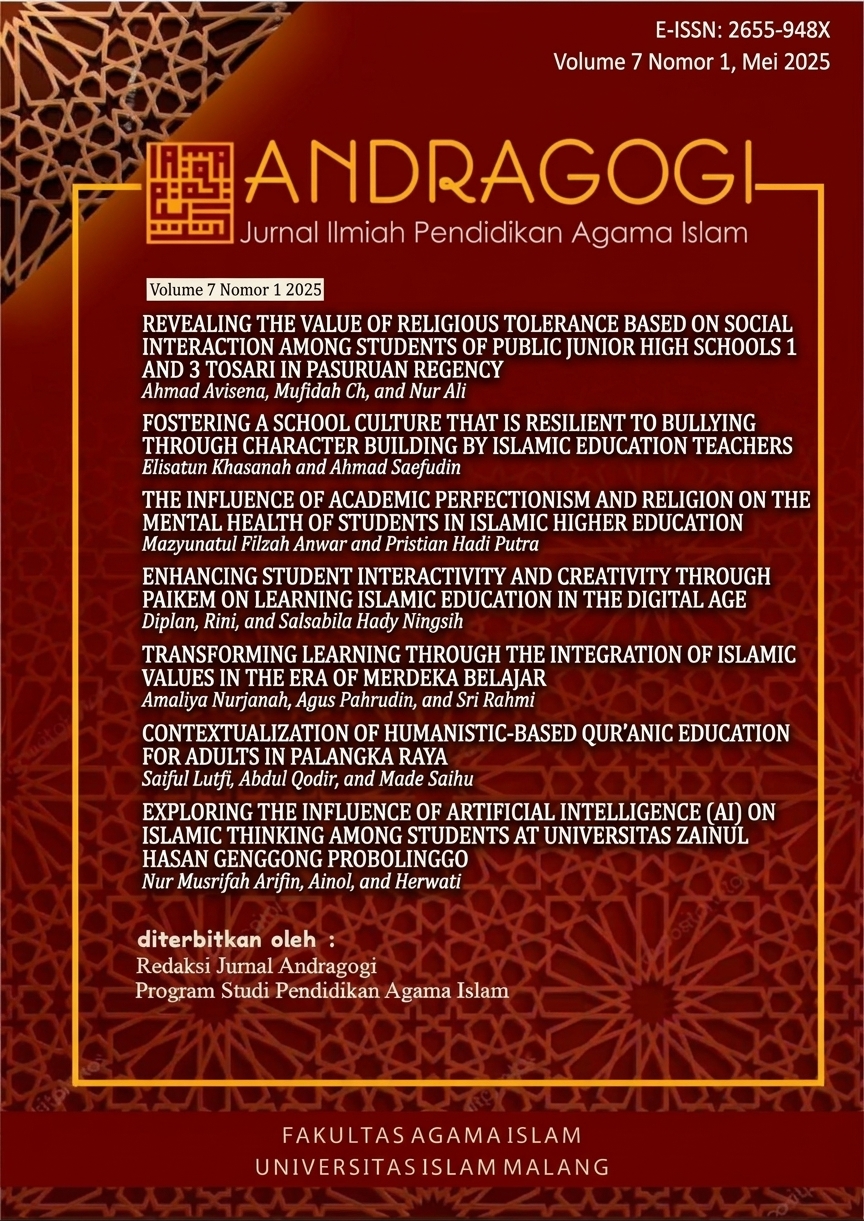
Contextualization of Humanistic-Based Qur'anic Education for Adults in Palangka Raya
DOI:
https://doi.org/10.33474/ja.v7i1.23508Abstract
This study explores the implementation of humanistic principles in the teaching of the Qur'an for adult learners. Adopting a qualitative research approach, the study aims to understand how humanistic theories, such as those proposed by Maslow and Rogers, are applied within the context of Qur'anic education and how they influence the personal and spiritual development of adult learners. The subjects of this study were 20 adult learners from several institutions and 5 educators from local Islamic education institutions. Data collection methods included semi-structured interviews, observations, and documentation analysis, with a focus on capturing the lived experiences of participants and the dynamics of the learning process. Triangulation of data and member checking will be employed to ensure validity and credibility of the findings. The study found that applying humanistic education in Qur'anic learning enhanced adult learners' engagement, reflection, and personal connection to the text. It fostered deeper, more meaningful learning by prioritizing personal growth and relevance to daily life. This research shows that humanistic principles can enrich Qur'anic education, offering a transformative model that supports adult learners' spiritual and personal development in modern contexts.
References
Alvanajati, N., Hamdanah, H., & Surawan, S. (2025). The Role of Positive Vibes in Preventing Academic Stres Among MTsN 1 Palangka Raya Students. G-COUNS: Jurnal Bimbingan Dan Konseling, 9(3), 1101–1107. https://doi.org/10.31316/g-couns.v9i3.7537
Amalia, N. (2021). Pembelajaran Al Qur‟an pada Usia Dewasa berdasarkan Psikologi Perkembangan dan Neurosains. Institut PTIQ Jakarta.
Braun, V., & Clarke, V. (2006). Using thematic analysis in psychology. Qualitative Research in Psychology, 3(2), 77–101. https://doi.org/10.1191/1478088706qp063oa
Creswell, J. W., & Poth, C. N. (2018). Qualitative inquiry and research design: Choosing among five approaches (4th ed.). Thousand Oaks, California: SAGE Publications Inc.
Deci, E. L., & Ryan, R. M. (1985). Intrinsic Motivation and Self-Determination in Human Behavior. Springer Science & Business Media.
Denzin, N. K. (2009). The Research Act A Theoretical Introduction to Sociological Methods. New York: Routledge.
DiCicco-Bloom, B., & Crabtree, B. F. (2006). The qualitative research interview. Medical Education, 40(4), 314–321. https://doi.org/10.1111/j.1365-2929.2006.02418.x
Febrianti, I., Alviani, L., Rahmawati, S., Huda, M. F., & Zulkarnain, A. I. (2024). Strategi Pendidik dalam Mewujudkan Pendidikan non Diskriminasi di MTs Terpadu Berkah Palangka Raya. La-Tahzan, 16(1), 1–12. https://doi.org/https://doi.org/10.62490/latahzan.v16i1.412
Goldon, T. (2016). Humanism in Education: Theory, Practice, and the Role of the Teacher. Routledge.
Halili, H. R. (2022). Kajian metode pembelajaran membaca Al-Qur’an usia dewasa dengan pendekatan konsep andragogi. IMTIYAZ: Jurnal Ilmu Keislaman, 5(3). https://doi.org/https://doi.org/10.46773/imtiyaz.v5i2.262
Husniah, L., Hamdanah, H., & Surawan, S. (2025). Development of Students ’ Religious Character Through Intimate Friendship. Jayapangus Press, 8(2), 112–125. https://doi.org/https://doi.org/10.37329/cetta.v8i2.4052
Irmayanti, I. (2021). Humanistic Learning Theory in Islamic Religious Education With a Cooperative Learning Approach. IJGIE (International Journal of Graduate of Islamic Education), 2(1), 1–10. https://doi.org/10.37567/ijgie.v2i1.278
Jannah, M., Surawan, S., & Widiastuty, H. (2024). The Trend Of Watching Religiously-Themed Horror Films: Analyzing The Impact On Social Behavior In Society. International Proceedings Universitas Tulungagung 2024, 1–23. https://doi.org/https://conference.unita.ac.id/index.php/conference/article/view/195
Jennah, R., Safitri, N., Noormila, C., & Surawan, S. (2025). Pengenalan 20 Sifat Wajib Allah Menggunakan Media Audio Visual Youtube di TK/TPA Syuhada Palangka Raya. JPIMI: Jurnal Pengabdian Inovasi Masyarakat Indonesia, 4(1), 99–104. https://doi.org/10.29303/jpimi.v4i1.3555
Joseph, S. (2021). How Humanistic Is Positive Psychology? Lessons in Positive Psychology From Carl Rogers’ Person-Centered Approach—It’s the Social Environment That Must Change. Frontiers in Psychology, 12, 1–10. https://doi.org/10.3389/fpsyg.2021.709789
Knowles, M. S. (1986). The Modern Practice Of Adult Education From Pedagogy to Andragogy. In Association Press. New York. https://doi.org/10.7312/kepp90968-001
Kolb, D. A. (1984). Experiential Learning: Experience as The Source of Learning and Development (Vol. 1). Prentice Hall, Inc.
Lincoln, Y. S., & Guba, E. G. (1985). Naturalistic Inquiry. SAGE Publications.
Lutfi, S., Surawan, S., & Zanuba, A. A. (2024). Self-regulation learning: upaya membangun kemandirian belajar al-qur’an di kalangan remaja. Anterior Jurnal, 23(1), 75–80. https://doi.org/https://doi.org/10.33084/anterior.v23i1.6618
Malisi, M. A. S., Fauziyah, F., & Surawan, S. (2023). Internalization of Faith Educational Value in the Humanistic Perspective Riko Animation Series. AL-ISHLAH: Jurnal Pendidikan, 15(1), 703–718. https://doi.org/10.35445/alishlah.v15i1.3095
Maslow, A. H. (1954). Motivation and personality.
Merriam, S. B., & Tisdell, E. J. (2009). Qualitative Research A Guide to Design and Implementation. San Fransisco: Jossey-Bass.
Rogers, C. L. (1969). Freedom to Learn. Columbus: Charles E. Merrill Publishing Company.
Rogers, C. L. (1983). Freedom to learn for the 80’s. Merrill Publishing.
Safitri, A., Ningsih, S. H., & Surawan, S. (2025). Journal of Islamic Education and Ethics Identity Crisis and Religious Conversion : The Religious Dynamics of Modern Society. JIEE Journal Of Islamic Education and Ethics, 3(1), 89–101. https://doi.org/https://doi.org/10.18196/jiee.v3i1.79 Identity
Sarifah, S., Hamdanah, H., & Surawan, S. (2025). Self-Efficacy : In-Depth Study of PAI Students ’ Teaching Readiness Through Teaching Practices 1 ( Microteaching ). Ideguru: Jurnal Karya Ilmiah Guru, 10(1), 593–599. https://doi.org/https://doi.org/10.51169/ideguru.v10i1.1525 Terakreditasi
Stake, R. E. (1995). The art of case study research. Sage Publications.
Sumantri, B. A., & Ahmad, N. (2019). Teori Belajar Humanistik dan Implikasinya terhadap Pembelajaran Pendidikan Agama Islam. Fondatia: Jurnal Pendidikan Dasar, 3(2), 1–18. https://doi.org/https://doi.org/10.36088/fondatia.v3i2.216
Suroso, Aryati, A., Yenni, T., Putri, S., Yanuarti, E., & Ahmal, A. (2023). Implementation of Humanistic Learning Theory in Islamic Religious Education Learning. AL-ISHLAH: Jurnal Pendidikan, 15(2), 1850–1858. https://doi.org/10.35445/alishlah.v15i2.2211
Tobroni, T., Saefulloh, A., Faridi, F., Nalus, S., & Surawan, S. (2024). Kandungan Nilai Pendidikan Islam Pada Tradisi Pawai Khatam Quran di Nagari Pasia Kabupaten Agam Sumetera Barat. Anterior Jurnal, 23(3), 17–25. https://doi.org/https://doi.org/10.33084/anterior.v23i3.7339
Wulandari, D., & Mafariech, M. S. (2025). Implementation of Humanistic Learning Theory in Islamic Religious Education Learning. SCHOOLAR: Social and Literature Study in Education, 4(3), 1850–1858. https://doi.org/https://ejournal.unwaha.ac.id/index.php/jurnal_pengabdian/article/view/5584
Yin, R. K. (2018). Case Study Research and Applications: Design and Methods, 6th Edition. London: SAGE Publications.
Zuhri, S., Sarnoto, A. Z., & Amalia, N. (2023). Pembelajaran Al-Qur’an pada Usia Dewasa Berdasarkan Psikologi Perkembangan dan Neurosains. Andragogi, 5(2), 131–152. https://doi.org/doi.org/10.36671/andragogi.v1i3.66 pembelajaran
Downloads
Published
How to Cite
Issue
Section
License
Copyright (c) 2025 Author(s)

This work is licensed under a Creative Commons Attribution-ShareAlike 4.0 International License.